Cable Chains: Guide to Styles, Materials, Designs and Key Insights
Jewelry made with linked components has been part of adornment traditions across many cultures and historical periods. A link is an individual connecting element that joins with another link to create a continuous structure.
Jewelry made with linked components has been part of adornment traditions across many cultures and historical periods. A link is an individual connecting element that joins with another link to create a continuous structure. By combining different link shapes, materials, finishes, and connection methods, jewelry designers can create chains, bracelets, necklaces, and other forms with distinct visual and structural characteristics.
The development of linked jewelry is closely connected with advances in metalworking. Early artisans worked with materials such as gold, silver, bronze, copper, beads, shells, and other natural materials. Techniques for forming wire, joining metal components, hammering surfaces, and creating repeated patterns allowed increasingly complex link structures to develop.
Today, linked jewelry ranges from simple chains with uniform components to elaborate designs containing multiple link shapes, textures, gemstones, and decorative elements. Understanding styles, link patterns, materials, and design details provides useful background for identifying how these pieces are constructed and why they look different.
What makes a linked design
A linked jewelry piece generally consists of individual components connected through openings, rings, hinges, soldered joints, or other structural methods. The size, thickness, shape, and orientation of each component affect how the finished piece moves and rests against the body.
Some designs use identical links throughout the entire piece, while others combine different components. For example, a chain may alternate between larger oval links and smaller connecting rings, creating a repeated pattern.
Common styles and link patterns
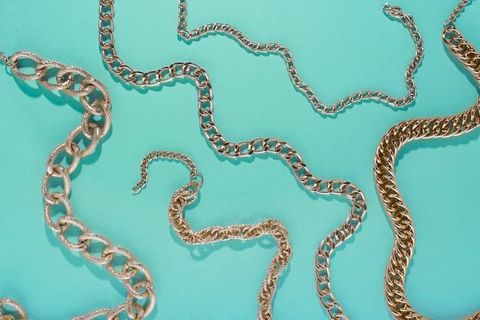
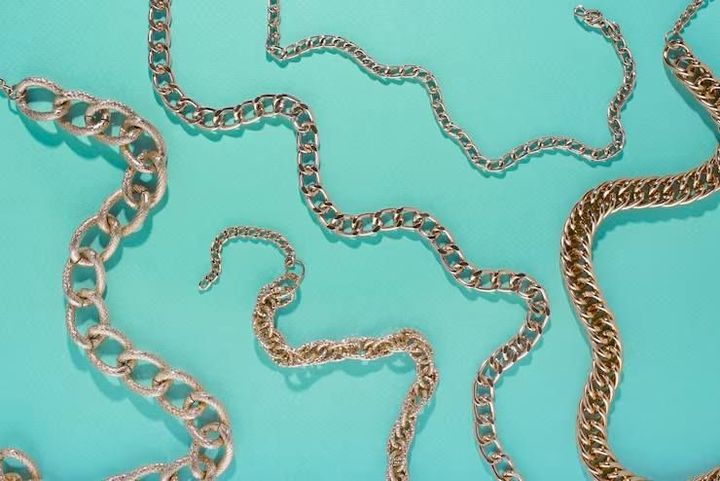
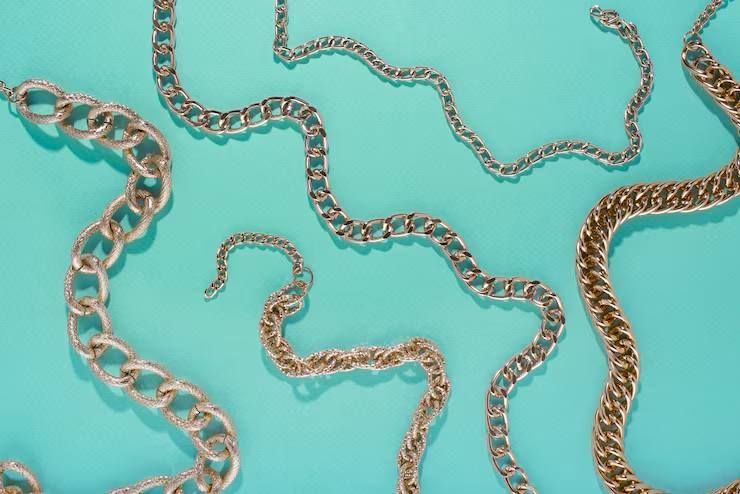
Linked jewelry can be classified according to the arrangement and shape of its components. Common patterns include:
- Cable links: Simple oval or round links connected in alternating directions.
- Curb links: Flattened links designed to sit closely together.
- Figaro patterns: A repeating sequence containing longer and shorter links.
- Rolo patterns: Rounded links with relatively uniform dimensions.
- Box patterns: Angular links arranged to create a more geometric appearance.
- Rope patterns: Multiple twisted or interwoven elements that create a textured surface.
- Snake-style structures: Closely connected components that create a smooth, flexible appearance.
The names can vary across regions and manufacturers, so visual structure is often more useful than terminology alone when identifying a link pattern.
Importance
Understanding styles, link patterns, materials, and design details helps explain how jewelry achieves particular appearances and movement characteristics. The structure of a linked piece affects flexibility, weight distribution, surface texture, and how individual components interact during movement.
This subject is relevant to jewelry students, designers, collectors, historians, craftspeople, and general readers interested in jewelry construction. It can also help people understand why two chains that appear similar may differ substantially in construction.
Why link patterns matter
Link geometry determines how individual components move against one another. Open links generally allow more visible separation, while closely arranged links can create a more continuous surface.
The direction in which links are arranged also changes the appearance. Alternating orientations can produce a more three-dimensional pattern, while links positioned in the same direction can create a flatter visual structure.
A link pattern may also influence how a piece bends. Jewelry designed to move around a wrist or neck needs sufficient flexibility, while a more rigid linked structure may be intended to maintain a particular shape.
Materials used in linked jewelry
Metal is the primary material in many traditional linked jewelry designs, although other materials can also be incorporated. Common metals include gold, silver, platinum, copper, brass, and stainless steel.
Different materials have different physical characteristics. Hardness, density, malleability, corrosion resistance, color, and surface behavior can all influence design decisions.
Gemstones, enamel, glass, beads, leather, wood, and synthetic materials may also appear as decorative or structural elements. The combination of materials can change the visual character and physical behavior of a linked piece.
| Material | General characteristics | Common design use |
|---|---|---|
| Gold | Malleable, available in different alloys | Links, clasps, decorative elements |
| Silver | Relatively soft and workable | Chains, bracelets, pendants |
| Platinum | Dense and durable | Fine jewelry structures |
| Copper | Malleable with a distinctive color | Decorative and craft jewelry |
| Brass | Copper-based alloy | Fashion and decorative pieces |
| Stainless steel | Hard and corrosion-resistant | Contemporary jewelry |
| Beads | Wide range of colors and materials | Decorative link patterns |
| Leather | Flexible and lightweight | Casual linked structures |
The properties listed are general and can vary according to alloy composition, manufacturing methods, and finishing processes.
Design details that affect appearance
Small construction details can significantly change the visual character of linked jewelry. These include link thickness, wire profile, surface finish, component size, connection style, clasp design, and spacing.
A polished surface reflects light differently from a brushed or textured surface. Similarly, rounded wire can produce a softer appearance, while flat or square-profile wire creates more defined edges.
Clasps are also part of the overall design. Common forms include lobster-style clasps, spring-ring mechanisms, box clasps, toggle systems, magnetic mechanisms, and hook-based closures. Their structure can influence both appearance and ease of handling.
Recent Updates
Linked jewelry design continues to combine traditional metalworking techniques with digital design, precision manufacturing, and changing aesthetic preferences. Between 2024 and 2026, jewelry development has increasingly incorporated computer-aided design, three-dimensional modeling, improved manufacturing techniques, and digital documentation.
Digital jewelry design
Computer-aided design software allows designers to create detailed models of links and connecting structures before physical production. Dimensions can be adjusted digitally, and designers can examine how components fit together.
Three-dimensional models are particularly useful for complex link patterns because they allow individual components to be examined from different angles. This can help identify spacing, alignment, thickness, and connection issues during the design stage.
Three-dimensional printing
Three-dimensional printing has become part of several jewelry development workflows. Digital models can be converted into physical patterns or prototypes for examination before metalworking.
Printing can be particularly useful when a design contains unusual link geometry or repeating structures that would be difficult to evaluate through two-dimensional sketches alone. Traditional finishing, assembly, polishing, and other manual techniques may still be used afterward.
Mixed materials and surface treatments
Contemporary jewelry includes increasing experimentation with combinations of metals, gemstones, beads, enamel, and non-metallic components. Mixed-material designs can create differences in texture, color, weight, and flexibility.
Surface treatments also contribute to visual variation. Polishing, brushing, hammering, engraving, oxidation, and other finishing techniques can make otherwise similar link patterns appear substantially different.
Digital identification and documentation
Digital photography, three-dimensional scanning, and cataloguing systems are increasingly used to document jewelry collections. Museums and researchers can use digital records to preserve information about dimensions, construction methods, materials, and historical characteristics.
These technologies are particularly useful when jewelry needs to be examined without extensive physical handling.
Laws or Policies
Jewelry design and production can be influenced by regulations concerning precious metals, hallmarking, consumer information, intellectual property, imported materials, and cultural heritage. Requirements differ by country and may also depend on the type of material and intended use.
Jewelry rules in India
In India, the Bureau of Indian Standards administers the hallmarking framework for specified precious-metal articles. Hallmarking provides standardized information relating to the purity and identification of applicable precious-metal jewelry.
The relevant requirements can change according to regulations and product categories, so official information from the Bureau of Indian Standards is an important reference when examining current hallmarking rules. Bureau of Indian Standards
Material identification
Jewelry descriptions should accurately identify relevant materials and characteristics. For example, information about metal purity, gemstone treatment, laboratory-grown stones, imitation materials, or plated surfaces should not create a misleading impression.
Different jurisdictions may also regulate the movement of precious metals, gemstones, cultural objects, or protected natural materials across borders.
Design and intellectual property
Distinctive jewelry designs can involve intellectual property considerations. Depending on the jurisdiction, artistic designs, ornamental patterns, technical features, logos, and other identifiable elements may receive different forms of legal protection.
Common geometric shapes and basic jewelry concepts are different from original decorative expressions. The legal status of a particular design depends on applicable intellectual property law.
Tools and Resources
Several tools can help people study link patterns, materials, construction methods, and design details.
Measuring equipment
Digital calipers, rulers, scales, magnifiers, and microscopes can help examine jewelry dimensions and construction. Measurements may include link length, width, wire thickness, clasp dimensions, and overall piece length.
Jewelry design software
Computer-aided design platforms can create three-dimensional models of individual links and complete jewelry pieces. They can also display measurements and allow components to be adjusted before a physical model is produced.
Gemological and material references
Gemological reference materials can explain gemstone properties, treatments, identification methods, and terminology. Metallurgical references can provide information about alloy composition, hardness, density, and other material characteristics.
Museum and heritage databases
Museum collections, digital catalogues, academic publications, and historical archives can provide information about traditional jewelry styles and regional link patterns. These resources are particularly useful for comparing historical designs with contemporary forms.
Sketches and design templates
Basic jewelry diagrams can help readers understand how individual links connect. Templates can show link orientation, repeating patterns, clasp positions, symmetry, and component dimensions.
FAQs
What are common linked jewelry styles and link patterns?
Common linked jewelry patterns include cable, curb, Figaro, rolo, box, rope, and closely connected snake-style structures. Their appearance depends on link shape, orientation, dimensions, surface treatment, and connection method.
What materials are commonly used in linked jewelry?
Gold, silver, platinum, copper, brass, and stainless steel are common metals used for linked jewelry. Designs may also incorporate beads, gemstones, enamel, leather, glass, wood, and synthetic materials.
How do link patterns affect jewelry design?
Link patterns influence flexibility, movement, surface appearance, weight distribution, and overall proportions. The size and orientation of individual links determine how closely components sit together and how the piece bends.
What design details should be examined in linked jewelry?
Important details include link shape, thickness, dimensions, orientation, connection method, surface finish, clasp structure, spacing, material, and decorative elements. These features help explain how the piece is constructed.
How is technology changing linked jewelry design?
Computer-aided design, three-dimensional modeling, digital scanning, and three-dimensional printing are being incorporated into jewelry workflows. These tools allow designers to examine complex link structures and proportions before or alongside physical craftsmanship.
Conclusion
Linked jewelry combines repeated components, connection methods, materials, surface treatments, and decorative details to create flexible or structured designs. Different link patterns can produce distinct appearances and movement characteristics even when similar materials are used. Digital modeling and precision manufacturing are adding new methods for developing and documenting complex designs while traditional craftsmanship remains relevant. Understanding these elements provides useful context for examining the construction and visual characteristics of linked jewelry.