Baroque Pearl Jewelry: Guide to Styles, Types, and Practical Insights
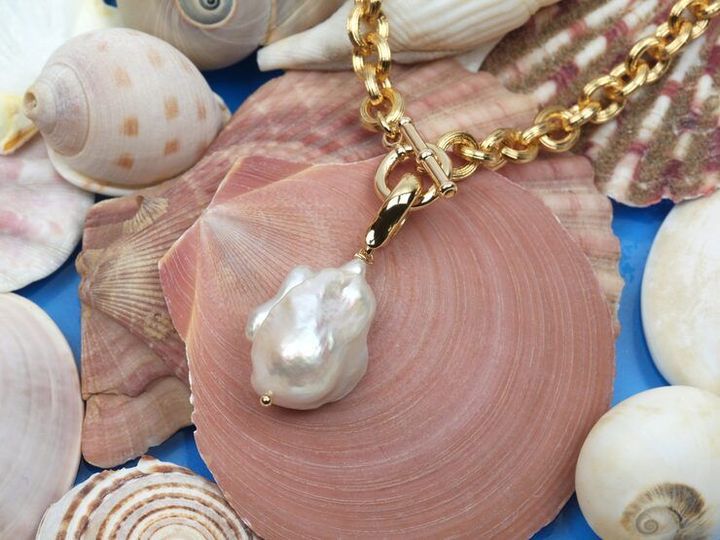
Baroque pearl jewelry uses pearls with irregular, asymmetrical, or free-form shapes rather than perfectly round forms. The word “baroque” describes the shape of the pearl, not whether it is natural or cultured, freshwater or saltwater. Baroque pearls can therefore come from different pearl-producing mollusks and can appear in many colors and sizes.
Unlike perfectly spherical pearls, baroque pearls develop with visible variations in contour. Their surfaces may appear elongated, curved, flattened, folded, ridged, or organically shaped. These differences make each pearl visually distinct.
How Baroque Pearls Form
Pearls develop when a mollusk produces layers of nacre, a hard, lustrous material, around an irritant or an introduced nucleus. Natural pearls develop without deliberate human intervention, while cultured pearls are produced through human involvement in the pearl-growing process. Most pearls in the modern jewelry market are cultured.
The final shape depends on several factors, including the mollusk, the cultivation process, the position of the growing pearl, and the way nacre develops around the nucleus or tissue. When growth does not result in a symmetrical sphere, an irregular or baroque form can develop.
Main Types of Baroque Pearls
Baroque pearls can be grouped according to their growing environment and pearl type.
Freshwater baroque pearls are widely used in jewelry because freshwater cultivation produces a broad range of shapes, sizes, and colors. Many freshwater pearls are tissue-nucleated, meaning a small piece of mantle tissue is introduced into the mollusk rather than a round bead.
Tahitian baroque pearls are saltwater cultured pearls associated mainly with French Polynesia. They can appear in gray, black, brown, green, blue, purple, and other color combinations.
South Sea baroque pearls are also saltwater cultured pearls. They can occur in white, silver, and golden colors and can have large, irregular forms.
Akoya baroque pearls are less commonly associated with the classic round Akoya appearance, but Akoya pearls can occur in different shapes. Akoya cultivation is associated primarily with Japan and China.
Baroque and Semi-Baroque Shapes
The difference between baroque and semi-baroque is mainly related to symmetry. GIA describes baroque pearls as having no apparent symmetry, while semi-baroque pearls have some symmetry but remain slightly irregular.
Common visual forms include elongated shapes, flattened forms, irregular drops, button-like shapes, and highly free-form pieces. Designers can use these natural variations to create earrings, pendants, necklaces, bracelets, and rings.
Importance
Why Baroque Pearl Jewelry Matters
Baroque pearl jewelry has a distinct relationship with natural variation. Instead of requiring every pearl to have an identical shape, many designs use irregularity as an important visual characteristic.
This makes baroque pearls useful for jewelry designs that emphasize organic lines and individual character. A necklace may combine several uneven pearls, while a pendant may use one large irregular pearl as its central element.
Pearl quality is generally assessed through factors such as size, shape, color, luster, surface quality, nacre quality, and matching when multiple pearls are used together. These factors are also part of GIA's pearl classification approach.
Styles of Baroque Pearl Jewelry
Baroque pearl necklaces can range from simple single-strand designs to combinations of different pearl sizes. Some designs arrange pearls according to approximate size, while others deliberately mix shapes and colors.
Baroque pearl earrings can use matching pairs or intentionally contrasting individual pearls. Because naturally irregular pearls may not be identical, designers sometimes select pairs with similar dimensions, color, and luster rather than identical outlines.
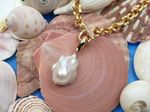
Baroque pearl pendants commonly use one prominent pearl. Its irregular contour can become the main visual feature, particularly when paired with a simple metal setting.
Baroque pearl rings can use a larger pearl mounted on a structured setting. The setting may be designed to protect part of the pearl while keeping its natural shape visible.
Baroque pearl bracelets can use individual pearls separated by knots, metal components, or other beads. The arrangement can be symmetrical or intentionally varied.
Important Characteristics to Compare
| Feature | What It Means | Why It Matters |
|---|---|---|
| Shape | Round, semi-baroque, or irregular form | Determines the visual character of the jewelry |
| Size | Pearl dimensions, usually measured in millimeters | Influences proportion and design |
| Color | Main bodycolor of the pearl | Affects the overall appearance |
| Overtone | Secondary color visible over the bodycolor | Can add visual depth |
| Luster | Strength and sharpness of surface reflections | Helps determine how lively the pearl appears |
| Surface | Natural marks, spots, ridges, or blemishes | Shows the pearl's surface condition |
| Nacre | Layered material forming much of the pearl | Influences appearance and durability |
| Matching | Similarity between multiple pearls | Important for necklaces, earrings, and bracelets |
GIA notes that pearl color can include bodycolor, overtone, and orient. Orient refers to a rainbow-like iridescent effect that can appear across the surface of some pearls.
Practical Advantages and Limitations
One practical characteristic of baroque pearls is variety. Their irregular forms allow jewelry designers to work with shapes that would not be suitable for highly symmetrical pearl designs.
Another characteristic is individuality. Two baroque pearls can have different contours even when they come from the same general pearl category.
However, pearls are relatively soft. GIA places pearl at about 2.5 on the Mohs hardness scale, meaning the surface can be scratched more easily than many common gemstones. Pearls can also be affected by heat, acids, cosmetics, perfume, hairspray, and other chemicals.
Recent Updates
Developments in Freshwater Pearl Cultivation
Recent pearl cultivation has expanded the range of freshwater pearl shapes, sizes, and colors available to jewelry designers. GIA reports that advances in farming techniques have produced freshwater pearls that can be larger, rounder, and more lustrous than many earlier examples.
Bead-nucleated freshwater pearls have also become increasingly common. This cultivation approach can contribute to larger and more symmetrical pearls, while tissue-nucleated methods can produce pearls composed largely of nacre.
Digital Pearl Identification and Education
Digital gemology resources have made it easier to research pearl characteristics, compare pearl categories, and understand terminology such as luster, nacre, overtone, orient, and matching.
Independent laboratory documentation can also help identify whether a pearl is natural or cultured and whether it formed in freshwater or saltwater. GIA provides pearl reports covering identification and, for cultured pearls, classification using its seven pearl value factors.
Greater Interest in Irregular Forms
Modern jewelry design continues to use irregular pearl shapes in contemporary pieces. Large and unusual pearls can be incorporated into creative designs rather than being rejected because they do not have perfectly spherical forms.
This reflects a broader design approach in which natural variation can become part of the visual concept. The trend does not mean that all baroque pearls have the same characteristics; size, luster, surface quality, color, nacre, and shape still vary considerably.
Laws or Policies
Pearl Disclosure and Jewelry Rules
There is no single worldwide law governing all baroque pearl jewelry. Requirements can differ according to the country where pearls are produced, processed, imported, marketed, or sold.
Jewelry businesses may need to follow local rules concerning product descriptions, gemstone identification, treatment disclosure, weights and measurements, consumer information, hallmarking, taxation, and import documentation. These requirements are jurisdiction-specific.
Natural and Cultured Pearl Identification
The distinction between natural and cultured pearls can be important because the two categories have different origins and rarity. GIA explains that natural pearls form without human intervention, while cultured pearls result from deliberate human involvement in pearl cultivation.
Where a pearl's identity is important, laboratory documentation can provide independent information. GIA pearl reports can identify whether a pearl is natural or cultured and, in relevant reports, identify the freshwater or saltwater environment.
Treatment and Origin Information
Pearls can undergo treatments such as dyeing or other processes that alter their appearance. GIA notes that treated pearl colors can change over time and that treatment information can be relevant when evaluating pearls.
For international trade, additional requirements may apply to customs documentation, endangered-species rules, protected wildlife, or materials associated with particular mollusk species. The exact requirements depend on the origin, species, destination country, and applicable law.
Tools and Resources
Pearl Identification Guides
Gemological references can help readers understand pearl terminology and distinguish freshwater, Akoya, Tahitian, and South Sea categories. GIA's pearl resources explain characteristics such as shape, color, luster, surface quality, nacre, size, and matching.
Measurement Tools
Jewelry professionals commonly use millimeter gauges or digital calipers to measure pearl dimensions. Measuring the length, width, or diameter helps document the physical characteristics of irregular pearls.
Magnification and Lighting
A jeweler's loupe or microscope can help examine surface characteristics, nacre appearance, drill holes, coatings, and other details. Consistent lighting is useful when comparing luster and color between multiple pearls.
Laboratory Reports
For pearls where identification or classification is important, an independent gemological laboratory report can provide additional documentation. GIA reports can address pearl identity and selected quality characteristics depending on the report type.
Pearl Care Resources
Pearls should be handled differently from harder gemstones. GIA recommends wiping pearls with a soft, clean cloth after wearing and keeping them away from harsh chemicals, sharp objects, excessive heat, and dry environments. Ultrasonic and steam cleaning are not recommended for pearls.
FAQs
What is baroque pearl jewelry?
Baroque pearl jewelry uses pearls with irregular or asymmetrical shapes. The term describes the pearl's form rather than its origin, so baroque pearls can be freshwater or saltwater and natural or cultured.
Are baroque pearls real pearls?
Yes. Baroque pearls are genuine pearls with irregular shapes. They can be naturally formed or cultured, and many examples used in modern jewelry are cultured freshwater pearls.
What types of baroque pearl jewelry are available?
Common designs include baroque pearl necklaces, earrings, pendants, rings, and bracelets. Designers may use individual irregular pearls or combine several pearls with similar colors, sizes, or luster.
How should baroque pearl jewelry be cared for?
Wipe pearls gently with a soft cloth after use and keep them away from perfume, hairspray, harsh chemicals, excessive heat, and abrasive objects. Pearl jewelry should not be cleaned with ultrasonic or steam cleaners.
What determines the quality of a baroque pearl?
Important characteristics include size, shape, color, luster, surface quality, nacre quality, and matching when several pearls are used together. An irregular shape does not by itself determine the overall quality of a pearl.
Conclusion
Baroque pearl jewelry uses the natural irregularity of pearls to create distinctive necklaces, earrings, pendants, rings, and bracelets. Freshwater, Tahitian, South Sea, and other pearl categories can produce baroque forms with different colors, sizes, surfaces, and luster. Recent cultivation methods and digital gemological resources have expanded understanding of pearl characteristics and identification. Proper handling and protection from chemicals, heat, scratches, and unsuitable cleaning methods are important for maintaining pearl jewelry.