Spice Grinding Machines: Guide to Grinding Technology and Machine Components
Spice Grinding Machines are industrial or commercial machines designed to reduce dried spices into smaller particles or powders. They are used for products such as chilli, turmeric, coriander, cumin, black pepper, cardamom, ginger, cinnamon, cloves, and blended spice mixtures.
Grinding is an important stage in spice processing because different food products require different particle sizes. A coarse grind may be suitable for certain seasoning applications, while a fine powder may be required for spice blends, sauces, packaged foods, and culinary preparations.
The grinding process can involve impact, cutting, crushing, shearing, or a combination of these mechanisms. Machine selection depends on the physical characteristics of the spice, desired particle size, production volume, moisture level, heat sensitivity, and required hygiene conditions.
How Spice Grinding Works
A typical grinding process begins with cleaned and dried raw spices. Foreign material and unsuitable particles are removed before the material enters the grinding equipment.
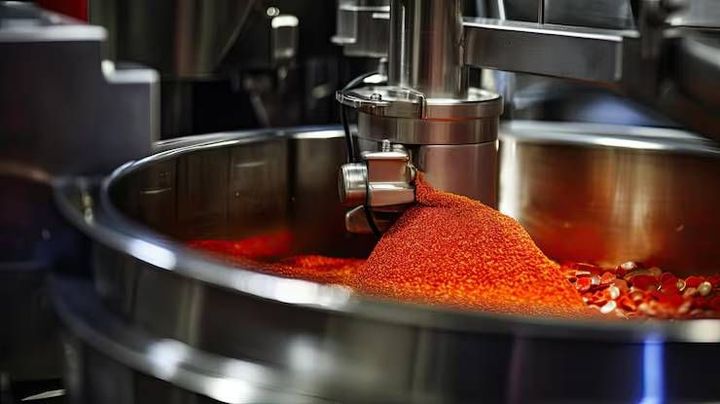
Inside the machine, rotating components create mechanical forces that break the spice particles into smaller pieces. The ground material may then pass through a screen or classification system that controls the final particle size.
A simplified process can include:
Cleaning: Removes stones, dust, stems, metal particles, and other unwanted material.
Drying or conditioning: Helps bring the spice to an appropriate moisture condition.
Feeding: Transfers the prepared spice into the grinding chamber.
Grinding: Mechanical forces reduce particle size.
Screening: Separates particles according to size.
Cooling: Helps control heat generated during grinding when required.
Collection: Transfers the finished powder into suitable containers or the next processing stage.
Blending: Combines different ground spices when a mixture is required.
Codex guidance for spices recognizes cleaning, grading, drying, grinding, blending, packaging, and storage as important stages in the broader spice-processing chain.
Why Grinding Conditions Matter
Spices contain aromatic compounds and oils that can be affected by heat, moisture, oxygen, and excessive mechanical stress. Grinding conditions therefore influence particle size as well as the physical characteristics of the resulting powder.
Some spices can become warm during intensive grinding. Excessive heat may influence volatile aromatic components and can also affect machine operation. For this reason, certain grinding systems incorporate airflow, cooling arrangements, controlled feeding, or multiple grinding stages.
Importance
Producing Consistent Particle Sizes
Particle size is one of the main considerations in spice grinding. Consistent powder dimensions can help create predictable texture, appearance, mixing behavior, and distribution in food products.
Different applications can require different particle-size ranges. A grinding system may therefore use interchangeable screens, adjustable settings, classifiers, or multiple stages.
Processing Different Spices
Spices have different physical characteristics. Black pepper is relatively hard and may behave differently from dried chilli. Turmeric can contain fibrous material, while cinnamon has a different structure and moisture response.
Because of these differences, one machine configuration may not produce the same result for every spice. Grinding equipment is selected according to material properties and the intended output.
Supporting Food Manufacturing
Ground spices are used in packaged foods, seasoning blends, sauces, snacks, bakery products, meat products, beverages, and many regional cuisines.
Spice-processing equipment therefore forms part of a wider food-production chain that can range from small processing units to large industrial plants.
Maintaining Hygienic Processing
Food-contact equipment needs appropriate construction, cleaning procedures, inspection, and maintenance. Machine surfaces and internal areas should be designed and managed to reduce the possibility of contamination.
Codex guidance specifically addresses hygiene across the spice-processing chain and identifies microbial, chemical, and physical hazards that can affect spices and dried culinary herbs.
Main Grinding Technologies
| Grinding Technology | Main Mechanism | Typical Application |
|---|---|---|
| Hammer mill | Impact from rotating hammers | Dried spices and coarse-to-fine grinding |
| Pin mill | High-speed impact and shearing | Fine spice powders |
| Pulverizer | Impact and size reduction | Various dried spices |
| Plate mill | Compression and shearing | Selected spices and grains |
| Roller mill | Compression between rollers | Controlled particle reduction |
| Universal mill | Impact, cutting, and screening | Multiple food materials |
| Air-classifying mill | Grinding with air classification | Fine and controlled powders |
Recent Updates
Greater Control of Particle Size
Modern Spice Grinding Machines increasingly incorporate adjustable grinding settings and classification systems. Instead of relying only on a single grinding stage, some production lines use several stages to gradually reach the required particle size.
Air classification can separate finer particles from larger ones and return selected material for additional grinding.
Improved Temperature Management
Temperature control has become an important consideration for products containing volatile aromatic compounds.
Some grinding systems use controlled airflow or cooling arrangements to remove heat generated during operation. Cryogenic grinding is another specialized approach in which very low temperatures are used to make certain materials more brittle during size reduction.
The appropriate technique depends on the spice and the desired product characteristics.
Automated Feeding and Monitoring
Modern processing lines can incorporate automated feeders, sensors, programmable controls, and monitoring systems. These technologies can help regulate material flow and operating conditions.
Digital controls may monitor factors such as motor load, temperature, airflow, vibration, and production status.
Improved Hygiene and Equipment Design
Food processors increasingly focus on equipment designs that allow easier inspection and cleaning. Smooth food-contact surfaces, suitable materials, accessible components, and reduced areas where powder can accumulate can support hygienic processing.
This is especially relevant because spices can pass through multiple processing and handling stages before reaching the final food product.
International Spice Standards
International attention toward spice standards continues to develop. The Codex Committee on Spices and Culinary Herbs is an active committee hosted by India and works on worldwide standards for dried and dehydrated spices in whole, ground, cracked, or crushed forms.
Recent Codex standards include requirements covering turmeric, small cardamom, allspice, juniper berry, star anise, large cardamom, coriander, and vanilla. This continuing standards activity demonstrates the importance of quality and safety considerations across the international spice-processing sector.
Greater Attention to Contamination Control
Spices can be exposed to microbial, chemical, and physical contaminants during growing, harvesting, drying, transportation, processing, and storage.
Codex's low-moisture food guidance includes an annex specifically covering spices and dried culinary herbs and identifies contamination control as a major consideration throughout the production chain.
Laws or Policies
International Food-Safety Frameworks
Spice processing is influenced by food-safety regulations in the country where the equipment is operated and where the resulting products are distributed.
International Codex texts provide reference points for governments, food businesses, and standards organizations. They address subjects such as hygiene, contaminants, product standards, sampling, and food information.
The Codex Committee on Spices and Culinary Herbs develops standards for dried and dehydrated spices in whole, ground, cracked, and crushed forms.
Hygiene Requirements
Grinding equipment should be incorporated into a hygienic processing environment. Raw spices, ground spices, equipment surfaces, personnel, water, air, storage areas, and packaging materials can all influence product hygiene.
Codex guidance emphasizes measures intended to reduce microbial and other contamination throughout spice production and processing.
Contaminant Control
Spices can contain potential hazards such as microorganisms, mycotoxins, chemical residues, heavy metals, and physical contaminants. Appropriate controls depend on the raw material, processing environment, destination market, and applicable regulations.
Codex maintains a specific code of practice addressing the prevention and reduction of mycotoxin contamination in spices.
Equipment Materials
Materials that come into direct contact with spices should be appropriate for food-processing applications and compatible with the cleaning procedures used in the facility.
Equipment design also needs to consider corrosion, wear, powder accumulation, access for inspection, and the possibility of particles entering the product from machine components.
Country-Specific Requirements
There is no single worldwide regulation governing every Spice Grinding Machine. Requirements can differ between regions.
Manufacturers and food processors may need to consider:
Food-contact material requirements.
Machinery safety rules.
Electrical safety requirements.
Food hygiene regulations.
Worker safety provisions.
Noise and environmental requirements.
Product testing and contaminant limits.
Import or export requirements.
Businesses operating across multiple markets need to examine the requirements applicable to each destination.
Tools and Resources
Particle-Size Analysis
Particle-size measurement tools help determine whether ground spice meets a specified size range. Sieves can provide relatively simple particle-size separation, while laboratory instruments can provide more detailed measurements.
Moisture Measurement
Moisture meters can help monitor raw spice conditions before grinding. Moisture influences grinding behavior, powder flow, storage stability, and the tendency of material to adhere to machine surfaces.
Temperature Monitoring
Temperature sensors can help identify excessive heating during grinding. Monitoring is particularly relevant when processing spices containing volatile aromatic compounds.
Metal Detection
Metal detectors can be incorporated into food-processing lines to identify selected metallic contaminants. Their use and configuration depend on the processing line and applicable food-safety procedures.
Magnetic Separation
Magnets can help capture certain ferrous particles before or after grinding. Magnetic systems are generally used as one part of a broader foreign-material control program.
Dust Collection
Fine spice particles can become airborne during feeding, grinding, screening, and transfer. Dust-collection systems can help manage airborne powder and maintain a cleaner processing environment.
Cleaning and Inspection Tools
Suitable brushes, vacuum systems, inspection equipment, and cleaning procedures help maintain grinding chambers, screens, feed systems, and collection areas.
The appropriate cleaning method depends on machine construction, spice characteristics, hygiene requirements, and manufacturer instructions.
FAQs
What are Spice Grinding Machines?
Spice Grinding Machines are mechanical systems used to reduce dried spices into smaller particles or powders. They can use impact, cutting, compression, shearing, or combinations of these mechanisms.
How do Spice Grinding Machines work?
Spice Grinding Machines feed prepared spices into a grinding chamber where rotating or stationary components apply mechanical forces. Screens or classification systems can then control the resulting particle size.
Which machines are used for spice grinding?
Common types include hammer mills, pin mills, pulverizers, plate mills, roller mills, universal mills, and air-classifying mills. The appropriate technology depends on the spice and required powder characteristics.
How is heat controlled during spice grinding?
Heat can be managed through controlled feeding, airflow, cooling arrangements, suitable grinding speeds, multiple processing stages, or specialized low-temperature grinding methods.
Why is hygiene important for Spice Grinding Machines?
Spices can be exposed to microbial, chemical, and physical contamination during processing. Hygienic machine design, appropriate cleaning, raw-material control, and monitoring help reduce these risks.
Conclusion
Spice Grinding Machines convert dried spices into powders or smaller particles through mechanical size-reduction processes. Different technologies, including hammer mills, pin mills, pulverizers, roller systems, and air-classifying mills, can be used according to material characteristics and desired particle size. Modern equipment increasingly incorporates temperature management, automated controls, classification, dust management, and hygienic construction. International Codex standards and food-safety guidance also continue to shape practices for spice processing across global markets.