Solar Panel Manufacturing Machines: Explore Their Processes
Solar panel manufacturing involves several stages that transform photovoltaic materials into finished solar modules. Depending on the factory design, production may cover silicon wafer preparation, solar cell production, module assembly, electrical testing, and final inspection.
The term solar panel manufacturing machines commonly refers to equipment used in the module assembly stage. However, a fully integrated photovoltaic manufacturing facility may also use machines for wafer processing and solar cell fabrication.
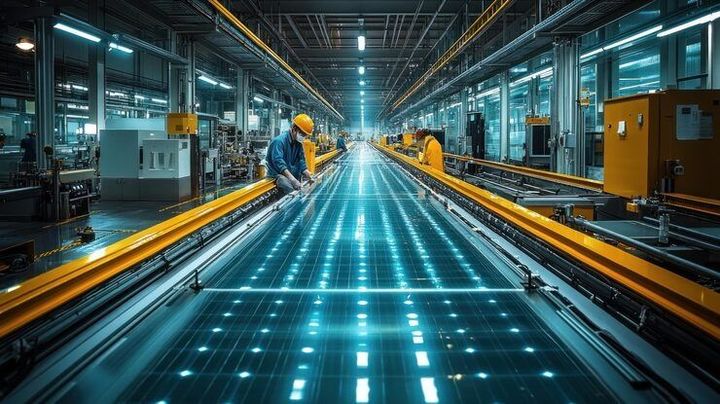
Modern production lines rely on controlled material handling, automated positioning, thermal processing, electrical testing, lamination, and inspection. These systems help maintain consistent module construction and provide measurable process controls.
Main Stages of Solar Panel Manufacturing
A typical crystalline-silicon photovoltaic manufacturing chain can be divided into:
- Silicon material preparation
- Wafer production
- Solar cell fabrication
- Cell testing and sorting
- Cell interconnection
- Module layup
- Lamination
- Framing
- Junction box installation
- Electrical testing
- Visual and dimensional inspection
- Final packaging
Not every factory performs all these stages. Some facilities specialize in solar cells, while others purchase cells and concentrate on module assembly.
Major Solar Panel Manufacturing Machines
| Machine or Equipment | Main Function |
|---|---|
| Wafer Cutting Machine | Produces silicon wafers from silicon material |
| Wafer Cleaning System | Removes contaminants from wafer surfaces |
| Cell Processing Equipment | Performs processes needed to create photovoltaic cells |
| Cell Tester | Measures electrical characteristics of cells |
| Cell Sorter | Groups cells according to electrical performance |
| Stringer Machine | Connects solar cells using interconnection ribbons |
| Layup Machine | Positions cells, glass, encapsulant, and backsheet |
| Bussing Machine | Creates electrical connections between cell strings |
| Laminator | Bonds module layers under controlled heat and pressure |
| Trimming Machine | Removes excess encapsulant after lamination |
| Framing Machine | Attaches the structural frame around the module |
| Junction Box Equipment | Installs and connects the junction box |
| EL Tester | Detects hidden defects using electroluminescence imaging |
| IV Tester | Measures current-voltage characteristics |
| Hi-Pot Tester | Checks electrical insulation |
| Flash Tester | Measures module electrical output under controlled illumination |
| Visual Inspection System | Checks surface, alignment, soldering, and assembly quality |
Importance
Solar panel manufacturing machines are important because photovoltaic modules contain multiple layers and numerous electrical connections. Small alignment, bonding, or interconnection variations can affect module performance and long-term durability.
Production Consistency
Automated machines can control positioning, temperature, pressure, timing, and movement more consistently than manual operations. This is particularly important during cell stringing and module lamination.
Cell Interconnection
The stringer machine is one of the important pieces of equipment in a module assembly line. It connects individual photovoltaic cells into strings using conductive ribbons or wires.
The interconnection pattern depends on the cell technology and module design. Modern equipment may support different cell formats and interconnection configurations.
Module Layup
During layup, several layers are arranged in a defined sequence. A common crystalline-silicon module structure includes front glass, encapsulant, photovoltaic cells, another encapsulant layer, and a rear layer.
Layup equipment helps position these components before lamination.
Lamination
The laminator applies controlled heat, pressure, and vacuum conditions to bond the module layers. This stage is important for protecting the cells and electrical connections from environmental exposure.
Process monitoring can include temperature profiles, vacuum levels, cycle duration, and pressure conditions.
Electrical and Quality Testing
Testing equipment provides information about module electrical performance and construction quality.
Common checks include:
- Electroluminescence inspection
- Current-voltage measurement
- Insulation testing
- Ground continuity checks
- Visual inspection
- Dimensional inspection
- Junction box inspection
- Flash testing
BIS documentation for photovoltaic standards includes testing and qualification requirements covering PV modules and their safety characteristics.
Recent Updates
Solar photovoltaic manufacturing has been evolving through higher cell efficiency, larger wafer formats, advanced cell architectures, automation, and increased module production capacity.
Larger and More Efficient Cell Formats
Module assembly equipment is increasingly designed to accommodate newer cell dimensions and configurations. Manufacturing lines therefore need flexible handling, alignment, stringing, and testing systems.
Automation and Process Monitoring
Modern production lines increasingly integrate PLC controls, machine vision, automated material handling, barcode or code-based traceability, and production data collection.
Machine vision can inspect cell positioning, soldering, glass surfaces, module edges, and other assembly characteristics.
Electroluminescence Inspection
EL testing has become an important inspection technique for identifying defects that may not be visible during ordinary visual inspection. Automated EL systems can capture module images and support production-level defect identification.
Growth of Domestic Solar Manufacturing
India's solar manufacturing ecosystem continues to expand across cells and modules. The Ministry of New and Renewable Energy maintains separate Approved List of Models and Manufacturers (ALMM) arrangements for solar PV modules and solar PV cells. The first ALMM list for solar PV cells was issued in July 2025, with subsequent revisions continuing during 2026.
MNRE's ALMM page also shows updated module and cell lists during 2026, reflecting continuing changes in the approved manufacturing landscape.
Advanced Cell Technologies
Solar manufacturing is also moving toward technologies such as TOPCon, heterojunction, back-contact architectures, and other high-efficiency cell designs.
These technologies can require changes in cell-processing equipment, metallization processes, inspection systems, and module interconnection equipment.
Laws or Policies
Solar panel manufacturing in India is influenced by product standards, conformity requirements, and MNRE policies.
BIS Requirements
The Bureau of Indian Standards maintains standards covering photovoltaic modules and related equipment. BIS lists crystalline-silicon terrestrial PV modules under standards including IS 14286 and IS/IEC 61730 requirements. Thin-film modules are covered separately under IS 16077 and related safety standards.
BIS explains that manufacturers seeking applicable certification need appropriate manufacturing infrastructure, process controls, quality control, and testing capabilities corresponding to the relevant Indian Standard.
Solar Systems, Devices and Components Order
The Solar Systems, Devices and Components Goods Order, 2025 introduced updated conformity requirements for specified solar products. BIS documentation notes implementation provisions for crystalline-silicon terrestrial PV modules under relevant standards.
The applicable requirement depends on the specific product, standard, and regulatory notification in force.
ALMM Framework
The MNRE Approved List of Models and Manufacturers framework is particularly relevant to solar PV modules used in specified government projects, government-assisted projects, government schemes, open-access projects, and net-metering projects.
Manufacturers therefore need to monitor current MNRE notifications and list revisions when planning production, model registration, and compliance activities.
Standards and Testing
Relevant photovoltaic standards address areas such as:
- Module design qualification
- Electrical safety
- Environmental durability
- Performance measurement
- Construction requirements
- Testing procedures
- Documentation and marking
BIS's "Know Your Standard" platform allows users to search standards by IS number or product keyword and access associated documents, amendments, testing information, and laboratory details.
Tools and Resources
A solar panel manufacturing facility may use several categories of equipment and digital systems.
Production Equipment
Typical module-production equipment includes:
- Cell stringer
- Automatic layup machine
- Bussing equipment
- Laminator
- Edge trimming system
- Framing machine
- Junction box installation equipment
- Curing equipment
- Module handling conveyors
Testing Equipment
Important testing systems include:
- EL tester
- Solar simulator
- IV tester
- Flash tester
- Hi-Pot tester
- Insulation resistance tester
- Ground continuity tester
- Visual inspection system
Digital Production Tools
Manufacturing execution systems and production-monitoring software can record process parameters, inspection results, equipment status, and production data.
Traceability systems can connect raw materials, cells, production stages, test results, and finished modules through unique identification codes.
Standards Resources
Manufacturers can use BIS's Know Your Standard platform to identify applicable Indian Standards and related documents.
MNRE's ALMM resource is useful for monitoring current module and cell listings, amendments, guidelines, and related notices.
FAQs
1. What are solar panel manufacturing machines?
Solar panel manufacturing machines are industrial systems used to assemble, process, inspect, and test photovoltaic cells and modules. They can include stringers, layup machines, laminators, framing equipment, EL testers, and electrical testing systems.
2. How does a solar panel manufacturing machine work?
The process depends on the machine. A stringer connects photovoltaic cells, a layup machine positions module layers, a laminator bonds those layers, and testing systems evaluate electrical and construction characteristics.
3. What machines are used for solar panel production?
Common equipment includes cell stringing machines, layup machines, bussing machines, laminators, trimming systems, framing machines, junction box equipment, EL testers, and IV or flash testing systems.
4. What is the role of a solar module laminator?
A solar module laminator uses controlled heat, pressure, and vacuum conditions to bond the different layers of a photovoltaic module. Proper lamination helps provide mechanical protection and environmental sealing.
5. Why is EL testing used in solar panel manufacturing?
Electroluminescence testing can reveal internal defects that may not be visible through ordinary visual inspection. It is used as part of module quality-control and inspection processes.
Conclusion
Solar panel manufacturing machines form an interconnected production system covering cell handling, interconnection, layup, lamination, framing, electrical testing, and inspection. Automation helps manufacturers maintain repeatable processes while collecting production and quality data. Current photovoltaic manufacturing is also moving toward higher-efficiency cell technologies, flexible automation, advanced inspection, and stronger traceability. In India, manufacturers need to monitor applicable BIS standards and current MNRE requirements, including ALMM developments, as the regulatory framework continues to evolve.