Seed Drilling Machines: Explore Types, Components, and Agricultural Applications
Seed Drilling Machines are agricultural machines designed to place seeds into prepared soil at controlled depths and row spacing. Instead of scattering seeds across the surface, a seed drill meters seed from a hopper and delivers it into furrows created by openers.
The basic principle is simple: store the seed, measure the required flow, open the soil, place the seed, and cover it. This process allows farmers to establish rows with a more controlled distribution of seed than conventional broadcasting.
Seed drills are widely associated with cereals and other close-row crops. Their designs vary according to crop type, soil conditions, farm size, residue levels, and the type of tractor or power unit used.
How Seed Drilling Machines Work
A typical machine begins with a seed hopper or box that holds the planting material. A metering mechanism controls how much seed moves toward each delivery point.
As the machine travels across the field, furrow openers create narrow openings in the soil. Seed travels through tubes and enters the furrows, after which covering devices or press wheels close the soil around the seed.
A simplified sequence is:
Seed storage: Seed remains in the hopper until it reaches the metering system.
Metering: The mechanism regulates seed flow according to the selected setting.
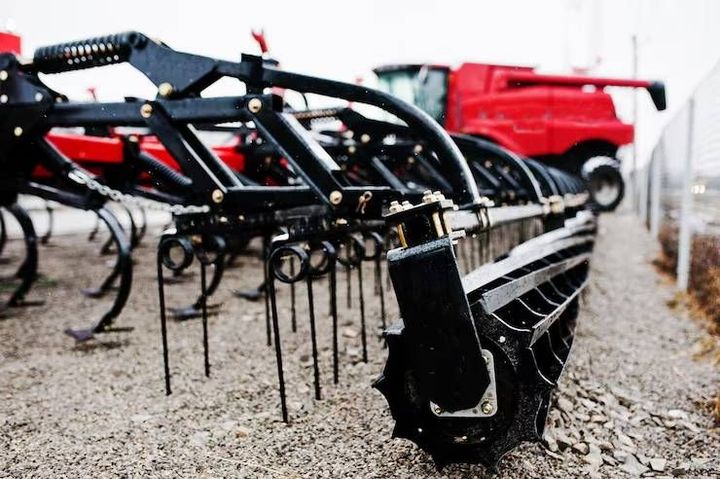
Furrow opening: Tines, shoes, or discs create openings in the soil.
Seed delivery: Tubes carry measured seed from the metering unit to the furrow.
Covering: Soil is moved back over the seed.
Pressing: A wheel or similar component may improve contact between soil and seed.
Extension guidance describes this basic arrangement and emphasizes calibration of the metering system before field operation.
Where Seed Drills Are Used
Seed Drilling Machines are commonly used for crops planted in relatively close rows. Examples include wheat, barley, oats, rye, pulses, oilseeds, forage crops, cover crops, and certain rice-production systems.
FAO's agricultural machinery database includes seed-drill systems used across Africa, Asia and the Pacific, Australia, Europe, Latin America and the Caribbean, the Near East, and North America, illustrating the international range of drill-based planting systems.
Importance
Controlled Seed Placement
Seed placement affects the conditions surrounding germination and early crop establishment. Depth, row spacing, seed distribution, and contact with soil can influence how uniformly a crop emerges.
A drill provides mechanical control over these factors rather than relying entirely on random surface distribution.
Reducing Uneven Seeding
A correctly adjusted metering mechanism helps maintain a more consistent flow of seed. The actual result depends on seed size, shape, moisture, machine settings, travel speed, soil conditions, and equipment condition.
Research on seed-flow monitoring has identified machine, seed, field, and operator factors that can contribute to blockages or irregular seed delivery.
Supporting Large-Scale Crop Establishment
Mechanical drilling allows a tractor and implement to cover substantial field areas during a planting operation. Working width, travel speed, hopper capacity, field shape, and soil conditions all influence field performance.
Larger farms may use wide drills with multiple rows, while smaller farms can use compact tractor-mounted or trailed machines.
Supporting Conservation Agriculture
Some seed drills are designed for reduced-tillage or no-tillage systems. These machines can place seed through crop residue while disturbing only selected portions of the soil.
FAO's database includes a no-tillage seed-drill system intended for small-grain cereals and designed for operation across several global agricultural regions.
Main Components
| Component | Main Function | Typical Design |
|---|---|---|
| Seed hopper | Stores seed | Box or divided hopper |
| Metering unit | Controls seed flow | Fluted, rotary, pneumatic |
| Drive system | Powers metering | Ground wheel, mechanical, electronic |
| Seed tube | Transfers seed | Flexible or rigid tube |
| Furrow opener | Creates seed furrow | Tine, shoe, single disc, double disc |
| Depth-control system | Controls placement depth | Gauge wheel, linkage, adjustment mechanism |
| Covering device | Covers deposited seed | Chain, drag, blade, or wheel |
| Press wheel | Firms soil around seed | Rubber or steel wheel |
| Frame | Supports components | Steel structural frame |
Recent Updates
Precision Seed Metering
Recent agricultural machinery development has increasingly focused on controlling seed placement more precisely. Electronic controls, improved metering mechanisms, sensors, and adjustable row units can help monitor or regulate planting operations.
Precision seeding is particularly relevant where farmers want greater control over seed population, spacing, and field variability.
Research indexed by FAO in 2024 examined sensing technologies for precision potato seeding, highlighting ongoing development around detection, metering, and irregular seed placement.
Digital Monitoring
Modern agricultural machinery can combine seed drills with positioning systems, sensors, electronic controllers, and field-data platforms.
Digital agriculture projects documented by FAO include precision seeding alongside GPS, soil maps, yield maps, variable-rate inputs, and machinery monitoring.
Such systems can provide information about where and how planting operations occur across a field.
Variable-Rate Seeding
Variable-rate technology allows the application rate to change according to selected field information. Soil characteristics, crop plans, historical yield information, and prescription maps may be used to determine different planting rates across field zones.
This approach requires compatible equipment, reliable field data, calibration, and suitable agronomic planning.
No-Till and Reduced-Tillage Drills
No-till drills are designed to work with crop residue and minimize soil disturbance. Their openers need sufficient strength and penetration to create a seed zone without extensive soil preparation.
The design can include specialized coulters, disc openers, depth-control mechanisms, and residue-management components.
Sensor-Based Seed Monitoring
Seed-flow sensors can detect whether seed is moving through individual delivery lines. This can help identify blockages, empty rows, or interruptions in seed flow during operation.
The technology is particularly relevant to larger multi-row machines, where a problem in one delivery line may otherwise remain unnoticed for some time.
Rice and Specialized Seeding Systems
Seed drilling technology is also being adapted for crops and conditions that traditionally use different establishment methods. A 2025 study indexed by FAO described a precision seeder developed for direct-seeded rice, combining adjustable seed and fertilizer boxes with a specialized metering system and controlled seed placement.
These developments demonstrate how drill concepts can be adapted to different crops, soil conditions, and cultivation systems.
Laws or Policies
International Machinery Safety
Seed drills contain moving parts, rotating components, drive systems, wheels, and soil-engaging equipment. Safety requirements therefore form an important part of their design and operation.
ISO 4254-9:2018 specifically addresses safety requirements and verification for mounted, semi-mounted, trailed, or self-propelled seed drills. It also covers combined seed and fertilizer drills and certain machines with integrated soil-working equipment.
ISO 4254-1 provides broader safety requirements for agricultural machinery and was reviewed and confirmed as current in 2026.
European Union Machinery Rules
The European Union has adopted Machinery Regulation (EU) 2023/1230, which establishes health and safety requirements for machinery and related products. The regulation becomes mandatory on 20 January 2027, replacing the current Machinery Directive framework.
The new framework also addresses technological developments such as AI-powered safety functions and cybersecurity-related aspects of safety control systems.
United States Agricultural Safety
In the United States, OSHA regulations include requirements for guarding farm field equipment and farmstead equipment. The rules address hazards associated with moving machinery parts and apply to covered agricultural equipment.
OSHA also provides agricultural safety guidance covering vehicle operation, machinery hazards, and safe agricultural work practices.
Regional Requirements
Agricultural machinery requirements differ between countries and regions. Depending on where a seed drill is manufactured, imported, or operated, requirements may involve machine guarding, conformity assessment, operator instructions, road transport, electrical components, noise, environmental considerations, and workplace safety.
Farm operators should therefore consult the regulations and machinery standards applicable in their jurisdiction.
Tools and Resources
Seed Drill Calibration Tools
Calibration is important for setting the intended seed rate. A common approach involves checking the quantity delivered by the metering mechanism over a known distance or simulated travel condition.
Manufacturer instructions should be followed because metering mechanisms differ between machines.
Seed-Rate Calculators
Digital or spreadsheet-based calculators can help convert desired seed populations or application rates into machine settings. Inputs may include seed size, germination characteristics, row spacing, travel speed, and target planting rate.
GPS Guidance Systems
GPS-based guidance can help maintain consistent field passes and reduce unintended overlap or gaps between adjacent passes. When integrated with compatible agricultural equipment, positioning information can also support precision planting.
Seed-Flow Sensors
Sensors installed near delivery tubes can monitor seed movement. When connected to an electronic display, they can alert operators to interruptions or irregular flow.
Soil and Field Mapping
Digital soil maps, field boundaries, historical crop information, and yield maps can provide information for precision planting decisions. FAO's digital agriculture resources describe combinations of remote sensing, field data, machine systems, and precision agriculture technologies.
Maintenance and Inspection Resources
Important inspection areas include seed boxes, metering mechanisms, delivery tubes, openers, drive components, wheels, frame connections, guards, and adjustment systems.
Field-equipment guidance also recommends checking connections, coulters, welds, and other areas for wear before operation.
FAQs
What are Seed Drilling Machines?
Seed Drilling Machines are agricultural implements that place seed into soil at controlled depths and row spacing. They normally combine a hopper, metering mechanism, delivery system, furrow openers, and covering equipment.
How do Seed Drilling Machines work?
Seed moves from a hopper into a metering mechanism, which regulates its flow. Delivery tubes carry the seed to furrow openers, which create openings in the soil, followed by covering and sometimes pressing operations.
What are the main types of Seed Drilling Machines?
Common categories include conventional grain drills, no-till drills, air drills, pneumatic drills, seed-and-fertilizer drills, and specialized precision drilling systems. Their designs vary according to crop, soil, field conditions, and required planting method.
Which crops use Seed Drilling Machines?
Seed drills are commonly associated with wheat, barley, oats, rye, pulses, oilseeds, forage crops, cover crops, and selected rice-production systems. The appropriate machine depends on seed characteristics and the crop-establishment method.
Why is calibration important for Seed Drilling Machines?
Calibration helps determine whether the metering system is delivering the intended amount of seed. Incorrect settings can result in excessive or insufficient seed flow, while field conditions can also influence actual placement.
Conclusion
Seed Drilling Machines are important agricultural implements for placing seed in controlled rows and depths across many farming systems worldwide. Their main components include seed hoppers, metering mechanisms, delivery tubes, furrow openers, depth controls, covering systems, and press wheels. Recent developments are connecting traditional drilling equipment with precision metering, sensors, GPS, digital field information, and specialized no-till systems. International standards and regional machinery regulations also provide safety frameworks for the design and operation of these machines.