Laser Manufacturing Machines: Explore Types, Processes, and Industrial Applications
Laser Manufacturing Machines are industrial systems that use concentrated laser energy to cut, weld, mark, engrave, drill, clean, or add material to manufactured components. A laser produces a highly focused beam of light that can deliver energy to a selected area with considerable precision.
These machines combine a laser source with optics, motion systems, software, workholding equipment, sensors, and safety enclosures or controls. Depending on the application, the laser can remove material, melt material, join components, alter a surface, or build a component layer by layer.
Laser processing is used with materials such as steel, stainless steel, aluminum, copper, plastics, ceramics, and selected composite materials. The appropriate laser wavelength, power, beam configuration, and processing method depend on the material and the intended operation.
How Laser Manufacturing Machines Work
A typical laser manufacturing system follows several basic stages:
Laser generation: A laser source generates a concentrated beam of light.
Beam delivery: Mirrors, optical fibers, lenses, or other optical components direct the beam.
Focusing: A lens or optical assembly concentrates the beam onto the working area.
Material interaction: The laser heats, melts, vaporizes, or otherwise modifies the material.
Motion control: Motors and precision stages move the laser head, workpiece, or both.
Process control: Software manages movement, power, speed, gas flow, and other parameters.
Inspection: Cameras, sensors, or measurement systems can monitor the finished operation.
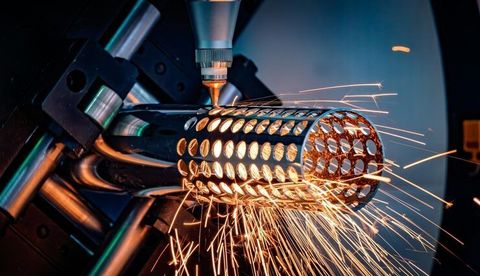
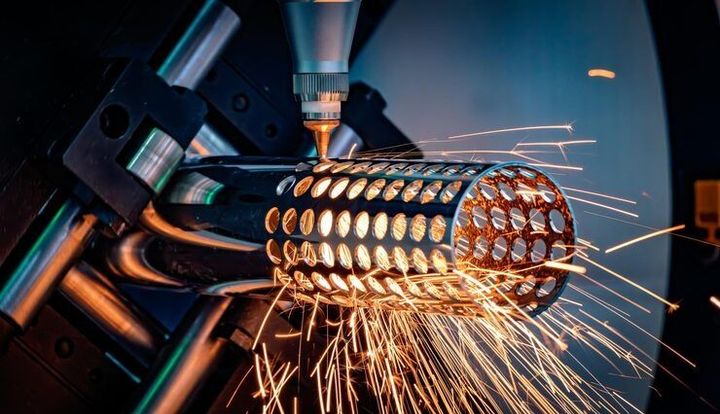
In laser cutting, for example, the focused beam melts or vaporizes material while an assist gas helps remove material from the cut area. In laser welding, the beam creates a controlled molten zone that joins two components.
Main Types of Laser Manufacturing Machines
Laser cutting machines use concentrated laser energy to cut sheet metal, plates, tubes, and other materials. They are commonly integrated with computer-controlled motion systems.
Laser welding machines join metal components by directing laser energy at the joint. The process can create a narrow heat-affected region compared with some conventional joining methods.
Laser marking machines create permanent markings such as serial numbers, codes, symbols, or identification patterns on selected materials.
Laser engraving machines remove a controlled amount of surface material to create letters, patterns, designs, or identification marks.
Laser drilling machines create small holes in components. They can be used where conventional drilling may not provide the required hole size, geometry, or production method.
Laser cladding systems deposit material onto a surface using a laser to melt a feedstock such as metal powder or wire. The process can be used to restore or modify selected surfaces.
Laser-based additive manufacturing machines use laser energy to melt material and build components layer by layer. One example is laser directed energy deposition, where powder or wire is fed into a laser-generated melt pool.
Importance
Precision Manufacturing
Laser processing can concentrate energy into a relatively small working area. This allows manufacturers to create narrow cuts, controlled welds, fine markings, and detailed surface features.
The actual precision depends on the machine, optics, material, motion system, process parameters, and calibration.
Flexible Material Processing
A single laser platform can sometimes perform multiple operations by changing tooling, software, optical configurations, or process equipment.
For example, a manufacturing facility may use laser technology for cutting sheet material, marking components, or processing selected parts with different programs.
Automation
Laser Manufacturing Machines are commonly connected to computer numerical control systems. Digital drawings or programmed tool paths can control the movement of the laser head or workpiece.
Automated loading systems, robotic arms, machine vision, sensors, and production monitoring can further connect laser processing with larger manufacturing lines.
Reduced Mechanical Contact
Many laser processes do not require a conventional cutting tool to physically contact the workpiece. This can reduce certain mechanical forces and tool-contact limitations.
However, laser systems still require careful control of heat, fumes, reflected radiation, material behavior, and process conditions.
Industrial Applications
Laser technology is used across many manufacturing sectors.
| Industry | Common Laser Application | Example |
|---|---|---|
| Automotive | Cutting and welding | Vehicle components |
| Aerospace | Drilling and additive manufacturing | Lightweight metal parts |
| Electronics | Marking and micromachining | Component identification |
| Medical devices | Cutting and marking | Precision components |
| Heavy engineering | Cutting and cladding | Large metal components |
| Tool manufacturing | Surface processing | Dies and molds |
| Jewelry | Cutting and engraving | Small detailed components |
| Energy | Welding and cladding | Selected equipment parts |
Recent Updates
Laser-Based Additive Manufacturing in India
Laser technology is increasingly connected with additive manufacturing and advanced production systems in India. In 2026, MeitY's National Additive Manufacturing Symposium highlighted continued development of machines, materials, products, and the wider additive-manufacturing ecosystem.
The Ministry of Heavy Industries has also supported development of a laser-based Directed Energy Deposition additive-manufacturing machine through CMTI and an Indian industry partner. The reported prototype uses a high-power laser, a deposition head, material feeding, melt-pool monitoring, and five-axis wire-fed metal deposition.
Advanced Manufacturing Systems
India's advanced-manufacturing initiatives increasingly connect CNC systems, robotics, testing and metrology, additive manufacturing, and other digitally controlled production technologies.
A February 2026 stakeholder consultation at CMTI focused on strengthening capabilities in advanced manufacturing systems, including advanced machines, CNC equipment, robotic systems, and additive manufacturing.
Laser machines fit into this broader movement because many laser processes already rely on computer-controlled motion, digital designs, sensors, and automated process parameters.
Process Monitoring
Sensors and cameras are becoming more important in laser processing. Monitoring can observe factors such as melt-pool behavior, temperature, position, beam characteristics, or surface conditions.
In additive manufacturing, real-time melt-pool monitoring can provide information about the deposition process and can support closed-loop control systems. The CMTI laser DED project specifically incorporates melt-pool monitoring for process monitoring and control.
Integration With Robotics
Laser processing can be combined with robotic arms to reach components with complex geometries or to automate repeated processing paths.
Robotic laser welding, cladding, cutting, and surface treatment can connect laser equipment with broader automated production cells. This approach is particularly relevant where components are large, three-dimensional, or difficult to position using a conventional fixed machine.
Electronics Manufacturing Growth
Laser equipment also has relevance to electronics manufacturing because lasers can perform selected marking, drilling, micromachining, trimming, and material-processing tasks.
India's Electronics Components Manufacturing Scheme is expanding domestic electronics-component production and related manufacturing capabilities. This broader manufacturing expansion can create additional applications for precision processing technologies.
Laws or Policies
Machinery Safety Requirements in India
Laser Manufacturing Machines are industrial machinery, so applicable machinery-safety requirements need to be considered alongside laser-specific precautions.
The Ministry of Heavy Industries issued the Machinery and Electrical Equipment Safety (Omnibus Technical Regulation) Amendment Order, 2025. The order states that the regulation applies from September 1, 2026 to machines and electrical equipment listed in its schedule, with applicable Indian Standards identified for covered equipment.
Whether a particular laser machine falls within a specific regulatory requirement depends on its classification, configuration, and applicable schedule.
Occupational Safety
India's Occupational Safety, Health and Working Conditions Code, 2020 forms part of the country's workplace-safety framework. The government announced that the four Labour Codes, including the OSH Code, became effective from November 21, 2025.
Laser-processing workplaces can require attention to machine guarding, risk assessment, worker training, protective equipment, emergency procedures, electrical safety, fumes, and other hazards associated with the specific process.
Laser Radiation Safety
Laser radiation can create hazards to the eyes and skin, particularly with higher-powered industrial systems. Direct exposure and certain reflected or scattered beams can present risks.
Industrial systems may therefore use enclosed processing areas, interlocks, warning indicators, controlled access, beam shielding, and appropriate protective equipment. The exact controls depend on laser classification, wavelength, power, machine design, and operating procedure.
Ventilation and Process Emissions
Laser cutting, welding, engraving, and other thermal processes can generate fumes, vapors, particles, or gases depending on the material and process.
Appropriate extraction and ventilation should be considered when designing a laser-processing workplace. Material-specific hazards also need to be evaluated before processing unfamiliar substances.
Standards and Technical Documentation
Manufacturers and users can refer to applicable Indian Standards, international standards, machine manuals, workplace rules, and technical risk-assessment procedures.
The correct standard depends on the machine type and process. A laser cutting machine, robotic laser cell, and laser additive-manufacturing system may have different technical and safety considerations.
Tools and Resources
CAD and CAM Software
Computer-aided design software creates digital component models, while computer-aided manufacturing software can convert design information into machine instructions.
Laser cutting and engraving systems commonly use digital files to define shapes, paths, markings, or processing areas.
Laser Parameter Libraries
Manufacturing systems can maintain parameter records for different materials and thicknesses. Parameters may include laser power, travel speed, focus position, assist-gas pressure, pulse settings, and other process variables.
These records can help operators reproduce validated processing conditions.
Machine Vision
Cameras and vision systems can identify component positions, inspect markings, detect selected defects, or guide robotic laser systems.
Vision can be particularly useful when workpieces are not positioned identically each time.
Process Monitoring Sensors
Sensors can monitor temperature, melt-pool behavior, position, vibration, power, gas flow, or other operating conditions.
Monitoring information can be used to identify deviations from expected process conditions and support quality assessment.
Laser Safety Equipment
Depending on the system, safety equipment can include:
Protective enclosures: Limit access to hazardous laser radiation.
Interlocks: Prevent operation when selected protective conditions are not satisfied.
Warning indicators: Signal laser operation or hazardous conditions.
Beam shields: Control unwanted laser radiation.
Laser protective eyewear: Selected according to wavelength and required protection.
Fume extraction: Removes process-generated airborne contaminants.
Emergency-stop systems: Provide a rapid method for stopping equipment when necessary.
Safety equipment should be selected according to the actual laser system and risk assessment rather than treated as interchangeable accessories.
FAQs
What are Laser Manufacturing Machines?
Laser Manufacturing Machines are industrial systems that use focused laser energy for processes such as cutting, welding, marking, engraving, drilling, cladding, and additive manufacturing.
How do Laser Manufacturing Machines work?
A laser source generates a concentrated beam that is directed and focused onto a workpiece. Depending on the process, the beam can melt, vaporize, join, mark, or deposit material while a computer-controlled system manages movement and process parameters.
What are the main types of laser manufacturing machines?
Major categories include laser cutting machines, welding systems, marking machines, engraving systems, drilling machines, cladding equipment, and laser-based additive manufacturing systems.
Where are Laser Manufacturing Machines used?
They are used in automotive, aerospace, electronics, medical-device, heavy-engineering, energy, tool-making, jewelry, and other manufacturing applications.
Are Laser Manufacturing Machines safe?
They can be operated safely when the complete system is appropriately designed, installed, guarded, maintained, and operated according to applicable requirements. Laser radiation, fumes, heat, electrical energy, moving machinery, and reflected beams can all require specific controls.
Conclusion
Laser Manufacturing Machines use concentrated light energy to perform a wide range of industrial processes, from cutting and welding to marking, drilling, cladding, and additive manufacturing. Their integration with CNC controls, robotics, sensors, machine vision, and digital manufacturing systems is expanding their role in modern production. India is also developing indigenous laser-based additive-manufacturing capabilities as part of broader advanced-manufacturing initiatives. Understanding the laser source, optics, motion system, material interaction, software, and safety controls provides a foundation for understanding how these machines operate across industrial applications.