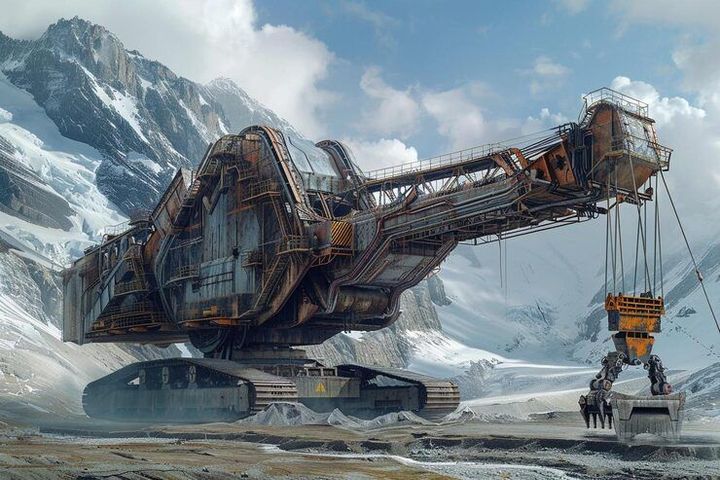
Draglines for Surface Mining: Guide to Components, Operation, and Practical Insights
Draglines for Surface Mining are large earthmoving machines designed to remove overburden, excavate material, and move large quantities of earth in open-pit and surface mining operations. They are particularly associated with large coal mines and other deposits where substantial volumes of material must be removed to expose the mineral beneath.
A dragline uses a large bucket suspended from a long boom by cables. Instead of driving directly into the material like a conventional excavator, the machine positions its bucket at a digging location, lowers or swings it into place, drags it through the material, lifts the loaded bucket, and swings it toward a dumping location.
Draglines can operate on very large mining sites because their long booms allow them to reach areas that may be difficult for conventional excavation equipment to access.
How a Dragline Works
A typical dragline operation follows a repeated sequence:
Positioning: The machine is placed at a suitable operating location.
Bucket placement: The bucket is lowered toward the digging area.
Digging: A drag rope pulls the bucket through the material.
Hoisting: A hoist rope raises the bucket after it is filled.
Swinging: The upper structure rotates toward the dumping location.
Dumping: The bucket releases its material.
Returning: The empty bucket moves back toward the excavation area.
This cycle continues according to the mine plan and required excavation sequence.
Main Types of Draglines
Draglines can be classified according to their operating configuration, size, mobility, and application.
Walking draglines use large walking mechanisms rather than conventional wheels or tracks. They can move across prepared mine surfaces and are widely associated with very large surface-mining operations.
Crawler-mounted draglines use crawler-type systems for movement. Their configuration depends on machine size and application requirements.
Electric draglines use electrical power to operate major drives and systems. Very large mining draglines commonly use electrical systems because of their substantial power requirements.
Mobile and specialized draglines may be designed for particular excavation environments, although their configuration varies considerably between manufacturers and mining operations.
Main Applications
Draglines are commonly used for:
Removing overburden above coal seams.
Excavating large quantities of loose or fragmented material.
Casting overburden into previously mined areas.
Creating or widening excavation areas.
Handling material over relatively long horizontal distances.
Supporting large-scale surface-mining sequences.
Their suitability depends on geological conditions, excavation geometry, required reach, material characteristics, and mine planning.
Importance
Large-Scale Material Removal
One of the main reasons mines use draglines is their ability to move substantial quantities of material during repeated excavation cycles.
A single machine can excavate and place overburden across a large working area. This can reduce the need for some truck-and-shovel movements in applications where dragline geometry is appropriate.
Long Reach
The long boom is one of the defining characteristics of a dragline. It allows the bucket to reach locations beyond the immediate position of the machine.
This capability can be particularly useful when overburden must be moved into adjacent mined areas or spoil locations.
Overburden Handling
In surface coal mining, overburden is the material lying above the coal seam. Removing this layer exposes the mineral deposit.
Draglines can excavate this material and place it into selected areas according to the mine plan. The ability to cast material directly can influence the design of surface-mining operations.
Production Planning
Dragline performance is closely connected with mine planning. Engineers consider digging depth, boom length, bucket capacity, swing angle, material characteristics, bench geometry, dumping location, and machine position.
Even small changes in these parameters can influence the number of cycles required and the amount of material moved during a working period.
Major Components
| Component | Main Function | Importance |
|---|---|---|
| Boom | Supports the bucket and cables | Determines reach and working geometry |
| Bucket | Excavates and carries material | Performs the digging task |
| Hoist rope | Raises and lowers the bucket | Controls vertical movement |
| Drag rope | Pulls the bucket through material | Produces digging action |
| Drag machinery | Controls drag movement | Manages bucket digging |
| Hoist machinery | Controls lifting movement | Raises loaded bucket |
| Swing system | Rotates the upper structure | Moves bucket toward dump area |
| Walking system | Moves the machine | Repositions the dragline |
| Electrical system | Powers major drives | Supports machine operation |
| Control system | Coordinates machine functions | Supports precise operation |
Recent Updates
Digital Monitoring
Modern Draglines for Surface Mining increasingly incorporate digital monitoring systems. Sensors can collect information about electrical equipment, motors, ropes, temperatures, loads, vibration, operating cycles, and other machine conditions.
This information can be displayed through monitoring platforms, allowing technical teams to identify unusual operating patterns and investigate potential equipment issues.
Automation and Machine Assistance
Automation technologies are becoming more relevant to large mining equipment. Automated or semi-automated systems can assist with selected machine movements, positioning, monitoring, and operating sequences.
ISO 17757:2019 provides safety requirements for autonomous and semi-autonomous machine systems used in earthmoving and mining operations. The standard was reviewed and confirmed in 2024, meaning the edition remains current.
Automation does not mean that every dragline operates without an operator. The level of automation depends on machine design, mine infrastructure, software, communications, and the specific operating plan.
Condition Monitoring
Condition monitoring can use sensors and historical operating information to track the behavior of important components.
For a dragline, monitoring may focus on electrical drives, ropes, motors, gear systems, structural components, bearings, and other critical equipment. Data can help technical teams plan inspections and maintenance activities based on machine condition.
Advanced Collision Awareness
Collision warning and avoidance technologies are also developing across earthmoving and mining equipment. International standardization work now addresses collision risks associated with different machine movements, including rotation and other forms of movement.
For large machines with extensive operating envelopes, awareness of people, vehicles, structures, and other equipment can be an important part of mine-site safety planning.
Electrification and Energy Management
Large draglines have traditionally used substantial electrical power. Modern mining operations are therefore paying greater attention to electrical efficiency, regenerative systems, drive technologies, energy monitoring, and overall power management.
The exact technology depends on the machine generation and mine infrastructure.
Digital Mine Planning
Three-dimensional mine models, surveying technologies, positioning systems, and digital planning platforms can help engineers evaluate excavation sequences before equipment is positioned.
These technologies can represent terrain, benches, material boundaries, spoil placement, and machine operating areas, allowing dragline movements to be considered within the wider mine plan.
Laws or Policies
International Safety Frameworks
Mining regulations differ between countries because surface-mining operations are governed by national, regional, and sometimes state or provincial authorities.
Important regulatory areas generally include machine safety, electrical safety, worker training, mine planning, ground control, emergency procedures, inspection, environmental management, and equipment operation.
Mining companies therefore need to identify the rules applicable to their particular jurisdiction rather than relying on one global regulation.
Machinery Safety Standards
ISO 20474-1:2017 provides general safety requirements for earth-moving machinery. It applies to machinery families used for activities such as excavation, loading, transportation, drilling, spreading, and related earthmoving applications. The standard was reviewed and confirmed in 2022.
The exact standards applicable to a dragline depend on its classification, configuration, electrical systems, autonomous features, and operating environment.
Mining Regulations in India
For operations in India, the Directorate General of Mines Safety maintains mining legislation and related regulatory material. Its published framework includes the Coal Mines Regulations, Metalliferous Mines Regulations, Oil Mines Regulations, Mines Rules, Central Electricity Authority regulations, and other mining-related legislation.
DGMS technical material specifically identifies draglines among electrically operated heavy earth-moving and mining machinery considered in mine safety and electrical-safety contexts.
Training and Competency
Operating a large dragline requires appropriate training and competency. Operators need to understand machine controls, bucket movement, swing areas, ground conditions, electrical systems, emergency procedures, and communication protocols.
Maintenance personnel also require knowledge appropriate to the machine's mechanical, electrical, hydraulic, structural, and control systems.
Environmental Requirements
Surface mining can affect land, water, air quality, noise levels, vegetation, and surrounding ecosystems. Environmental rules vary significantly by country and project.
Mine planning may therefore include land rehabilitation, water management, dust control, noise monitoring, waste placement, and other environmental measures alongside equipment planning.
Tools and Resources
Mine-Planning Software
Mine-planning platforms can create three-dimensional models of excavation areas and represent material locations, benches, spoil areas, and planned equipment movements.
These models can help engineers study possible dragline positions and excavation sequences.
Surveying and Positioning Systems
Surveying equipment, GNSS positioning, laser-based measurement, and other geographic technologies can help establish machine locations and monitor changes in excavation areas.
Accurate spatial information is particularly important for large machines operating close to excavation boundaries.
Machine Monitoring Platforms
Monitoring platforms collect information from sensors and control systems. Data may include machine position, operating cycles, electrical parameters, temperatures, loads, and equipment status.
Historical information can also support performance analysis and maintenance planning.
Digital Twin and Simulation Tools
Digital models can represent equipment behavior and mine conditions. Simulation can be used to examine potential excavation sequences, machine movements, and operational scenarios before implementation.
The level of detail varies between systems, from basic three-dimensional visualization to more advanced dynamic simulation.
Safety Documentation
Manufacturers' technical documentation, mine operating procedures, risk assessments, inspection records, regulatory publications, and international standards are important resources for dragline operations.
For international projects, teams may need to consider both local regulations and relevant international technical standards.
FAQs
What are Draglines for Surface Mining?
Draglines for Surface Mining are large excavation machines that use a long boom, cables, and a suspended bucket to remove and relocate overburden or other materials in large surface-mining operations.
How do Draglines for Surface Mining work?
Draglines for Surface Mining lower a bucket into the excavation area, pull it through material with a drag rope, lift the loaded bucket, swing it toward a dumping location, release the material, and return the bucket for another cycle.
What are the main components of a dragline?
Major components include the boom, bucket, hoist rope, drag rope, hoist machinery, drag machinery, swing system, walking mechanism, electrical equipment, and control system.
Where are draglines commonly used?
Draglines are particularly associated with large surface coal mines and other open-pit operations where substantial quantities of overburden must be excavated and relocated.
Are modern draglines automated?
Some modern mining operations use automation, monitoring, positioning, and machine-assistance technologies. However, the level of automation varies by machine, mine, software, infrastructure, and operating requirements.
Conclusion
Draglines for Surface Mining are large-scale excavation machines designed to remove and relocate substantial quantities of overburden and other material. Their long booms, suspended buckets, powerful hoist and drag systems, and large operating envelopes make them particularly suited to selected surface-mining conditions. Modern draglines are increasingly connected with digital monitoring, automation, positioning, condition monitoring, and advanced mine-planning technologies. Their operation also requires careful attention to local mining regulations, machine safety standards, training, environmental requirements, and site-specific risk controls.