Chillers: Insights Into Modern Cooling Technology
Chillers are refrigeration systems designed to remove heat from water or another circulating fluid. The cooled fluid can then be distributed through a building or industrial process to provide controlled cooling.
Chillers are widely used in commercial buildings, manufacturing facilities, data centres, hospitals, hotels, district cooling systems, and process industries. Depending on the design, a chiller may use air or water to reject heat from the refrigeration cycle.
A typical chilled-water system includes a chiller, chilled-water pumps, condenser-water equipment where applicable, cooling towers for many water-cooled systems, air-handling units, fan-coil units, valves, sensors, and control systems.
Main Components of a Chiller
| Component | Main Function |
|---|---|
| Compressor | Raises refrigerant pressure and circulates refrigerant |
| Evaporator | Transfers heat from chilled water into the refrigerant |
| Condenser | Transfers refrigerant heat to air or condenser water |
| Expansion Device | Reduces refrigerant pressure before evaporation |
| Refrigerant Circuit | Circulates refrigerant through the cooling cycle |
| Chilled-Water Pump | Circulates cooled water through the building |
| Condenser-Water Pump | Circulates condenser water in water-cooled systems |
| Cooling Tower | Rejects heat from condenser water to the atmosphere |
| Control Panel | Coordinates system operation |
| Sensors | Monitor temperature, pressure, flow, and other conditions |
| Variable-Speed Drive | Adjusts motor speed according to system demand |
How a Chiller Works
The basic chiller operation follows the refrigeration cycle.
First, the compressor raises the pressure and temperature of the refrigerant. The refrigerant then enters the condenser, where heat is rejected to outdoor air or condenser water.
The refrigerant passes through an expansion device, causing its pressure and temperature to decrease. It then enters the evaporator.
Inside the evaporator, the refrigerant absorbs heat from the circulating chilled water. The cooled water is then sent through the building's cooling network.
The refrigerant returns to the compressor, and the cycle repeats.
Chilled-Water Distribution
In a typical building system, chilled water leaves the chiller at a controlled supply temperature. Pumps circulate the water through air-handling units, fan-coil units, or process heat exchangers.
After absorbing heat, the return water travels back to the chiller. The system then removes the accumulated heat and sends the cooled water back into circulation.
This arrangement allows a central chiller plant to serve multiple rooms, floors, production areas, or process loads.
Importance
Chillers are important for applications that require centralized and controlled cooling.
Commercial Building Cooling
Large buildings often have changing cooling loads throughout the day. A central chiller plant can distribute cooling through a chilled-water network while control systems adjust equipment operation according to demand.
Common applications include:
- Office buildings
- Hotels
- Shopping complexes
- Hospitals
- Airports
- Educational facilities
- Data centres
- Convention centres
- Large residential developments
Industrial Process Cooling
Industrial processes may require cooling for machinery, production materials, fluids, or process equipment.
Chillers can be integrated with heat exchangers and process loops to maintain defined fluid temperatures.
Applications can include:
- Plastic processing
- Food processing
- Chemical processing
- Pharmaceutical manufacturing
- Metal processing
- Electronics production
- Industrial refrigeration
- Data-centre cooling
Centralized Cooling
A centralized chiller plant can connect multiple cooling zones through a common chilled-water network. This arrangement can simplify temperature management across large facilities.
Multiple chillers may also be arranged in parallel so that operating capacity can change according to the building or process load.
Part-Load Operation
Cooling demand rarely remains constant throughout the day. Variable-speed compressors, pumps, and fans can adjust operating capacity according to changing requirements.
Part-load performance is therefore an important consideration when evaluating a chiller plant.
Recent Updates
Modern chiller technology is increasingly focused on energy performance, variable-speed operation, digital controls, refrigerant management, heat recovery, and system-level monitoring.
Variable-Speed Chillers
Variable-speed compressors can change their operating speed according to cooling demand. This can improve part-load operation compared with systems that rely mainly on fixed-speed operation.
Variable-speed drives can also be applied to chilled-water pumps, condenser-water pumps, and cooling-tower fans.
Intelligent Chiller Controls
Modern controllers can continuously monitor parameters such as:
- Chilled-water supply temperature
- Chilled-water return temperature
- Condenser-water temperature
- Refrigerant pressure
- Compressor speed
- Water flow
- Electrical demand
- Alarm conditions
- Operating hours
Control algorithms can use these measurements to coordinate chiller operation with pumps, cooling towers, and building-management systems.
Digital Monitoring
Chiller plants are increasingly connected to building-management systems and energy-monitoring platforms.
Historical operating data can help identify changes in cooling performance, flow conditions, temperatures, and electrical consumption. This supports condition assessment and operational planning.
Heat Recovery
Some chiller configurations can recover heat from the refrigeration cycle and use it for hot-water production or other heating requirements.
This approach can be useful in facilities that have simultaneous cooling and heating demand.
Refrigerant Technology
Refrigerant selection has become an increasingly important part of modern chiller design. Current standards address refrigerant designation, safety classification, and refrigeration-system safety.
BIS lists IS 16656:2026 for refrigerant designation and safety classification and the IS 16678 series for refrigeration-system safety and environmental requirements.
Improved Plant-Level Controls
Modern chiller plants increasingly use sequencing controls to determine which chillers, pumps, and cooling towers should operate at a particular load.
Rather than operating every component continuously, plant controls can coordinate equipment according to cooling demand and operating conditions.
Laws or Policies
Chiller installations in India can be influenced by energy-efficiency requirements, building-energy codes, refrigeration safety standards, electrical requirements, and environmental provisions.
BIS Chiller Standard
The Bureau of Indian Standards lists IS 16590:2023, Liquid Chilling Package Units — Specification, as part of its refrigeration and air-conditioning standards.
The applicable standard depends on the equipment configuration and the specific product being evaluated.
Energy Efficiency Requirements
The Bureau of Energy Efficiency includes chillers within its Standards & Labelling programme. BEE's current programme page lists Chillers under Schedule 21.
The Energy Conservation and Sustainable Building Code 2024 also provides chiller efficiency criteria. For example, its whole-building performance section specifies minimum COP and IPLV values for water-cooled and air-cooled chillers based on chiller capacity.
For water-cooled chillers, the ECSBC 2024 tables specify increasing minimum COP and IPLV values across capacity ranges. Air-cooled chillers have separate minimum values.
Building Energy Performance
Building-energy requirements can affect chiller selection, plant configuration, chilled-water temperatures, pumping systems, and control strategies.
BEE's commercial-building programme describes ECBC as a framework for energy performance across building components and notes that requirements vary with climatic conditions.
Refrigeration Safety
Refrigeration and heat-pump systems are covered by the IS 16678 series. BIS identifies requirements covering definitions and classification, system design and construction, installation sites, and operation, maintenance, repair, and refrigerant recovery.
These requirements are relevant when designing, installing, operating, and maintaining refrigeration equipment.
Standards Verification
BIS's standards resources can be used to verify applicable Indian Standards, amendments, and related technical information. This is useful because standards can be revised and new editions may replace earlier documents.
BEE also maintains current information on its Standards & Labelling programme and related check-testing activities.
Tools and Resources
Chiller design and operation involve mechanical, electrical, thermal, and control-system tools.
Cooling-Load Calculation
Cooling-load calculations help determine the required cooling capacity of a chiller plant.
Important inputs can include:
- Building area
- Outdoor climate
- Solar heat gain
- Occupancy
- Lighting
- Equipment loads
- Ventilation
- Building-envelope characteristics
- Process heat loads
Accurate load assessment helps prevent significant over-sizing or under-sizing.
Chiller Performance Monitoring
Common monitored parameters include:
- Chilled-water supply temperature
- Chilled-water return temperature
- Condenser-water temperature
- Refrigerant pressure
- Water flow
- Compressor speed
- Electrical power
- COP
- IPLV
- Operating hours
These measurements can help engineers evaluate system performance.
Commissioning Instruments
Common field instruments include:
- Digital thermometers
- Pressure gauges
- Flow meters
- Clamp meters
- Power analysers
- Refrigerant leak detectors
- Vibration meters
- Hygrometers
- Differential-pressure meters
Building Management Systems
A building-management system can integrate chillers with pumps, cooling towers, air-handling units, sensors, and other HVAC equipment.
Centralized monitoring can display operating conditions, alarms, schedules, and selected energy data.
Energy Analysis
Chiller-plant energy analysis can compare electrical consumption against cooling output.
Useful indicators include coefficient of performance, integrated part-load value, kW per unit of cooling capacity, chilled-water temperature difference, and plant-level electrical demand.
FAQs
1. What are chillers?
Chillers are refrigeration systems that remove heat from water or another circulating fluid. The cooled fluid is then distributed to building or industrial cooling equipment.
2. How does a chiller work?
A chiller uses a refrigeration cycle in which the compressor, condenser, expansion device, and evaporator work together to remove heat from chilled water. The cooled water is circulated through the required cooling system.
3. What are the main types of chillers?
Common types include air-cooled chillers and water-cooled chillers. Chillers can also be classified by compressor technology, such as screw, scroll, centrifugal, or reciprocating configurations.
4. What is the difference between air-cooled and water-cooled chillers?
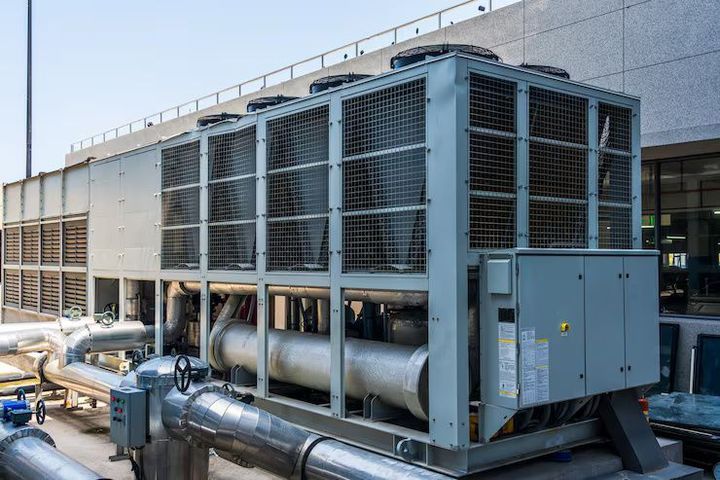
Air-cooled chillers reject heat directly to outdoor air through condenser coils. Water-cooled chillers reject heat to condenser water, which is commonly cooled through a cooling tower.
5. What are COP and IPLV in chiller systems?
COP represents the relationship between useful cooling output and energy input under defined conditions. IPLV is a part-load performance metric used to represent chiller efficiency across specified operating conditions.
Conclusion
Chillers provide centralized cooling for commercial buildings, industrial processes, data centres, and other applications requiring controlled thermal conditions. Their operation depends on the refrigeration cycle, heat exchangers, compressors, pumps, controls, and supporting equipment. Modern systems increasingly use variable-speed drives, digital monitoring, advanced controls, heat recovery, and updated refrigerant technologies. In India, chiller projects should be evaluated against applicable BIS standards, BEE efficiency requirements, building-energy provisions, and refrigeration safety requirements.