Centrifuges: Tips for Understanding Centrifuge Components
Centrifuges are machines that use centrifugal force to separate materials according to differences in density. They are used in laboratories, pharmaceutical processing, food processing, chemical industries, wastewater treatment, biotechnology, mining, and many other industrial applications.
A centrifuge rotates a container, bowl, basket, or rotor at a controlled speed. The resulting centrifugal force causes denser materials to move outward while lighter materials remain closer to the center. This separation principle can be used to divide solids from liquids, liquids from liquids, or suspended particles from a fluid.
Understanding centrifuge components is important because each part contributes to the machine's separation performance, stability, and safe operation. Components such as the rotor, bowl, drive system, bearings, housing, control panel, and safety interlocks must work together.
Basic Working Principle
A centrifuge typically receives a mixture through an inlet. The mixture enters a rotating chamber where centrifugal force separates its components.
Depending on the machine design, the separated material may collect on the outer wall, pass through different outlets, or be removed continuously.
The basic sequence is:
- Material enters the centrifuge.
- Rotation creates centrifugal force.
- Components separate according to density and other physical characteristics.
- Separated phases move toward designated collection areas.
- The separated materials leave through outlets or are removed during a controlled cycle.
Main Centrifuge Components
The main components can vary according to centrifuge type, but commonly include:
- Rotor or rotating bowl
- Drive motor
- Shaft
- Bearings
- Housing or chamber
- Inlet system
- Outlet system
- Control panel
- Safety lid or enclosure
- Interlock mechanism
- Braking system
- Vibration monitoring system
- Temperature or process sensors
The size and arrangement of these components depend on the application and centrifuge design.
Importance
Rotor or Bowl
The rotor is one of the most important centrifuge components. It rotates around a central axis and transfers centrifugal force to the material being processed.
Different rotor designs are used for different separation tasks. Laboratory machines may use fixed-angle or swinging-bucket rotors, while industrial machines can use baskets, solid-bowl designs, or specialized separation assemblies.
Because the rotor operates at high rotational speed, its mechanical condition and balance are important for safe operation.
Drive System
The drive system provides the rotational energy required by the centrifuge. It normally includes an electric motor, coupling or transmission arrangement, and shaft.
Modern systems can use variable-speed drives to control rotational speed according to process requirements.
Speed control allows operators to select an appropriate operating condition while reducing unnecessary mechanical stress.
Shaft and Bearings
The shaft transfers rotational motion from the drive system to the rotor or bowl. Bearings support the rotating assembly and help maintain alignment.
Bearing condition can affect vibration, noise, temperature, and overall machine stability. Regular inspection can therefore be an important part of centrifuge maintenance.
Housing and Safety Enclosure
The housing surrounds the rotating assembly and provides structural protection. It can also help contain material in the event of a mechanical problem.
Industrial centrifuges may have heavy-duty housings designed for specific process conditions, while laboratory machines commonly have enclosed chambers with locking lids.
Inlet and Outlet Systems
The inlet system introduces the material into the centrifuge. Depending on the design, the feed may need to be distributed evenly across the rotating assembly.
Outlet systems remove the separated liquid, solids, or other phases. Continuous industrial centrifuges can have dedicated outlets for different separated streams.
Control System
The control system allows operators to manage parameters such as:
- Rotational speed
- Operating time
- Acceleration
- Deceleration
- Temperature
- Feed rate
- Alarms
- Emergency shutdown
Advanced systems may use programmable controllers and digital interfaces to monitor operating conditions.
Safety Interlocks
Safety interlocks prevent access to the rotating assembly while it is moving. A lid or door may remain locked until the rotor has stopped.
BIS documentation for centrifuges includes requirements related to safe operation, including instructions for starting, increasing speed, and stopping, along with requirements concerning electrical safety.
Types of Centrifuges
Centrifuges are available in several configurations.
Laboratory Centrifuges
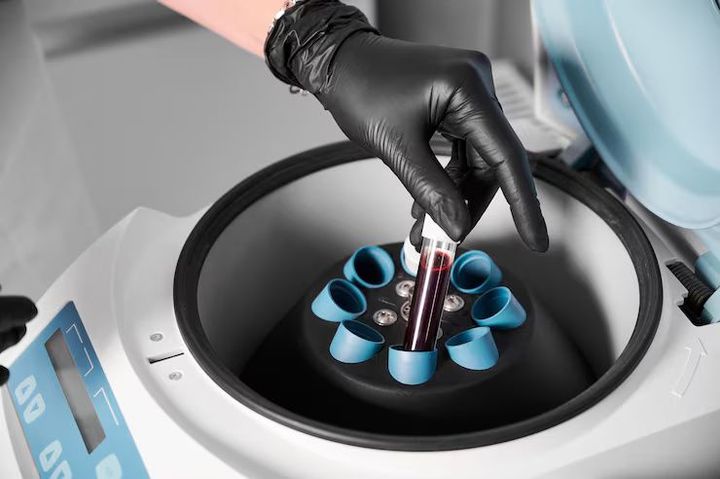
Laboratory centrifuges are commonly used for separating samples in research, testing, medical laboratories, and educational environments.
They can have interchangeable rotors and controlled speed settings for different sample types.
Decanter Centrifuges
Decanter centrifuges are commonly used for continuous separation of solids from liquids. They generally use a rotating bowl and internal conveying mechanism to move separated solids.
Applications can include wastewater treatment, industrial processing, food processing, and mineral-related processes.
Disc-Stack Centrifuges
Disc-stack centrifuges contain a stack of closely spaced discs that increase the effective separation area.
They can be used for liquid-liquid separation and fine solid separation in industries where continuous processing is required.
Basket Centrifuges
Basket centrifuges use a perforated or solid basket to retain or separate material. They are used in several industrial processes involving solid-liquid separation.
Tubular Centrifuges
Tubular centrifuges use a narrow rotating bowl and can provide high centrifugal forces. They are used for selected applications requiring fine separation.
Recent Updates
Increased Focus on Machinery Safety
BIS continues to maintain a broad machinery-safety framework covering equipment design, risk reduction, guarding, control systems, and related safety principles.
BIS's machinery-safety compendium includes standards supporting general machinery safety and risk assessment.
For centrifuges, safety is particularly important because rotating assemblies can store significant kinetic energy during operation.
Centrifuges in Machinery Certification Frameworks
BIS's current Scheme-X information identifies all types of centrifuges, filtering or purifying machinery for liquid and gas, and their assemblies, subassemblies, and components within the listed machinery categories.
However, the existence of a Scheme-X category should not automatically be interpreted as meaning that every centrifuge currently requires certification in every situation. The applicable conformity requirements should be checked against the specific product, current government notifications, and relevant standards.
Laboratory Centrifuge Safety
Laboratory centrifuges continue to receive attention through electrical and laboratory-equipment safety standards. BIS's laboratory testing scope includes IS/IEC 61010 Part 2 Section 020:2016, which covers particular safety requirements for laboratory centrifuges.
Safety features can include lid interlocks, imbalance detection, controlled acceleration, overspeed protection, braking, and automatic shutdown.
Automation and Monitoring
Modern industrial centrifuges increasingly combine mechanical systems with digital controls and sensors.
Monitoring can include:
- Rotor speed
- Vibration
- Bearing temperature
- Motor load
- Feed conditions
- Differential pressure
- Process temperature
- Alarm conditions
These measurements can help operators maintain stable operation and identify unusual conditions.
Improved Process Control
Automated centrifuges can adjust operating parameters according to process requirements. Variable-speed drives, programmable controllers, digital displays, and automated alarms can provide more consistent control than manually operated systems.
The level of automation varies according to the centrifuge application and process complexity.
Laws or Policies
Indian Standards
BIS provides standards applicable to different centrifuge categories and applications. One established Indian Standard referenced in BIS documentation is IS 1223, covering centrifuges and associated safety requirements. The BIS document includes requirements concerning construction, electrical safety, operating instructions, installation, balancing, and operator training.
The relevant standard should always be confirmed according to the centrifuge's application and current BIS information.
Machinery Safety
Centrifuges involve rotating mechanical assemblies, so machinery-safety principles are important. Risk assessment should consider hazards associated with rotation, imbalance, access to moving parts, electrical systems, temperature, pressure, materials being processed, and potential mechanical failure.
BIS maintains machine-safety publications and standards addressing general principles for machinery risk assessment and risk reduction.
BIS Certification
BIS explains that its certification system is generally voluntary, although the Central Government can make compliance compulsory for specific products through Quality Control Orders.
Therefore, an Indian Standard existing for a centrifuge does not by itself mean that certification is compulsory for every centrifuge. The current requirements applicable to the specific equipment should be checked.
Electrical Safety
Electrical centrifuges require suitable electrical protection, grounding, insulation, controls, and emergency arrangements. BIS documentation for centrifuges references electrical safety requirements and provides operational guidance for electrical centrifuges.
The exact electrical requirements depend on the centrifuge type and its installation environment.
Operator Safety
Operator training is an important part of centrifuge safety. BIS documentation specifically states that operators should receive training before being permitted to operate a centrifuge. It also provides guidance concerning balanced loading, operating speed, and safe handling after a suspected mechanical failure.
Safe operating procedures should be based on the manufacturer's instructions, applicable standards, and the conditions of the particular installation.
Tools and Resources
Speed and Time Controls
Speed controls allow operators to select the required rotational speed. Timers can control the duration of a centrifuge cycle.
The correct combination depends on the material and separation objective.
Vibration Monitoring
Vibration monitoring can provide an early indication of imbalance, bearing problems, misalignment, or other mechanical conditions.
Industrial centrifuges may use vibration sensors connected to alarms or automated shutdown systems.
Temperature Monitoring
Temperature sensors can monitor bearings, motors, process material, or the centrifuge chamber.
Temperature information can be particularly useful when the separation process is sensitive to heat or when mechanical components require thermal monitoring.
Inspection Equipment
Inspection activities can use tools such as:
- Vibration meters
- Tachometers
- Temperature sensors
- Electrical testing instruments
- Bearing inspection equipment
- Thickness measurement equipment
- Visual inspection tools
The appropriate equipment depends on the centrifuge design and maintenance program.
BIS Standards Portal
The BIS Know Your Standard portal allows users to search for Indian Standards by IS number or keyword. It also provides access to available standard documents, amendments, testing information, laboratory details, and licensing information. The portal was updated in May 2026.
This can be useful when identifying standards associated with a particular centrifuge type.
FAQs
What are the main centrifuge components?
The main centrifuge components commonly include the rotor or bowl, motor, shaft, bearings, housing, inlet and outlet systems, control panel, braking system, and safety interlocks.
What does the rotor do in a centrifuge?
The rotor is the rotating assembly that generates centrifugal force and applies it to the material being processed. Its design depends on the separation process and centrifuge type.
Why are centrifuge safety interlocks important?
Safety interlocks help prevent access to the rotating assembly while it is moving. They can keep the lid or enclosure secured until the centrifuge reaches a safe stopped condition.
How does a centrifuge control rotational speed?
A centrifuge can use a motor and electronic speed-control system to regulate rotational speed. Variable-speed drives allow different operating speeds to be selected according to process requirements.
What affects centrifuge performance?
Important factors include rotational speed, rotor design, material density, feed characteristics, operating time, temperature, loading balance, equipment condition, and separation requirements.
Conclusion
Understanding centrifuge components helps explain how these machines achieve controlled separation while maintaining mechanical stability. Components such as rotors, shafts, bearings, drive systems, housings, control systems, and safety interlocks each have an important function. Recent developments emphasize machinery safety, monitoring, automation, and more controlled operation. Appropriate standards, operator training, inspection, and equipment-specific safety procedures remain important for reliable centrifuge operation.