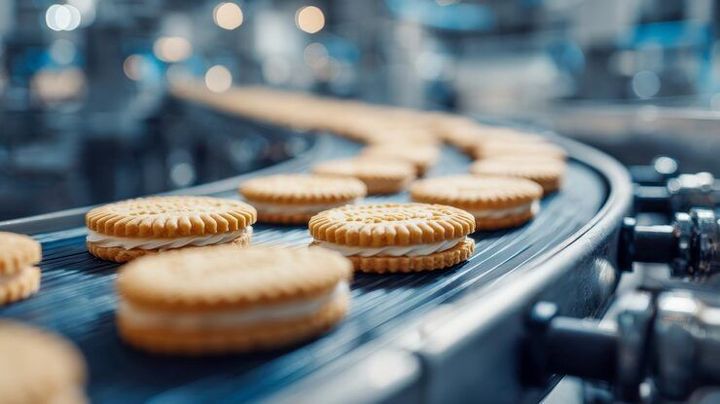
Biscuit Manufacturing Machines: Explore Production Processes and Key Equipment
Biscuit Manufacturing Machines are industrial machines used to prepare ingredients, form biscuit dough, bake shaped pieces, cool them, inspect them, and package the finished product. A biscuit production line connects several machines so that the product can move through these stages in a controlled sequence.
The exact equipment depends on the biscuit recipe and shape. A simple biscuit may require mixing, forming, baking, cooling, and packaging equipment, while a more complex product can require additional systems for depositing, laminating, sandwiching, cream filling, decoration, or inspection.
The Ministry of Food Processing Industries identifies mixing and kneading, moulding, baking, cooling, packaging, and testing as important stages in biscuit production. Its sector assessment also identifies mixers, biscuit moulding machines, ovens, cooling conveyors, packaging machines, and texture analysers as corresponding equipment.
How Biscuit Production Works
A typical biscuit production line follows a sequence in which ingredients gradually become a finished packaged product.
Ingredient preparation: Flour, sugar, fats, leavening agents, flavoring ingredients, and other recipe components are measured and prepared.
Mixing: Ingredients are combined to produce dough with the required characteristics.
Dough forming: The dough is rolled, laminated, deposited, or otherwise shaped according to the biscuit type.
Cutting or moulding: Dough is divided into individual biscuit shapes.
Baking: Formed dough passes through an oven where heat develops its structure, texture, color, and flavor.
Cooling: Baked biscuits travel through cooling conveyors until they reach a suitable temperature for handling and packaging.
Inspection: Samples or products may be checked for dimensions, weight, appearance, texture, or other quality characteristics.
Packaging: Cooled biscuits are arranged and enclosed in suitable packaging.
The sequence can change according to the product. For example, cream-filled sandwich biscuits require additional filling and assembly stages.
Main Types of Biscuit Manufacturing Machines
Flour handling and sifting machines remove unwanted particles and help prepare flour for controlled processing.
Ingredient weighing systems measure recipe components according to predetermined quantities.
Dough mixers combine flour, fats, sugar, liquids, leavening agents, and other ingredients into a consistent dough.
Dough sheeters flatten dough into a controlled thickness. They are commonly associated with biscuits made from sheeted dough.
Laminators create layered dough structures by combining and folding dough sheets.
Rotary moulding machines shape suitable dough into individual biscuits using a patterned moulding roller.
Wire-cut machines produce pieces by extruding dough and cutting it into individual portions.
Biscuit ovens apply controlled heat as biscuits travel through the baking chamber.
Cooling conveyors transport baked biscuits while allowing heat to dissipate before further handling.
Packaging machines arrange and wrap or otherwise enclose biscuits according to the selected package format.
Importance
Consistent Dough Preparation
Dough characteristics influence the shape, texture, appearance, and baking behavior of biscuits. Mixing equipment helps combine ingredients according to the production recipe.
The mixing time, mixing speed, ingredient sequence, and dough temperature can influence the resulting dough. These parameters vary according to the formulation and biscuit type.
Accurate Biscuit Forming
The forming stage determines the size and shape of individual biscuits. Equipment such as rotary moulders, wire-cut machines, sheeters, laminators, and depositors can be selected according to the dough characteristics.
Consistent forming helps create biscuits with similar dimensions before they enter the oven.
Controlled Baking
Baking is one of the most important stages because heat changes the dough into a finished biscuit. The process influences moisture, texture, color, structure, and flavor.
Industrial ovens can contain multiple heating zones. Operators can control selected conditions so that biscuits receive the required thermal treatment as they travel through the oven.
Controlled Cooling
Freshly baked biscuits remain hot and can be relatively delicate immediately after leaving the oven. Cooling conveyors provide a controlled path for reducing their temperature before handling and packaging.
Adequate cooling also helps prevent unwanted moisture conditions inside packaging.
Packaging Protection
Biscuits can lose their desired texture when exposed to moisture. Packaging therefore plays an important role in protecting the product during handling and storage.
Packaging machines can arrange biscuits, form packages, apply wrapping material, and seal packages according to the selected format.
Major Equipment and Functions
| Machine | Main Function | Production Stage |
|---|---|---|
| Flour sifter | Screens flour | Ingredient preparation |
| Weighing system | Measures ingredients | Recipe preparation |
| Dough mixer | Combines ingredients | Dough preparation |
| Sheeter | Creates dough sheets | Forming |
| Laminator | Creates layered dough | Forming |
| Rotary moulder | Shapes dough | Moulding |
| Wire-cut machine | Cuts portions | Forming |
| Tunnel oven | Bakes biscuits | Baking |
| Cooling conveyor | Reduces product temperature | Cooling |
| Packaging machine | Encloses finished biscuits | Packaging |
| Texture analyser | Measures texture characteristics | Testing |
Recent Updates
Automation Across Production Lines
Automation is becoming increasingly important in food-processing equipment. Automated systems can coordinate ingredient handling, dough preparation, forming, baking, cooling, inspection, and packaging.
The Ministry of Food Processing Industries identifies automation, robotics, advanced sensors, data analytics, and machine learning among important trends in food-processing machinery.
In a biscuit plant, automation can help coordinate conveyor speeds, oven conditions, forming equipment, and packaging operations.
Digital Monitoring
Modern production lines can collect information from sensors installed throughout the equipment. Temperature, speed, pressure, motor conditions, product flow, and other operating variables can be monitored through control systems.
Digital records can help operators identify changes in production conditions and investigate variations between batches.
Machine Vision
Camera-based inspection systems can examine selected characteristics of biscuits as they move through a production line.
Depending on the system, machine vision can identify differences in shape, color, position, surface appearance, or packaging alignment. The exact inspection capability depends on camera resolution, lighting, software, and product characteristics.
Energy-Efficient Baking
Baking requires substantial thermal energy, so oven design has an important effect on overall production efficiency.
Modern food-processing development increasingly includes energy-efficient equipment, improved process control, heat management, and monitoring technologies. These approaches can help plants understand how energy is being used across different production stages.
Flexible Production
Consumer demand includes biscuits with different shapes, sizes, flavors, textures, fillings, and ingredient combinations. Production equipment is therefore increasingly designed around flexibility and controlled changeovers.
Adjustable forming systems, programmable controls, modular equipment, and recipe management can support different product configurations where the machinery is designed for such changes.
Smart and Sustainable Food Processing
MoFPI's current food-technology material identifies AI, IoT, robotics, real-time monitoring, energy-efficient processing, and reduced water use as areas of development in food processing. It also highlights advances in packaging technologies and traceability.
For biscuit production, these developments can appear through connected machines, automated inspection, production-data collection, improved packaging controls, and digital monitoring.
Laws or Policies
FSSAI Requirements
Biscuit manufacturing in India falls within the country's food-safety regulatory framework. The Food Safety and Standards Authority of India maintains regulations under the Food Safety and Standards Act, 2006, including regulations covering licensing and registration of food businesses and food-product standards and additives.
Manufacturers need to follow the requirements applicable to their food category, ingredients, processing activities, hygiene arrangements, labeling, and facility.
Food Additives
FSSAI regulations specify permitted food additives and conditions for their use. The regulations specifically address the use of permitted additives in bread and biscuits.
The applicable ingredient and additive requirements depend on the product formulation and current regulatory provisions.
Food Business Licensing
FSSAI licensing requirements apply to food businesses according to the applicable category and scale of activity.
FoSCoS documentation for manufacturing and processing units includes information such as the processing-unit layout, equipment and machinery list, installed capacity, and the food categories intended for manufacture.
Hygiene and Manufacturing Controls
Food-processing equipment should be designed and maintained in a way that supports hygienic production. Areas that contact food need appropriate materials, cleaning procedures, and maintenance practices.
Production facilities also need controls for contamination, personal hygiene, storage, pest management, water quality, and other applicable food-safety requirements.
Food-Processing Development Programs
The Ministry of Food Processing Industries has programs supporting creation, expansion, modernization, and technological improvement of food-processing capacity. Its unit scheme includes creation or expansion of processing and preservation capacity and modernization of existing units.
The ministry's 2025 guidelines also cover creation and expansion of food-processing and preservation capacities.
Tools and Resources
Recipe and Batch-Control Systems
Digital recipe systems can store ingredient quantities and processing parameters for different biscuit varieties. They can help operators follow standardized production sequences.
Industrial Mixers
Mixers are available in different configurations and capacities. Selection depends on dough characteristics, batch size, mixing requirements, and production layout.
Tunnel Ovens
Tunnel ovens provide continuous baking as products travel on a conveyor. Important parameters can include temperature zones, conveyor speed, airflow, and heat-transfer conditions.
Cooling Conveyors
Cooling conveyors provide controlled travel time between the oven and subsequent production stages. Their length and speed depend on product temperature, line capacity, and facility layout.
Machine Vision Systems
Camera systems can be integrated into production lines to inspect biscuits or packages. They can monitor selected visual characteristics and provide production data for analysis.
Texture Analysis
A texture analyser can apply controlled forces to biscuit samples and measure characteristics such as hardness, crispness, or chewiness. MoFPI's assessment specifically identifies texture analysis as a testing stage in biscuit production.
Production Control Systems
Industrial control systems can connect individual machines and conveyors. Operators can monitor selected parameters from centralized interfaces and coordinate different sections of the production line.
Food-Processing Resources
MoFPI publishes sector reports covering food-processing machinery, bakery, food-processing capacity, and related technologies. These resources can help readers understand equipment categories and developments in India's food-processing sector.
FAQs
What are Biscuit Manufacturing Machines?
Biscuit Manufacturing Machines are equipment systems used for ingredient preparation, dough mixing, forming, baking, cooling, testing, and packaging during biscuit production.
How does a biscuit manufacturing process work?
The process generally begins with ingredient preparation and mixing. Dough is then formed and cut or moulded, baked in an oven, cooled on conveyors, inspected, and packaged.
What machines are used to make biscuits?
Common equipment includes flour sifters, weighing systems, dough mixers, sheeters, laminators, rotary moulders, wire-cut machines, tunnel ovens, cooling conveyors, testing equipment, and packaging machines.
What does a biscuit moulding machine do?
A biscuit moulding machine shapes prepared dough into individual pieces with a selected size and design. Different forming technologies are used for different dough types.
Why are cooling conveyors used in biscuit production?
Cooling conveyors allow freshly baked biscuits to gradually lose heat before handling and packaging. This helps prepare the product for subsequent processing and packaging.
Conclusion
Biscuit Manufacturing Machines form a connected production system covering ingredient preparation, dough mixing, forming, baking, cooling, testing, and packaging. Different biscuit varieties require different combinations of mixers, moulders, sheeters, ovens, conveyors, inspection equipment, and packaging systems. Current food-processing developments include automation, digital monitoring, machine vision, robotics, sensor technology, and improved process control. In India, FSSAI regulations and food-processing policies provide important frameworks for food safety, manufacturing, equipment documentation, and sector development.