Automated Guided Vehicles (AGVs) for Warehouses: Guide to Technology and Applications
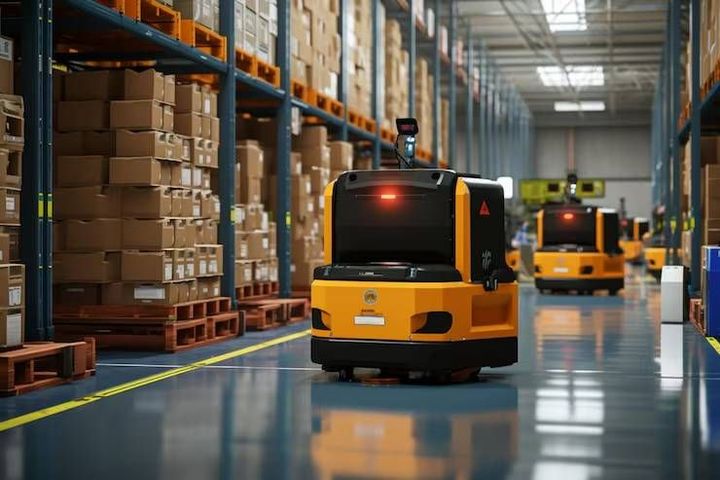
Automated Guided Vehicles (AGVs) for Warehouses are mobile robotic vehicles designed to move materials, products, pallets, containers, or other loads through controlled warehouse environments. They operate according to programmed routes, navigation systems, sensors, and warehouse-management instructions.
AGVs have been used in industrial material handling for decades, while newer mobile robots have introduced more flexible navigation methods. Traditional AGVs may follow magnetic strips, wires, reflectors, markers, or predefined paths. Modern systems can also use laser scanners, cameras, inertial sensors, maps, and software-based navigation.
An AGV system normally includes the vehicle itself, navigation equipment, sensors, control software, charging equipment, communication networks, and interfaces with warehouse systems.
How AGVs Work
A typical warehouse AGV follows a sequence of activities:
Task assignment: A warehouse control or management system sends a movement instruction.
Navigation: The AGV determines its route using its guidance technology.
Obstacle detection: Sensors monitor people, vehicles, structures, and other objects.
Load handling: The vehicle collects, carries, pushes, pulls, or places a designated load.
Destination movement: The AGV travels to a predefined location.
Load transfer: The load is transferred to another workstation, conveyor, rack area, or vehicle.
Task confirmation: The control system records the completed movement.
Charging: The vehicle returns to a charging location or uses an automated charging point when required.
The exact process depends on the AGV design and the warehouse layout.
AGV Navigation Technologies
Different navigation methods are suitable for different warehouse environments.
Magnetic guidance uses magnetic tape or markers installed along designated routes. It is relatively straightforward but requires changes to the physical guidance path when the layout changes.
Wire guidance uses an embedded wire that creates a detectable electromagnetic path. It is commonly associated with fixed routes.
Laser navigation uses laser scanners to identify reflectors or environmental features and calculate vehicle position.
Vision-based navigation uses cameras to identify visual features, floor markings, objects, or environmental references.
Natural-feature navigation allows vehicles to use maps and sensors to navigate around recognizable features without depending entirely on fixed physical tracks.
AGVs and AMRs
Automated Guided Vehicles and Autonomous Mobile Robots are related but are not identical terms.
AGVs traditionally depend on predefined guidance methods or structured routes. AMRs generally use more flexible navigation and can calculate routes around obstacles or changing environments.
The distinction is becoming less rigid as modern mobile platforms combine several navigation methods. Safety standards such as ISO 3691-4:2023 cover driverless industrial trucks and explicitly include terminology such as automated guided vehicles and autonomous mobile robots.
Importance
Moving Materials Inside Warehouses
Warehouses contain continuous movement between receiving areas, storage locations, picking zones, packing stations, production areas, and shipping docks.
AGVs can perform repeated transport tasks between these locations. This creates a predictable material-flow pattern and can reduce the amount of manual vehicle movement required for selected workflows.
Supporting Warehouse Automation
AGVs can connect different parts of an automated warehouse. For example, an AGV may collect a pallet from a receiving zone and transport it to a storage area. Another vehicle may later move the pallet from storage to an order-processing area.
AGVs can also interact with conveyors, automated storage systems, robotic arms, lifts, and warehouse-management platforms.
Handling Repetitive Transportation
Material transportation can involve repeated journeys over the same or similar routes. AGVs are particularly suited to applications where loads, destinations, and movement rules can be clearly defined.
Common examples include pallet transportation, container movement, production-line replenishment, and movement between storage and dispatch areas.
Improving Movement Visibility
Connected AGVs can generate information about location, task status, battery condition, movement history, and operational events.
This information can help warehouse managers understand material flows and identify areas where vehicles spend excessive time waiting, traveling, or charging.
Main AGV Categories
| AGV Type | Main Function | Common Warehouse Application |
|---|---|---|
| Tugger AGV | Pulls carts or trailers | Bulk material movement |
| Pallet AGV | Carries pallets | Storage and dispatch |
| Fork AGV | Lifts pallet loads | Rack and floor handling |
| Unit-load AGV | Carries individual loads | Containers and cartons |
| Conveyor AGV | Uses an integrated conveyor | Load transfer |
| Heavy-load AGV | Moves large or heavy loads | Industrial warehouses |
| Automated cart | Moves smaller loads | Picking and internal transport |
Recent Updates
More Flexible Navigation
Warehouse automation is moving toward mobile systems that can work in environments where routes and operating conditions change.
Modern navigation can combine laser scanning, cameras, inertial measurement, mapping, and other sensors. This can allow mobile robots to calculate routes without depending entirely on fixed physical guidance.
The level of flexibility depends on the vehicle, software, warehouse layout, and safety architecture.
Artificial Intelligence and Robotics
Artificial intelligence is becoming increasingly connected with robotics. The International Federation of Robotics identified AI and autonomy as major robotics trends for 2026, including applications involving logistics, path planning, and resource allocation.
For warehouse AGVs and related mobile robots, AI can support areas such as:
Object recognition
Route planning
Traffic management
Demand prediction
Fleet coordination
Anomaly detection
Warehouse mapping
Dynamic task allocation
AI does not remove the need for safety engineering. Navigation decisions still need to operate within defined safety limits.
Fleet Coordination
Large warehouse environments may contain multiple mobile vehicles operating simultaneously.
Fleet-management software can assign tasks, coordinate routes, manage traffic, prioritize movements, and monitor vehicle status.
Instead of treating each AGV as an isolated machine, fleet systems can coordinate several vehicles as part of one material-flow network.
Automated Charging
Battery technology and charging systems are also developing. Some AGVs can automatically travel to charging stations when their battery level reaches a defined threshold.
Opportunity charging can allow vehicles to recharge during planned waiting periods. Battery-swapping systems are another approach used in selected warehouse environments.
The appropriate approach depends on operating hours, vehicle design, battery chemistry, charging infrastructure, and warehouse workflow.
Better Sensor Integration
Modern mobile vehicles can combine multiple sensing technologies.
Laser scanners can detect obstacles and environmental structures. Cameras can provide visual information. Inertial sensors can track movement, while wheel encoders can measure vehicle travel.
Combining several sources of information can improve localization and navigation reliability.
Integration With Warehouse Systems
AGVs increasingly operate as part of connected warehouse environments rather than independently.
A warehouse-management system can determine what material needs to move, while a fleet-management platform can determine which vehicle should perform the task.
The AGV then executes the movement and returns status information to the connected system.
Laws or Policies
Global Safety Frameworks
AGV safety requirements vary by country and application. International standards provide important technical references, while national laws and workplace regulations may establish additional obligations.
ISO 3691-4:2023 specifies safety requirements and verification methods for driverless industrial trucks and their systems. It addresses hazards associated with the truck and its operating environment.
ISO is currently developing a new edition, ISO/DIS 3691-4, which is intended to replace the 2023 edition. As of September 2026, the document remains under development.
European Union
The European Union's Machinery Regulation establishes requirements for machinery and related products placed on the EU market.
The regulation specifically addresses autonomous mobile machinery. It includes requirements concerning obstacle detection, safe movement, emergency stopping, steering-system failures, and risk-related protective measures.
Manufacturers and integrators operating in Europe need to consider the applicable machinery requirements together with relevant harmonized standards and conformity procedures.
United States
In the United States, warehouse employers must address workplace hazards associated with automated equipment and robotics.
The U.S. Occupational Safety and Health Administration identifies hazards involving conveyors, automated equipment, and industrial robots in warehouse environments. It notes that poorly integrated automated equipment can create struck-by and caught-between hazards.
OSHA also provides robotics safety information covering hazard recognition and evaluation. OSHA states that there is currently no single OSHA standard specifically dedicated to the robotics industry, so several applicable workplace-safety requirements and recognized safety practices may need to be considered.
North American Robotics Standards
ANSI/A3 R15.08 addresses industrial mobile robot safety. Its framework includes requirements related to industrial mobile robots and their operating environments.
ANSI/A3 R15.08-2 addresses industrial mobile robot systems and applications, while ANSI/A3 R15.08-3:2026 provides guidance concerning the use of industrial mobile robot applications and emphasizes risk assessment and management of changes to the operating environment.
ANSI/ITSDF B56.5-2024 also addresses driverless, automatic guided industrial vehicles and automated functions of certain industrial vehicles.
Risk Assessment
A warehouse AGV should be evaluated as part of the complete working environment.
Important considerations include:
Vehicle speed
Load dimensions
Load stability
Pedestrian movement
Rack locations
Crossings and intersections
Emergency stopping
Charging areas
Blind corners
Floor conditions
Sensor performance
Software behavior
Manual intervention
Maintenance procedures
Safety requirements should be reviewed whenever the vehicle, software, load, route, or warehouse layout changes.
Tools and Resources
Warehouse Management Systems
Warehouse-management systems coordinate inventory, storage locations, receiving, picking, replenishment, and dispatch activities.
AGV systems can receive movement tasks from these platforms through software interfaces.
Fleet Management Software
Fleet-management software coordinates multiple vehicles. It can assign tasks, manage traffic, monitor battery levels, track vehicle locations, and provide operational information.
Warehouse Mapping Tools
Digital maps represent aisles, racks, workstations, charging locations, restricted areas, and travel routes.
Mapping tools are particularly relevant to mobile robots that navigate using environmental features rather than fixed guidance tracks.
Simulation Platforms
Warehouse simulation software can represent AGV movement, storage locations, conveyors, picking areas, and traffic patterns.
Simulation can help planners examine how changes in vehicle numbers, routes, storage arrangements, or task volumes may influence warehouse movement.
Sensors and Safety Equipment
AGVs can use combinations of:
Laser scanners: Detect nearby objects and obstacles.
Cameras: Provide visual information.
Proximity sensors: Detect nearby objects.
Encoders: Measure wheel movement.
Inertial sensors: Track changes in motion and orientation.
Safety scanners: Create monitored protective zones.
Emergency-stop devices: Provide a means to stop the vehicle when required.
Battery Monitoring Systems
Battery-management systems track battery condition, charge level, temperature, and other parameters.
For larger fleets, battery information can be integrated with fleet-management software so that vehicles can be assigned tasks according to their available operating time.
FAQs
What are Automated Guided Vehicles (AGVs) for Warehouses?
Automated Guided Vehicles (AGVs) for Warehouses are mobile robotic vehicles designed to transport materials, pallets, containers, and other loads through warehouse environments using automated guidance and control systems.
How do warehouse AGVs navigate?
Warehouse AGVs can navigate using magnetic tape, wires, markers, laser systems, cameras, maps, inertial sensors, or combinations of these technologies. The navigation method depends on the vehicle and application.
What is the difference between AGVs and AMRs?
Traditional AGVs generally operate along structured or predefined guidance paths, while AMRs typically use more flexible navigation and can dynamically plan routes around obstacles. Modern systems can combine characteristics of both approaches.
Where are Automated Guided Vehicles (AGVs) used?
Automated Guided Vehicles (AGVs) are used for pallet movement, production replenishment, container transportation, warehouse-to-warehouse movement, storage-area transfers, conveyor connections, and dispatch activities.
Are AGVs safe to use around warehouse workers?
AGV safety depends on the complete system, including vehicle design, sensors, navigation, speed control, protective functions, warehouse layout, operating procedures, and risk assessment. International and regional standards provide frameworks for addressing these hazards.
Conclusion
Automated Guided Vehicles (AGVs) for Warehouses are an important part of modern material-handling automation. They can transport pallets, containers, components, and other loads while connecting storage areas with picking, production, packing, and dispatch operations. Recent developments include flexible navigation, AI-assisted robotics, fleet coordination, automated charging, improved sensors, and deeper integration with warehouse-management systems. Global standards such as ISO 3691-4, ANSI/A3 R15.08, ANSI/ITSDF B56.5, and European machinery requirements provide important references for safe AGV deployment.