Slurry Separation Equipment: Guide to Types, Functions, and Practical Insights
Slurry Separation Equipment refers to machines and process systems used to separate solid particles from liquids or to divide suspended particles according to size, density, or other physical characteristics. A slurry is generally a mixture in which solid particles are suspended in a liquid, often water. Slurries are widely encountered in mineral processing, mining, drilling, construction, wastewater treatment, ceramics, chemical processing, and other industries.
The separation process can have different objectives. A plant may need to remove water from solids, recover valuable particles, divide coarse and fine material, remove unwanted solids, or produce a clearer liquid for another processing stage.
International standards also recognize slurry as particulate material mixed with a liquid. ISO 11794:2017, for example, provides methods for sampling slurries containing materials such as copper, lead, zinc, and nickel concentrates.
How Slurry Separation Works
A basic slurry separation system receives a mixture containing solids and liquid and applies a physical separation method.
The process can involve several stages:
Feed preparation: The slurry is mixed or conditioned so that it can move consistently through the equipment.
Classification: Particles are divided according to size or density.
Thickening: Solid particles are concentrated while a portion of the liquid is separated.
Filtration: A filter removes additional liquid from the concentrated solids.
Dewatering: Water content is reduced to produce a thicker solid product.
Water recovery: Separated liquid may be returned to another part of the process when suitable.
Final handling: The separated solids may move to storage, further processing, transport, or disposal.
The sequence depends on the material properties and the desired final result.
Main Types of Slurry Separation Equipment
Hydrocyclones use rotational flow and centrifugal forces to separate particles according to size and density. They are widely used for classification, desliming, densification, and dewatering in mineral-processing applications.
Thickeners use gravity settling to concentrate suspended solids. A thickener generally produces a denser underflow containing more solids and an overflow containing clarified liquid.
Filter presses apply pressure to slurry held within filter chambers. Liquid passes through filter media while solids form a filter cake.
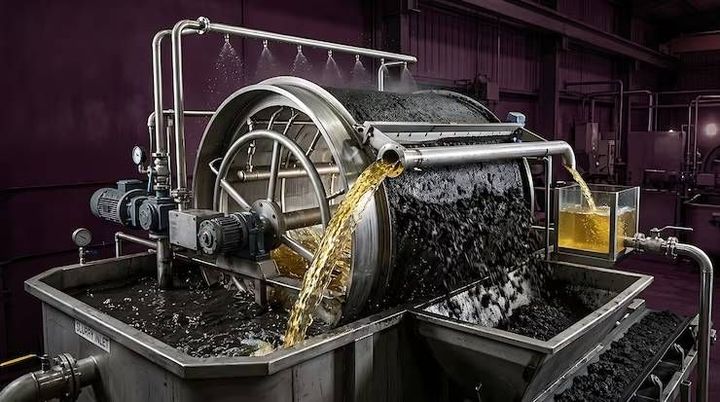
Vacuum filters use pressure differences to draw liquid through a filter medium while retaining solid particles.
Centrifuges use rotational forces to separate components with different densities. They can be used for solid-liquid separation and dewatering.
Screens separate particles according to physical size. Wet screening can be useful when the material is transported as a slurry.
Settling tanks and clarifiers allow particles to settle under gravity, creating a clarified liquid layer and a concentrated solids layer.
Importance
Supporting Mineral Processing
Slurry separation is fundamental to many mineral-processing operations. After crushing and grinding, mineral particles may be mixed with water to create a slurry. Separation equipment can then classify particles, remove excess water, or prepare material for processes such as flotation.
Hydrocyclones, slurry pumps, thickeners, and filtration systems are commonly combined within mineral-processing flows.
Recovering Water
Water can be an important process input in industries that handle large quantities of slurry. Separation equipment can recover liquid from solid material, allowing suitable process water to be treated and reused.
Water recovery is particularly relevant in regions where water availability is limited. The actual amount that can be recovered depends on slurry characteristics, equipment selection, process design, and water quality requirements.
Controlling Particle Size
Some processes require particles within a particular size range. Hydrocyclones and screens can divide slurry into coarse and fine fractions so that different material streams can follow different processing routes.
Hydrocyclones, for example, direct coarser particles toward the underflow while finer particles generally leave through the overflow.
Reducing Water in Solids
Dewatering can make solid material easier to transport, store, handle, or process. In mining, dewatered tailings can also form part of strategies intended to reduce water content in tailings storage.
A 2025 UN guidance document on critical energy transition minerals notes that filtered and thickened tailings can improve stability through dewatering, while also emphasizing that risks remain and that appropriate management is still required.
Equipment Categories
| Equipment | Primary Function | Typical Output |
|---|---|---|
| Hydrocyclone | Classification and densification | Fine overflow and coarse underflow |
| Thickener | Gravity concentration | Clarified liquid and dense underflow |
| Filter press | Pressure filtration | Filter cake and filtrate |
| Vacuum filter | Continuous filtration | Dewatered solids and filtrate |
| Centrifuge | Centrifugal separation | Concentrated solids and liquid |
| Wet screen | Size separation | Different particle-size streams |
| Clarifier | Settling and clarification | Clarified liquid and settled solids |
Recent Updates
Greater Focus on Water Recovery
Recent mineral-processing discussions increasingly connect slurry separation with water management and tailings reduction. The goal is not simply to separate solids and liquid but to understand how recovered water, concentrated solids, and residual material fit into the complete process.
The 2025 UN guidance on critical energy transition minerals highlights process-water recycling and dewatering as approaches that can contribute to reducing tailings impacts and improving resource efficiency.
Filtered and Thickened Tailings
Tailings are fine-grained residues remaining after mineral processing. Traditional wet tailings contain substantial amounts of water, while thickened and filtered approaches reduce water content before storage.
The Global Industry Standard on Tailings Management addresses the entire tailings-facility lifecycle, including design, construction, operation, monitoring, closure, and post-closure activities.
This has increased attention toward separation technologies that can produce denser tailings streams.
Digital Monitoring
Digital technologies are increasingly being applied to slurry-handling equipment. Sensors can monitor pressure, flow, vibration, density, temperature, and other operating variables.
Research presented through the Australasian Institute of Mining and Metallurgy in 2025 describes remote monitoring of slurry pumps as part of broader digitalization in mining and mineral processing.
Digital monitoring can help operators understand equipment behavior and identify changes in operating conditions.
Separation for Critical Minerals
Critical-mineral processing can involve difficult solid-liquid separation stages. Lithium, nickel, rare earth elements, vanadium, and other materials can involve fine particles, large liquid volumes, corrosive conditions, or challenging filtration characteristics.
Proceedings from the 2024 Critical Minerals Conference described several combinations of thickening, filtration, centrifugation, and liquid polishing for critical-mineral processing.
More Integrated Process Design
Modern slurry systems are increasingly considered as connected process chains rather than individual machines. A hydrocyclone may feed a flotation circuit, a thickener may receive flotation residue, and a filter press may process thickener underflow.
This integrated approach allows engineers to consider particle size, solids concentration, liquid chemistry, flow rate, filtration behavior, and final moisture together.
Laws or Policies
International Tailings Management
There is no single worldwide law governing every slurry separation installation. Requirements vary according to country, industry, material, environmental conditions, and the purpose of the separation process.
For mining operations, the Global Industry Standard on Tailings Management provides an international framework covering tailings facilities throughout their lifecycle. It contains six topic areas, 15 principles, and 77 auditable requirements.
The framework is not a replacement for national legislation. Its requirements are intended to operate alongside applicable laws and regulations in the jurisdiction where a facility is located.
Environmental Controls
Slurry separation systems can influence wastewater discharge, suspended solids, chemical use, water consumption, and waste storage. Environmental requirements therefore depend heavily on the industry and location.
Mining operations may face rules concerning tailings facilities, water quality, waste management, environmental approvals, and monitoring. Industrial plants may have separate requirements for wastewater and solid residues.
Sampling and Measurement
Accurate sampling is important when evaluating slurry composition and separation performance. ISO 11794:2017 provides sampling methods for particulate material mixed with liquid in moving slurry streams containing copper, lead, zinc, and nickel concentrates. The standard remains current following its 2022 review.
For iron-ore slurries, ISO 16742:2014 provides sampling methods and was confirmed in 2025, although the standard is currently marked for revision.
Coal Separation
Coal-processing operations also use density-based separation equipment. ISO 923:2022 describes principles and methods for evaluating density-separation equipment used for coal cleaning, including dense-medium separators, jigs, spirals, and water-only cyclones.
The applicable national rules still depend on the country and the specific facility.
Drilling Applications
Slurry-like drilling fluids also require solids-control equipment. ISO 13501:2011 establishes a standardized procedure for evaluating and modifying the performance of solids-control equipment systems used in petroleum and natural-gas drilling fluids processing. The standard was confirmed in 2022.
Tools and Resources
Hydrocyclone Sizing Information
Hydrocyclone selection depends on factors such as feed pressure, flow rate, particle-size distribution, solids concentration, slurry density, and desired separation point.
Manufacturers and engineering references commonly provide sizing information and process calculations for selecting appropriate cyclone configurations.
Thickener Calculations
Thickener design can involve variables such as solids concentration, settling rate, particle characteristics, feed rate, underflow density, and overflow clarity.
Laboratory settling tests can provide information that helps engineers evaluate thickening behavior before full-scale equipment is selected.
Filtration Tests
Filterability tests can evaluate how easily liquid passes through a filter medium and how a solid cake develops.
Important variables can include particle size, slurry concentration, cake thickness, pressure, filtration time, and moisture content.
Slurry Density Measurement
Density measurement helps operators understand the relationship between solids and liquid in a slurry. Density meters, sampling systems, and laboratory measurements can be used depending on the process.
Consistent density information can help control hydrocyclones, thickeners, pumps, and filtration equipment.
Process Monitoring Systems
Modern plants may combine flow meters, pressure sensors, density instruments, level sensors, vibration monitoring, and digital control systems.
These instruments can provide information about changing operating conditions and help operators maintain stable process parameters.
International Technical Resources
Useful technical resources include:
ISO standards: Provide internationally recognized methods and technical frameworks for selected slurry, mineral-processing, coal, and drilling applications.
Global Tailings Review: Provides the Global Industry Standard on Tailings Management and supporting technical material.
Mining and metallurgy organizations: Publish technical papers, conference proceedings, and research related to separation processes.
Equipment documentation: Manufacturer manuals provide operating limits, component information, maintenance instructions, and process requirements.
Laboratory testing: Settling, filtration, particle-size, and slurry-density tests can provide information for process design.
FAQs
What is Slurry Separation Equipment?
Slurry Separation Equipment includes machines used to separate solids from liquids or classify suspended particles according to characteristics such as size and density. Common examples include hydrocyclones, thickeners, filter presses, centrifuges, screens, and clarifiers.
How does slurry separation equipment work?
Different machines use different physical principles. Hydrocyclones use centrifugal forces, thickeners use gravity settling, filter presses use pressure filtration, and centrifuges use rotational forces to separate solid and liquid phases.
Where is Slurry Separation Equipment used?
Slurry Separation Equipment is used in mining, mineral processing, drilling, construction materials, wastewater treatment, ceramics, chemical processing, and other industries where solids and liquids need to be separated.
What is the difference between a hydrocyclone and a thickener?
A hydrocyclone uses rotational forces to classify or concentrate particles, while a thickener primarily uses gravity to settle suspended solids and produce a denser underflow.
Why is dewatering important in slurry processing?
Dewatering reduces the amount of liquid associated with solid material. It can make solids easier to handle and transport and can support water recovery and certain tailings-management approaches.
Conclusion
Slurry Separation Equipment plays an important role wherever solids and liquids must be separated, concentrated, classified, or recovered. Hydrocyclones, thickeners, filter presses, centrifuges, screens, and clarifiers use different physical principles for different process requirements. Current developments increasingly emphasize water recovery, filtered and thickened tailings, digital monitoring, and separation challenges associated with critical-mineral processing. International standards and tailings-management frameworks provide useful technical references, while national environmental and industrial requirements determine the rules applicable to each installation.