Sewage Treatment Plants: Guide to Treatment Stages
Sewage Treatment Plants (STPs) are systems designed to treat wastewater generated from homes, commercial buildings, institutions, and municipal areas. Sewage can contain suspended solids, organic matter, nutrients, microorganisms, oils, detergents, and other contaminants that require controlled treatment before discharge or reuse.
An STP uses a sequence of physical, biological, and sometimes chemical treatment processes. The selected treatment method depends on sewage characteristics, flow rate, land availability, treated-water requirements, operating conditions, and the intended reuse or discharge route.
CPCB documents identify treatment technologies such as activated sludge processes, trickling filters, aerated lagoons, UASB, oxidation ponds, extended aeration, SBR, MBR, and MBBR among the processes used for sewage treatment in India.
Main Components of an STP
A sewage treatment plant can contain several interconnected units:
- Inlet chamber
- Bar screen
- Grit removal system
- Equalization or collection tank
- Primary settling tank
- Biological treatment tank
- Secondary clarifier
- Tertiary filtration system
- Disinfection system
- Sludge handling system
- Treated-water storage tank
- Pumps and pipelines
- Monitoring and control system
The actual configuration depends on the required treatment capacity and the characteristics of the incoming sewage.
How an STP Works
Sewage first enters the inlet section, where large floating materials and coarse solids are removed through screening. Grit removal can then separate heavier inorganic particles such as sand and small stones.
The screened sewage moves toward primary treatment, where suspended particles settle under controlled hydraulic conditions. The partially clarified water then enters biological treatment.
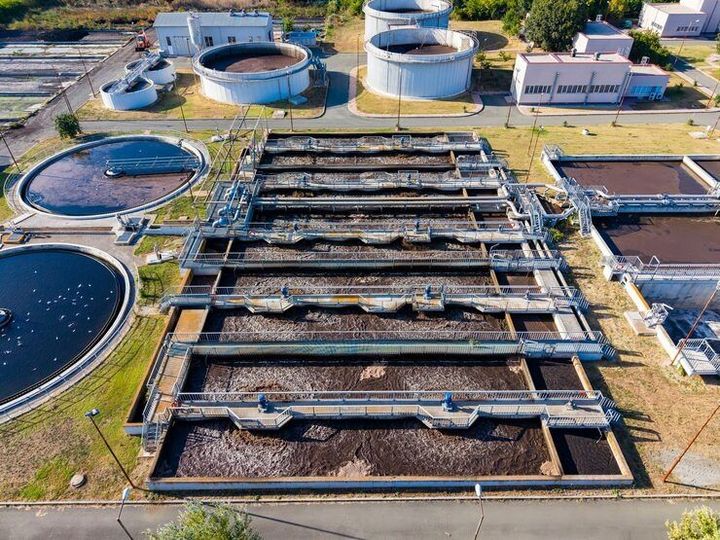
During biological treatment, microorganisms consume biodegradable organic matter. Aeration may be used to provide oxygen, while systems such as MBBR, SBR, activated sludge, or MBR use different approaches to maintain biological activity.
After biological treatment, a secondary clarifier separates treated water from biological solids. Additional filtration and disinfection can be applied when higher-quality water is required for reuse or discharge.
A simplified treatment sequence is:
Screening → Grit Removal → Primary Treatment → Biological Treatment → Secondary Clarification → Tertiary Treatment → Disinfection → Treated Water
Sludge collected during treatment is separately thickened, dewatered, stabilized, or otherwise managed according to its characteristics and applicable requirements.
Importance
Reduction of Water Pollution
Untreated sewage can introduce organic matter, suspended solids, nutrients, pathogens, and other contaminants into rivers, lakes, groundwater, and coastal environments.
Treatment reduces pollutant concentrations before the water reaches a receiving environment. CPCB has published standards and directions concerning treated sewage and the responsibilities of pollution-control authorities under the Water Act.
Water Reuse
Treated sewage can become a supplementary water resource when it meets the quality requirements for a particular application.
CPCB's guidelines for treated-sewage reuse discuss applications including agriculture, thermal power, industrial uses, and municipal applications. The guidelines promote a circular approach in which treated sewage can support non-potable water requirements.
Possible reuse applications include:
- Landscape irrigation
- Toilet flushing
- Gardening
- Industrial utility water
- Cooling applications
- Construction activities
- Certain agricultural applications
- Other approved non-potable uses
The required treatment level depends on the intended application.
Protection of Public Health
Sewage can contain pathogenic microorganisms. Treatment processes combined with appropriate disinfection can reduce microbial contamination before treated water is released or reused.
The required disinfection method and performance depend on the intended use and applicable water-quality requirements.
Resource Management
Modern STPs are increasingly considered part of water-resource management rather than only wastewater disposal systems.
Water recovery, sludge management, biogas generation, energy efficiency, and nutrient recovery can all be incorporated into suitable treatment configurations.
Recent Updates
Greater Focus on Treated-Water Reuse
Water reuse is becoming an important part of sewage-treatment planning in India. CPCB's reuse guidelines identify the gap between sewage generation and treatment capacity as an important reason to develop treated wastewater as a supplementary resource.
Reuse planning can influence STP design because water intended for irrigation, industrial utilities, or municipal applications may require different treatment and monitoring levels.
Advanced Biological Treatment
Biological treatment systems have developed beyond conventional activated sludge arrangements.
MBBR uses attached microbial growth on carrier media, while SBR performs different treatment phases within a batch reactor. MBR combines biological treatment with membrane separation and can produce comparatively high-quality treated water.
These technologies can be selected where space, treatment performance, automation, or reuse requirements influence plant design.
Digital Monitoring and Automation
Modern STPs increasingly incorporate sensors, programmable logic controllers, variable-frequency drives, online instruments, and supervisory monitoring systems.
Typical monitoring points can include:
- Flow
- pH
- Dissolved oxygen
- Turbidity
- Conductivity
- Tank level
- Pressure
- Oxidation-reduction potential
- Selected organic-load indicators
Automation can coordinate aeration, pumping, sludge return, chemical dosing, filtration, and disinfection.
Energy-Efficient Operation
Aeration is often a significant energy-consuming stage in biological wastewater treatment. Variable-speed blowers, dissolved-oxygen control, efficient pumps, and automated aeration management can help optimize energy use.
Energy monitoring can also help operators identify changes in equipment performance and process demand.
Compact Treatment Systems
Urban areas can face limitations related to land availability. Compact biological reactors, MBR systems, modular treatment units, and optimized clarification systems can reduce the physical footprint required for particular treatment capacities.
Laws or Policies
Sewage treatment in India is influenced by the Water (Prevention and Control of Pollution) Act, 1974, the Environment (Protection) Act, 1986, the Environment (Protection) Rules, 1986, and requirements issued by CPCB and State Pollution Control Boards.
Treated Sewage Standards
CPCB has published standards and directions for treated sewage. Applicable requirements can depend on the discharge location, receiving environment, treatment arrangement, and specific regulatory conditions.
Pollution-control authorities can prescribe requirements for parameters such as pH, biochemical oxygen demand, suspended solids, chemical oxygen demand, nutrients, and microbiological indicators.
The Water Act gives State Pollution Control Boards responsibilities related to sewage treatment, inspection of treatment plants, and standards for sewage discharge and receiving waters.
Consent and Regulatory Requirements
Applicable municipal authorities, institutions, commercial establishments, and other facilities may have regulatory obligations depending on their activities, discharge arrangements, location, and local requirements.
Large STPs can also be subject to monitoring and reporting conditions established by the relevant pollution-control authority.
Sewage Treatment and Reuse
CPCB's reuse guidelines provide a framework for considering treated sewage as a supplementary water source. They discuss regulatory considerations, water-quality requirements, sector-specific applications, and responsibilities associated with reuse.
Environmental Standards
The Environment (Protection) Rules contain standards for various industrial and environmental discharges. Sector-specific requirements can be stricter than general conditions depending on the source and receiving environment.
Therefore, STP design should consider the applicable local consent conditions and current requirements rather than relying on a single generic treatment specification.
Tools and Resources
STP operation depends on mechanical equipment, biological-process systems, instrumentation, electrical controls, and laboratory analysis.
| Tool or System | Main Purpose |
|---|---|
| Bar screen | Removes coarse solids |
| Grit chamber | Separates sand and heavy inorganic particles |
| Primary clarifier | Settles suspended solids |
| Aeration tank | Supports biological treatment |
| MBBR system | Provides attached-growth biological treatment |
| SBR system | Performs treatment phases in a batch reactor |
| MBR system | Combines biological treatment and membrane separation |
| Secondary clarifier | Separates biological solids |
| Filter system | Removes remaining suspended particles |
| Disinfection system | Reduces microorganisms |
| Sludge dewatering system | Reduces water content in sludge |
| DO sensor | Measures dissolved oxygen |
| pH meter | Measures acidity or alkalinity |
| Flow meter | Measures sewage or treated-water flow |
| Turbidity meter | Indicates suspended-particle levels |
| PLC | Controls plant operations |
| HMI | Displays operating conditions |
| SCADA system | Supports centralized monitoring and data recording |
| Laboratory equipment | Supports water-quality analysis |
Biological Treatment Equipment
Biological treatment equipment forms the central part of many STPs. Aeration systems, microbial carriers, diffusers, mixers, return-sludge pumps, and biological reactors work together to reduce biodegradable organic matter.
Filtration Equipment
Tertiary filtration can use pressure filters, multimedia filters, disc filters, sand filters, or other systems depending on the required treated-water quality.
Disinfection Systems
Disinfection can use ultraviolet radiation, chlorination, ozone, or other appropriate methods. Selection depends on water quality, treatment objectives, operational conditions, and applicable requirements.
Sludge Management Equipment
Sludge can be handled using thickening, drying, filter presses, centrifuges, screw presses, or other appropriate technologies.
Proper sludge management is important because treatment does not eliminate contaminants; it transfers a portion of the pollutant load into the sludge stream.
FAQs
What is a Sewage Treatment Plant?
A Sewage Treatment Plant is a system that treats wastewater from domestic, municipal, commercial, or institutional sources through physical, biological, and sometimes chemical processes.
What are the main stages of an STP?
The main stages generally include screening, grit removal, primary treatment, biological treatment, secondary clarification, tertiary treatment, and disinfection. The exact sequence depends on plant design and treated-water requirements.
What is biological treatment in an STP?
Biological treatment uses microorganisms to break down biodegradable organic matter present in sewage. Activated sludge, MBBR, SBR, MBR, and other biological processes can be used.
What is the difference between an STP and an ETP?
An STP primarily treats domestic or municipal sewage, while an Effluent Treatment Plant generally treats wastewater generated by industrial processes. The treatment processes and equipment can overlap, but wastewater characteristics are usually different.
Why is treated sewage reused?
Treated sewage can be reused for suitable non-potable applications such as irrigation, landscaping, toilet flushing, industrial utilities, and other approved purposes when the required water-quality criteria are met. CPCB specifically promotes treated-sewage reuse as part of a circular water-management approach.
Conclusion
Sewage Treatment Plants use multiple treatment stages to reduce contaminants in domestic and municipal wastewater. Screening, settling, biological treatment, clarification, filtration, and disinfection can be combined according to flow, sewage characteristics, and intended water use. Current STP development is increasingly focused on water reuse, biological-process optimization, automation, energy efficiency, and advanced treatment technologies. Proper process selection and monitoring are essential for maintaining treatment performance and meeting applicable Indian environmental requirements.