Seed Drills: Insights Into Modern Seeding Technology
Seed Drills are agricultural machines designed to place seeds into soil at controlled spacing and depth. They help organize the sowing process by opening furrows, metering seeds, placing them into the soil, and covering the seed row.
Compared with broadcasting, a seed drill can provide more controlled seed placement. Consistent placement can support uniform crop establishment when suitable seed quality, soil conditions, machine settings, and field preparation are maintained.
Modern Seed Drills range from manually operated implements to tractor-operated machines with mechanical or pneumatic seed-metering systems. Some models can also place fertilizer along with seed, while specialized systems are designed for zero-tillage, bed planting, direct sowing, or particular crops.
ICAR lists several seeding and planting technologies, including animal-drawn seed drills, tractor-operated multi-crop planters, rotary till drills for direct wheat sowing, and seed-cum-fertilizer drills designed for fertilizer placement at different depths.
How a Seed Drill Works
The basic operating sequence is:
Seed Hopper → Metering Mechanism → Seed Tube → Furrow Opener → Seed Placement → Soil Covering
Seeds are placed in a hopper and directed toward a metering mechanism. The metering unit regulates the quantity of seed released into the seed tube.
The furrow opener creates a narrow opening in the soil. Seed then travels through the seed tube and is deposited at the intended depth. A covering or closing mechanism moves soil back over the seed.
Ground wheels, drive systems, gears, chains, shafts, or electronic controls can operate the seed-metering mechanism depending on the machine design.
Main Types of Seed Drills
| Type | Main Characteristic | Typical Application |
|---|---|---|
| Conventional seed drill | Places seeds in prepared soil | General field crops |
| Seed-cum-fertilizer drill | Places seed and fertilizer in one operation | Cereal and field crops |
| Zero-till seed drill | Places seed without conventional seedbed preparation | Direct sowing |
| Multi-crop seed drill | Adjustable for different seeds and spacing | Diverse cropping systems |
| Pneumatic seed drill | Uses air for seed metering or conveying | Precision-oriented sowing |
| Mechanical seed drill | Uses mechanical metering mechanisms | General agricultural operations |
| Bed planter/seeder | Places seeds on prepared beds | Bed-planted crops |
| Animal-drawn seed drill | Operated using animal traction | Small-scale farming |
| Tractor-operated seed drill | Powered or pulled by a tractor | Field-scale sowing |
| Precision seed drill | Provides controlled seed spacing and depth | Row crops and precision agriculture |
Importance
Controlled Seed Placement
Seed drills help place seeds in rows rather than distributing them randomly across the field. Row placement can make subsequent crop-management operations easier and provide more consistent crop geometry.
Uniform Sowing Depth
Seed depth affects seed-to-soil contact, moisture availability, and emergence. A properly adjusted furrow-opening and depth-control mechanism can help maintain a relatively consistent sowing depth across the field.
Seed Metering
The metering mechanism is one of the most important parts of a seed drill. It controls the quantity and spacing of seeds entering the furrow.
Different crops and seed sizes may require different metering arrangements. Fluted rollers, cell mechanisms, cups, plates, and pneumatic systems are among the approaches used in agricultural sowing equipment.
Combined Seed and Fertilizer Placement
Seed-cum-fertilizer drills can perform sowing and fertilizer placement during the same field pass. ICAR describes seed-cum-fertilizer equipment that can place fertilizer at different depths, illustrating the integration of sowing and nutrient-placement functions.
Direct and Zero-Tillage Sowing
Zero-till drills are designed to place seeds directly into soil without conventional seedbed preparation. ICAR describes a tractor-operated zero-till seed-cum-fertilizer drill developed for sowing wheat directly into rice-harvested fields.
This approach can be particularly relevant to cropping systems where reducing field passes and retaining crop residues are important considerations.
Agricultural Mechanization
Seed drills reduce dependence on manual seed placement and allow larger areas to be sown using tractor-operated or other mechanized systems.
ICAR's agricultural engineering programs include farm machinery and planting technologies as part of broader efforts involving agricultural mechanization and resource-efficient crop production.
Recent Updates
Seed-drilling technology continues to develop through precision metering, multi-crop adaptability, direct sowing, pneumatic systems, sensors, digital controls, and improved residue-handling arrangements.
Precision Seed Metering
Modern seed drills increasingly focus on accurate seed-rate and spacing control. Improved metering mechanisms can accommodate different seed sizes and desired planting patterns.
Precision-oriented systems may use interchangeable components, adjustable seed openings, calibrated drives, or electronically controlled metering systems.
Zero-Till and Conservation Seeding
Zero-till drills are becoming an important part of conservation-oriented crop establishment systems. Their design allows seed placement with limited soil disturbance.
ICAR identifies rotary till drills for direct sowing of wheat and other planting technologies within its agricultural engineering technology portfolio.
Multi-Crop Systems
Multi-crop seed drills are designed with adjustable components so that one machine can accommodate different crops and seed characteristics.
ICAR also documents a multi-crop planter and other adaptable planting equipment, reflecting continued development of flexible agricultural machinery.
Pneumatic Seeding Technology
Pneumatic seed drills use airflow and controlled pressure or vacuum arrangements to meter or transport seeds. These systems can support more precise seed placement for selected crops.
Sensors and electronic controls can be integrated into pneumatic systems to monitor seed flow, spacing, or machine operating conditions.
Smart Monitoring
Modern agricultural machinery can incorporate sensors, electronic controllers, digital displays, and positioning technologies.
In advanced seeding systems, monitoring may include seed-flow interruptions, row-unit operation, ground speed, planting rate, depth, and machine status.
These systems can help identify irregularities while the machine is operating.
Specialized Crop Seeding
Recent agricultural engineering developments include crop-specific seeders and planters. ICAR's technology listings include planters for millet seeds, a seed drill for onion, a tractor-operated turmeric rhizome planter, and other crop-oriented equipment.
This trend reflects a shift from one general-purpose sowing arrangement toward equipment designed around specific crop geometry and planting requirements.
Farmer-Led Innovations
ICAR's 2025 Insights and Outcomes material documents farmer-led innovations including a multi-purpose seed drill for diverse cropping systems, a manually operated wheat seed drill for bed planting, and modified seed-drill arrangements for sunflower intercropping.
These developments demonstrate that seeding technology is not limited to large tractor-mounted systems; smaller and locally adapted designs also continue to evolve.
Laws or Policies
Seed drills in India are covered primarily through agricultural machinery standards, testing procedures, equipment specifications, and agricultural mechanization programs.
IS 6813
IS 6813 — Sowing Equipment — Seed-Cum-Fertilizer Drill — Specification is an important Indian Standard for seed-cum-fertilizer drills.
BIS currently lists the standard as having been reviewed in 2026, making it a current reference when examining the specification framework for this category of sowing equipment.
IS 6316
IS 6316:1993 — Sowing Equipment — Seed-Cum-Fertilizer Drill — Test Code provides a testing framework for evaluating the performance of seed-cum-fertilizer drills.
The BIS document states that the test code covers methods for assessing operational performance and constructional soundness and identifies IS 6813 as a necessary reference.
Agricultural Machinery Standards
BIS's agricultural machinery standards cover equipment used for soil preparation, sowing, planting, harvesting, and other agricultural operations. The FAD 11 technical committee covers Agricultural Machinery and Equipment.
BIS's 2024 agricultural machinery material specifically identifies IS 6813 for seed-cum-fertilizer drills and IS 6316 for their test code among important standards for tillage and sowing machinery.
Field Performance Considerations
BIS technical material published in 2024 gives indicative recommended operating parameters for agricultural machinery. For seed drills and seed-cum-fertilizer drills, the document lists a recommended average travel speed of 5.0 km/h and an average field efficiency of 70% as typical reference values. Actual performance depends on soil, crop, field layout, machine configuration, and operating conditions.
Standards Reference Resources
BIS's Know Your Standard portal allows users to search Indian Standards by IS number or keyword and provides access to standard documents, amendments, notifications, testing information, and related records.
Tools and Resources
A modern Seed Drill combines seed-storage, metering, soil-opening, drive, adjustment, and monitoring components.
| Tool or Component | Function |
|---|---|
| Seed hopper | Stores seed before metering |
| Fertilizer hopper | Stores fertilizer in combined systems |
| Seed metering unit | Controls seed delivery |
| Fluted roller | Meters selected seeds mechanically |
| Seed plate | Controls seed placement in selected systems |
| Pneumatic meter | Uses air for controlled seed metering |
| Seed tube | Guides seed toward the furrow |
| Furrow opener | Opens the seed furrow |
| Disc opener | Cuts soil using a disc |
| Tine opener | Opens a narrow soil furrow |
| Depth-control wheel | Helps maintain sowing depth |
| Press wheel | Improves seed-to-soil contact |
| Covering device | Covers deposited seed with soil |
| Ground wheel | Drives mechanical metering systems |
| Gearbox | Adjusts metering rate |
| Chain and sprocket | Transfers mechanical drive |
| Frame | Supports machine components |
| Hitch system | Connects equipment to tractor |
| Fertilizer placement unit | Places fertilizer with or near seed |
| Calibration mechanism | Helps set seed rate |
| Seed-flow sensor | Detects seed movement |
| Electronic controller | Manages automated functions |
| Digital display | Shows operating information |
| GPS/GNSS unit | Supports location-based field operations |
| Hydraulic system | Operates selected machine functions |
Seed Metering Systems
Seed metering is responsible for regulating the number of seeds delivered to each row. Mechanical systems are widely used, while pneumatic systems can provide more controlled metering for selected crop and field conditions.
Furrow Openers
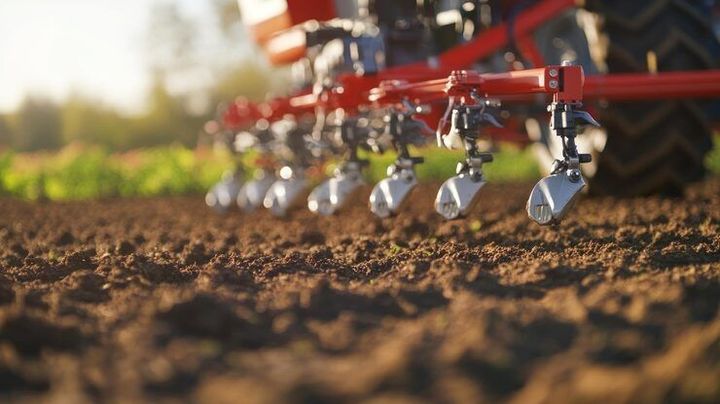
Furrow openers create the space in which seeds are deposited. Tine, shoe, disc, inverted-T, and other opener configurations can be used depending on the machine and soil conditions.
Depth-Control Systems
Gauge wheels, press wheels, linkages, and adjustable opener assemblies can influence planting depth. Maintaining consistent depth is especially important when uniform emergence is a major objective.
Seed-Cum-Fertilizer Systems
Combined systems contain separate seed and fertilizer metering arrangements. Proper separation and placement are important so that fertilizer does not interfere with seed establishment.
Calibration
Before field operation, seed drills can be calibrated to establish an appropriate seed delivery rate. Calibration generally considers seed type, desired application rate, row spacing, machine settings, and ground-wheel movement.
Digital and Sensor-Based Systems
Advanced seed drills can incorporate seed-flow sensors, electronic controllers, GNSS systems, digital displays, and machine-monitoring functions.
These technologies can support more detailed observation of planting operations and can identify issues such as interrupted seed flow or irregular row operation.
Maintenance Resources
Routine maintenance can include checking seed-metering components, cleaning seed tubes, inspecting furrow openers, checking chains and bearings, examining drive wheels, verifying calibration, and inspecting fertilizer passages where applicable.
Proper adjustment and maintenance help maintain consistent machine operation during the sowing season.
FAQs
What is a Seed Drill?
A Seed Drill is an agricultural machine that places seeds into soil at controlled depth and spacing. It typically uses a seed hopper, metering mechanism, seed tube, furrow opener, and covering arrangement.
How does a Seed Drill work?
Seeds are stored in a hopper and released through a metering mechanism. The seeds travel through tubes into furrows opened by the machine, after which the soil is moved back over the seed.
What is a Seed-Cum-Fertilizer Drill?
A Seed-Cum-Fertilizer Drill combines seed placement and fertilizer placement in a single field operation. Separate metering systems generally control seed and fertilizer delivery.
What is a Zero-Till Seed Drill?
A Zero-Till Seed Drill is designed to place seeds directly into soil with limited or no conventional seedbed preparation. Such equipment can be used for direct sowing systems and crop-residue conditions.
Which Indian Standards apply to Seed Drills?
IS 6813 covers the specification of seed-cum-fertilizer drills, while IS 6316:1993 provides a test code for evaluating seed-cum-fertilizer drill performance and constructional soundness. BIS currently lists IS 6813 as reviewed in 2026.
Conclusion
Seed Drills provide a mechanized method for placing seeds at controlled depth, spacing, and application rates. Modern systems increasingly incorporate precision metering, zero-till technology, multi-crop adaptability, pneumatic mechanisms, sensors, and digital monitoring. In India, standards such as IS 6813 and IS 6316 provide important references for seed-cum-fertilizer drill specifications and testing. ICAR's ongoing work also demonstrates continued development of crop-specific, multi-crop, direct-sowing, and locally adapted seeding technologies.