Robotics & Automation: Explore Modern Technologies and Future Innovations
Robotics & Automation refers to technologies that allow machines, software, and physical systems to perform tasks with limited or controlled human involvement. Robotics focuses on machines that can sense their surroundings, process information, and carry out physical actions, while automation focuses on making processes operate according to defined instructions.
The roots of modern robotics can be traced to mechanical devices, automated machinery, programmable controllers, and early industrial robots. As computing, sensors, artificial intelligence, and communication technologies developed, robots became capable of handling more varied environments and tasks.
Today, Robotics & Automation appears in manufacturing plants, warehouses, agriculture, healthcare, transportation, laboratories, homes, and public infrastructure. Systems may range from a robotic arm that performs repeated movements to autonomous machines that navigate spaces using cameras, sensors, and software.
How Robotics and Automation Work Together
Robotics and automation are related but are not identical. A robot is generally a physical machine capable of movement or interaction, whereas automation can also involve software, electronic controls, sensors, and data systems without a physical robot.
A modern automated system may combine several elements:
- Sensors collect information about position, temperature, pressure, distance, or surrounding objects.
- Controllers process information and determine the required action.
- Motors and actuators create physical movement.
- Software provides instructions and coordinates different components.
- Communication systems allow machines and computers to exchange information.
This combination allows automated equipment to repeat defined processes with consistent operating instructions.
Importance
Robotics & Automation matters because many activities involve repetitive, hazardous, highly precise, or physically demanding tasks. Machines can be designed to handle particular processes while people supervise systems, interpret information, manage exceptions, and make decisions that require broader judgment.
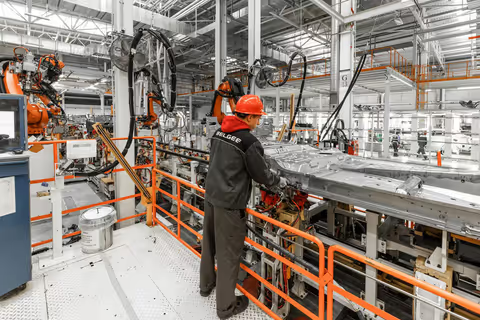
In manufacturing, robotic systems can assist with assembly, welding, inspection, packaging, and material movement. In warehouses, automated equipment can help move goods between locations and organize physical inventory. Agriculture can use automated systems for monitoring crops, controlled equipment movement, and selected field activities.
Healthcare is another area where robotics can support specific tasks. Robotic equipment may assist with laboratory procedures, rehabilitation activities, physical movement, or the controlled handling of materials. Such systems remain dependent on appropriate human oversight, operational procedures, and safety controls.
Everyday Problems Addressed by Automation
Automation can address several practical challenges:
- Repetition: Machines can repeat defined movements without becoming physically tired.
- Precision: Sensors and controllers can help maintain specific positions or measurements.
- Hazardous environments: Specialized robots can work in areas that may be difficult for people to access safely.
- Monitoring: Automated systems can continuously collect information from equipment or surroundings.
- Process coordination: Connected systems can exchange information between machines and software.
The effects are not limited to factories. People may encounter automation through automated checkout systems, navigation technologies, robotic cleaning equipment, smart appliances, logistics systems, and automated information processing.
Common Robotics and Automation Categories
| Technology | Main Function | Common Setting |
|---|---|---|
| Industrial robots | Repeated physical operations | Manufacturing |
| Collaborative robots | Work near people under defined conditions | Assembly and inspection |
| Mobile robots | Move through indoor or outdoor areas | Warehouses and facilities |
| Autonomous systems | Sense surroundings and make programmed decisions | Transport and research |
| Robotic vision | Identify objects or conditions | Inspection |
| Process automation | Automate digital or machine-based workflows | Offices and industry |
The value of a particular system depends on its design, environment, safety controls, data quality, and intended purpose rather than on automation alone.
Recent Updates
Robotics & Automation has been moving toward greater integration with artificial intelligence, computer vision, advanced sensors, digital models, and connected systems. Instead of operating as isolated machines, many newer systems are designed to exchange information with other equipment and software.
A significant development is the growing interest in physical AI, where AI-based systems interact with the physical environment through robots or autonomous machines. India’s government has also been discussing robotics as part of a broader technology ecosystem, with attention to collaborative robots, physical AI, healthcare applications, and autonomous platforms.
India's National Mission on Interdisciplinary Cyber-Physical Systems also includes robotics and autonomous systems among its technology areas. The mission has established Technology Innovation Hubs focused on technology development, human resource development, entrepreneurship development, and related activities.
Another current trend is the combination of robotics with advanced manufacturing. Robots can increasingly communicate with sensors, industrial controllers, computer vision systems, and production software. This creates integrated environments in which machines can respond to changing conditions rather than simply repeating one fixed sequence.
Emerging Directions
Several areas are receiving continued attention:
- Collaborative robotics, where machines are designed to operate around people under defined safety conditions.
- Mobile robotics, involving machines that navigate warehouses, facilities, agricultural areas, or research environments.
- AI-enabled vision, allowing systems to interpret images and identify objects or conditions.
- Digital twins, which create digital representations of physical equipment or processes for analysis and testing.
- Physical AI, connecting intelligent software with machines that interact with real-world environments.
- Human-machine collaboration, where technology supports human activities rather than being treated solely as a replacement for them.
India's Research, Development and Innovation scheme also identifies robotics and other deep technologies among its areas of strategic research interest.
Laws or Policies
In India, robotics does not operate under one single law covering every type of robot. Different requirements can apply depending on the machine, industry, workplace, electrical equipment, data environment, and intended use.
The Bureau of Indian Standards (BIS) maintains standards relating to industrial automation and robotics. These include standards concerning industrial robot safety, robot performance, interfaces, and integrated manufacturing systems. BIS documentation also shows continuing work on standards for industrial automation systems and robotics.
Safety is an important consideration when robots are integrated into workplaces. A BIS draft aligned with ISO 11161:2025 addresses safety requirements for integrating machinery into a system, including risk assessment, design measures, task zones, and risk reduction.
BIS has also worked on Indian standards covering industrial robot applications and robot cells. These standards address hazards associated with integrating robots with end-effectors and other machinery.
Government technology programs also influence the development of robotics in India. The National Mission on Interdisciplinary Cyber-Physical Systems supports research and development across areas such as robotics, AI, IoT, cybersecurity, and autonomous systems.
For organizations using robotic equipment, applicable workplace safety rules, electrical requirements, machinery standards, sector-specific regulations, and data-related requirements may all need consideration. The exact requirements depend on the application and operating environment.
Tools and Resources
People learning about Robotics & Automation can use a range of educational and technical resources. The appropriate resource depends on whether the goal is basic understanding, programming, simulation, design, research, or workplace implementation.
Learning and Simulation Resources
Robot simulation software can help learners understand movement, sensors, robotic arms, navigation, and control logic without immediately working with physical equipment. Programming environments can also be used to test algorithms and control systems in simulated environments.
Technical documentation from organizations such as BIS, the Ministry of Electronics and Information Technology, and the Department of Science and Technology can provide information about Indian standards, technology programs, and policy developments. BIS maintains searchable information about Indian Standards and related technical documentation.
Practical Areas to Explore
Useful learning activities include:
- Robot programming fundamentals for understanding movement and control.
- Sensor exercises for learning how machines detect their surroundings.
- Computer vision projects for exploring image-based recognition.
- Automation simulations for understanding process sequences.
- Robotics safety documentation for learning about risk assessment.
- Digital twin concepts for understanding links between physical equipment and software models.
These resources can help general readers understand how robotic systems operate without requiring advanced engineering knowledge at the beginning.
FAQs
What is Robotics & Automation?
Robotics & Automation combines physical machines, sensors, controllers, software, and automated processes to perform defined activities with limited or supervised human involvement. Robotics generally focuses on physical machines, while automation can also involve software and industrial control systems.
How is Robotics & Automation changing modern industries?
Robotics & Automation is changing industries by supporting repetitive operations, inspection, material movement, monitoring, and process coordination. Increasing integration with AI and computer vision is allowing some systems to respond to more varied physical conditions.
What technologies are used in Robotics & Automation?
Common technologies include sensors, motors, controllers, machine vision, artificial intelligence, programmable logic controllers, communication networks, simulation software, and data-processing systems. Different combinations are used depending on the task.
Is Robotics & Automation used outside manufacturing?
Yes. Robotics & Automation is used in areas such as agriculture, healthcare, logistics, research, infrastructure, transportation, and household equipment. The level of autonomy varies according to the system and its intended environment.
What is the future of Robotics & Automation?
Future development is expected to involve closer integration of robotics with AI, computer vision, connected devices, simulation, and autonomous systems. Current Indian policy discussions also emphasize physical AI, collaborative robotics, healthcare applications, and domestic technology development.
Conclusion
Robotics & Automation combines machines, software, sensors, and control systems to perform physical and digital tasks in structured ways. Its applications now extend beyond manufacturing into healthcare, agriculture, logistics, research, and everyday technology. Current developments are increasingly connecting robotics with artificial intelligence, computer vision, autonomous systems, and cyber-physical technologies. In India, standards, research programs, and policy initiatives continue to shape how these technologies are developed and used.