Pneumatic Conveying Systems: Explore Types, Components, and Applications
Pneumatic Conveying Systems are material-handling arrangements that use moving air or another gas to transport powders, granules, pellets, and other small bulk solids through enclosed pipelines. Instead of moving material on a belt or through an open mechanical conveyor, the material travels inside a pipe as part of an air-material stream.
These systems are widely used because pipelines can pass horizontally, vertically, and around obstacles. A single arrangement can connect storage vessels, processing equipment, weighing systems, packaging areas, and collection points.
Pneumatic conveying is commonly found in industries such as food processing, pharmaceuticals, chemicals, plastics, cement, minerals, agriculture, and other bulk-material operations. The appropriate system depends heavily on the material's particle size, density, moisture, temperature, flow characteristics, and sensitivity to breakage.
How Pneumatic Conveying Works
A basic system starts with a material source such as a hopper, silo, bag unloading station, or process machine. A controlled stream of air then carries the material through a conveying pipeline.
At the destination, a separator or receiver separates the solid material from the conveying air. The material is discharged into the next process, while the air passes through filtration or another separation arrangement.
A simplified sequence is:
Material feeding: A controlled quantity of powder or granules enters the conveying line.
Air movement: A blower, fan, or vacuum arrangement creates the required pressure difference.
Material transport: Air carries the particles through the pipeline.
Air-material separation: A filter receiver, cyclone, or similar device separates the solids from the air.
Material discharge: The conveyed material enters a storage vessel or processing machine.
Air filtration: Remaining particles are removed before air is released or recirculated.
The exact arrangement depends on the material and required conveying distance.
Pressure and Vacuum Systems
Pneumatic Conveying Systems can generally be arranged around positive pressure, negative pressure, or a combination of both.
Positive-pressure conveying pushes air and material from the feeding point toward the destination. It can be useful when material needs to move from one source toward several downstream destinations.
Vacuum conveying pulls material toward a receiving point by creating lower pressure downstream. This arrangement can help contain dusty materials and can collect material from several sources.
Combination systems use both pressure and vacuum sections when the process requires different conveying stages.
Industrial references commonly describe positive-pressure, negative-pressure, and combined arrangements along with dilute- and dense-phase conveying.
Importance
Efficient Bulk Material Movement
Pneumatic conveying can move bulk solids through enclosed pipelines without requiring a continuous mechanical belt along the entire route. This can be useful in factories where equipment is separated by walls, floors, tanks, or other machinery.
The enclosed route can also help reduce direct exposure of the material to the surrounding environment.
Flexible Pipeline Routing
Pipes can be routed around existing equipment and through different elevations. This flexibility is useful when a production layout contains multiple processing stages.
Pipeline design still requires careful consideration of bends, pipe diameter, material velocity, pressure, and particle behavior. ISO 2327 specifies dimensions for piping used in pneumatic handling of loose bulk materials, while ISO 3284 covers dimensions of bends used in pneumatic handling. Both standards were confirmed as current in 2025.
Handling Different Materials
Pneumatic systems can transport many types of dry bulk solids, including:
Plastic pellets
Flour and starch
Sugar
Grain products
Pharmaceutical powders
Chemical powders
Cement
Minerals
Food ingredients
Fine granules
However, not every material behaves in the same way. Some powders can compact, absorb moisture, degrade under high velocity, or create combustible dust conditions.
Enclosed Material Transfer
Because the material travels through pipes, pneumatic conveying can reduce open handling points. This can be particularly important when controlling dust or protecting sensitive materials from surrounding contamination.
The design must still prevent leakage at connections, filters, valves, feeders, and other components.
Main System Types
| System Type | Main Principle | Typical Material Behavior |
|---|---|---|
| Dilute phase | Material moves at relatively high air velocity | Powders and light granules |
| Dense phase | Material moves at lower velocity with higher solids concentration | Dense or fragile materials |
| Positive pressure | Air pushes material through pipeline | Source-to-destination transfer |
| Vacuum | Air pulls material toward receiver | Multiple pickup points |
| Pressure-vacuum | Combines both methods | Complex plant layouts |
Recent Updates
Greater Use of Automation
Modern conveying installations increasingly use sensors, automated valves, programmable controls, and monitoring systems to regulate material movement.
A control system can monitor parameters such as pressure, air flow, temperature, filter condition, valve position, and equipment status. These measurements can help operators identify abnormal operating conditions.
Energy Monitoring
Air movement requires energy, particularly when blowers or compressors operate continuously. Current system design therefore places attention on airflow control, pressure requirements, leakage reduction, pipeline configuration, and appropriate equipment sizing.
Energy efficiency depends on the complete system rather than one component. Excessive air velocity, unnecessary pressure, poor filtration, or unsuitable pipe dimensions can affect energy use.
Improved Material Protection
Some materials can fracture or degrade when transported at excessive velocity. Dense-phase systems and controlled conveying conditions can reduce the amount of high-speed particle movement in selected applications.
Material testing is important because the behavior of one powder or granule cannot automatically be applied to another.
Digital Monitoring
Sensors and industrial control systems are increasingly being connected to data platforms. This allows operating information to be collected over time and compared with normal system conditions.
Pressure trends, filter pressure differences, blower behavior, and material flow can provide useful information for maintenance planning and process monitoring.
Current International Standards
ISO's classification for continuous handling equipment includes a specific category for pneumatic transport and its components. ISO 2327:1972, covering pneumatic-handling piping, was reviewed and confirmed in 2025, while ISO 3284:1974 covering pneumatic-handling bends was also confirmed in 2025.
These standards are part of the broader international framework for bulk-material handling equipment.
Safety Focus for Combustible Dust
Safety remains an important area because some powders can form combustible dust clouds when dispersed in air. OSHA identifies pneumatic conveying as an area where fire or explosion hazards can involve electrostatic discharge, frictional heating, sparks, and dust-cloud formation.
This has encouraged continued attention to grounding, bonding, dust containment, equipment selection, explosion protection, and operating controls.
Laws or Policies
International Requirements
There is no single worldwide law governing every pneumatic conveying installation. Requirements depend on the country, industry, material, workplace, and hazard classification.
Manufacturers and plant operators may need to consider machinery safety, pressure equipment, electrical requirements, workplace safety, environmental rules, and explosion protection according to the location.
European ATEX Framework
In the European Union, Directive 2014/34/EU establishes requirements for equipment and protective systems intended for potentially explosive atmospheres. The framework covers equipment that may be used where explosive gas, vapor, mist, or dust atmospheres can occur.
This can be relevant to pneumatic conveying when combustible powders create a potential dust-explosion environment.
The EU workplace framework under Directive 1999/92/EC also addresses risk reduction, equipment selection, worker protection, training, and explosion-protection documentation for workplaces where explosive atmospheres may occur.
United States Workplace Safety
In the United States, OSHA provides guidance concerning combustible dust hazards. Finely divided combustible materials can become explosible when dispersed in air at suitable concentrations and exposed to an ignition source.
For pneumatic conveying applications, safety planning can therefore include dust characterization, grounding and bonding, suitable electrical equipment, containment, explosion protection, housekeeping, and equipment inspection.
International ISO Standards
ISO standards provide technical references for different aspects of bulk-material handling and pneumatic transport. ISO 2327 addresses pneumatic-handling piping, while ISO 3284 addresses bends used in pneumatic handling. ISO also maintains a technical classification specifically covering pneumatic transport and its components.
Applicable national laws and industry-specific requirements may impose additional conditions.
Tools and Resources
Blowers and Vacuum Pumps
Blowers provide the airflow needed for positive-pressure conveying. Vacuum pumps or similar equipment can create the pressure difference required for vacuum conveying.
Selection depends on required airflow, pressure, material characteristics, conveying distance, and system configuration.
Rotary Airlocks
A rotary airlock can feed material into a pressurized conveying line while limiting the uncontrolled escape of conveying air.
It can also be used at discharge points in selected system designs.
Filter Receivers
Filter receivers separate conveyed solids from the transport air. Filters retain particles while allowing cleaned air to pass through.
Pressure measurements across the filter can help indicate whether cleaning or inspection is needed.
Cyclone Separators
Cyclones use rotational airflow to separate particles from a gas stream. They may be used when appropriate for the particle size and process conditions.
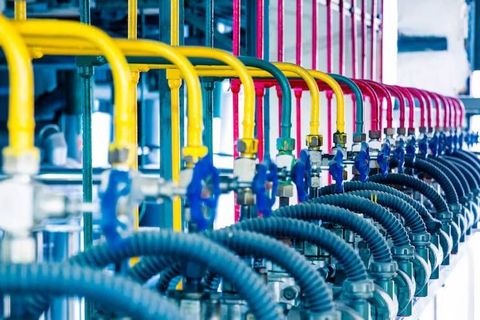
Conveying Pipelines
Pipelines form the main transport path. Their diameter, length, bends, material, surface characteristics, and layout all influence system behavior.
Pipeline bends deserve particular attention because changes in direction can increase particle impact and pressure loss.
Diverter and Isolation Valves
Valves can direct material toward different destinations or isolate sections of a conveying system.
Automated valves can be integrated with control systems for coordinated material movement.
System Design Software
Engineering software and calculation tools can help evaluate pressure drop, airflow, pipe dimensions, material loading, and equipment requirements.
Material testing is often important because theoretical calculations may not fully capture the behavior of unusual powders or mixtures.
FAQs
What are Pneumatic Conveying Systems?
Pneumatic Conveying Systems transport powders, granules, pellets, and other bulk solids through enclosed pipelines using moving air or another gas.
What are the main types of Pneumatic Conveying Systems?
The main categories include dilute-phase and dense-phase systems, along with positive-pressure, vacuum, and combined pressure-vacuum arrangements.
What components are used in Pneumatic Conveying Systems?
Common components include blowers, vacuum pumps, feeders, rotary airlocks, pipelines, bends, valves, filter receivers, cyclones, sensors, and control systems.
Where are Pneumatic Conveying Systems used?
They are used across food processing, pharmaceuticals, plastics, chemicals, cement, agriculture, minerals, and other industries that handle powders, granules, or pellets.
Are pneumatic conveying systems suitable for combustible powders?
They can be used for suitable materials when the system is specifically designed around the material's fire and explosion characteristics. Risk assessment, grounding, dust control, appropriate equipment, and applicable explosion-protection requirements are important considerations. OSHA and EU ATEX frameworks provide relevant safety references for different jurisdictions.
Conclusion
Pneumatic Conveying Systems use controlled air or gas movement to transport bulk solids through enclosed pipelines. Dilute-phase, dense-phase, pressure, vacuum, and combined configurations can be selected according to material characteristics and plant requirements. Modern systems increasingly incorporate sensors, automation, energy monitoring, and digital controls. International standards and regional safety frameworks also remain important, particularly when systems handle combustible powders or operate in potentially explosive environments.