Pallet Wrapping Machines: Guide to Packaging Processes and Machine Features
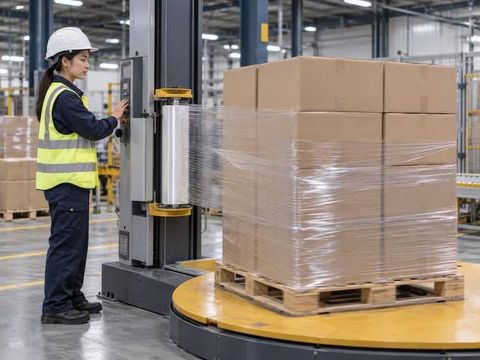
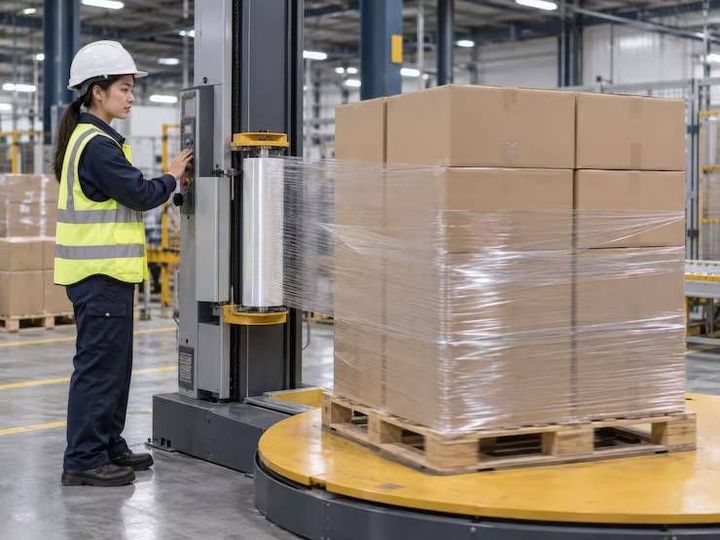
Pallet Wrapping Machines are automated or semi-automated packaging machines used to secure palletized products with stretch film. The film is wrapped around cartons, boxes, bags, containers, or other products arranged on a pallet to create a stable load for storage and transportation.
A typical machine rotates the pallet or moves a film carriage around the load. As the film is applied, controlled tension stretches the material and holds the products together.
Pallet wrapping is commonly used in warehouses, manufacturing plants, distribution centers, food and beverage facilities, pharmaceutical production, chemical handling, and logistics operations.
How the Wrapping Process Works
The wrapping process usually follows a sequence of coordinated steps.
Pallet positioning: A loaded pallet is placed on the machine's turntable or designated wrapping area.
Film attachment: Stretch film is attached to the pallet or initial layer of the load.
Film dispensing: A powered carriage releases film at a controlled rate.
Load rotation: The pallet or wrapping arm moves around the load.
Film stretching: The film may be mechanically stretched before application.
Layer formation: Several layers are applied around the load according to programmed settings.
Top wrapping: Some machines apply additional film around the upper section.
Film cutting: An automatic cutting mechanism separates the film when wrapping is complete.
Load removal: The wrapped pallet is moved to storage, a conveyor, or another handling stage.
The exact sequence varies according to machine design and packaging requirements.
Main Types of Pallet Wrapping Machines
Turntable wrappers rotate the pallet while the film carriage moves vertically. They are commonly associated with smaller or moderate-volume operations.
Rotary-arm wrappers keep the pallet stationary while an arm carrying the film rotates around the load. This configuration can be useful for unstable or heavy pallets.
Ring wrappers use a rotating ring or hoop to distribute film around the pallet. They are commonly integrated into automated packaging lines.
Orbital or specialized wrapping systems are designed for particular load shapes or products that may require alternative wrapping movements.
Robotic wrapping systems use a mobile or articulated platform to travel around pallets. They can be useful where pallets are positioned in different locations.
Importance
Stabilizing Pallet Loads
One of the main purposes of pallet wrapping is to keep products together during movement. Properly applied stretch film can help reduce shifting between individual cartons or packages.
Load stability depends on several factors, including pallet arrangement, product shape, film characteristics, wrapping pattern, film tension, and the number of layers.
Supporting Transportation
Pallets can experience vibration, acceleration, braking, turning, loading, unloading, and repeated handling during distribution.
A correctly configured wrapping process can help maintain the arrangement of products during these movements. However, wrapping film is only one part of overall load stability. Pallet quality, product arrangement, corner protection, strapping, and handling practices may also influence results.
Improving Packaging Consistency
Manual wrapping can produce variations in film tension, overlap, number of layers, and wrapping height.
An automated machine can apply programmed settings repeatedly. This allows operators to establish a defined wrapping pattern for particular pallet types.
Reducing Material Variation
Modern machines can control film pre-stretch, carriage speed, wrapping speed, overlap, and film tension.
These controls can help packaging teams apply an appropriate quantity of film for a particular load rather than relying entirely on manual judgment.
Common Machine Features
| Machine Feature | Main Function | Packaging Role |
|---|---|---|
| Turntable | Rotates pallet | Circular film application |
| Film carriage | Holds and moves film | Film distribution |
| Pre-stretch unit | Stretches film mechanically | Controlled film use |
| Tension control | Regulates film pull | Load containment |
| Photoelectric sensor | Detects load height | Automatic positioning |
| Control panel | Stores operating settings | Process control |
| Film cutter | Separates film | Wrapping completion |
| Conveyor interface | Moves pallets | Automated line integration |
Recent Updates
Automation and Connected Packaging Lines
Packaging machinery is increasingly being integrated into connected production and warehouse systems. Industry analysis from PMMI has identified automation, digitization, sustainability considerations, and reduced dependence on manual intervention as important packaging machinery themes.
For pallet wrapping, this can mean connecting the wrapper with conveyors, palletizers, label systems, scanners, weighing equipment, and warehouse-control systems.
A connected line can coordinate pallet movement and wrapping sequences so that the machine becomes part of a larger packaging workflow.
Intelligent Film Control
Modern wrapping machines can use programmable controls to regulate film tension, pre-stretch ratios, carriage speed, wrapping patterns, and the number of rotations.
Some systems use sensors and feedback mechanisms to detect load dimensions and automatically adjust selected parameters.
The objective is to create a repeatable wrapping pattern suited to the particular pallet rather than applying identical settings to every load.
Greater Integration With Automation
Pallet wrappers can be combined with robotic palletizers, conveyors, automated guided vehicles, and warehouse systems.
In a highly automated environment, a pallet can move from product handling to pallet formation, wrapping, labeling, inspection, and storage with limited manual intervention.
The level of automation varies widely between facilities and depends on production volume, layout, product characteristics, and integration requirements.
Sustainability and Material Efficiency
Packaging operations are increasingly examining material use, recyclable packaging materials, and equipment settings that can reduce unnecessary film consumption.
Machine-based film stretching can help control how much film is applied to a load. However, reducing film quantity must not compromise the required load stability.
Packaging machinery standards are also increasingly considering energy consumption and environmental aspects alongside machine safety and operational performance. ISO/TC 313 identifies process automation, digitization, environmental impact, and operational efficiency among current packaging-machinery themes.
Improved Machine Monitoring
Digital controls can record operating information such as wrapping cycles, film usage, machine status, alarms, and selected performance indicators.
This information can help operators identify interruptions, monitor production patterns, and plan inspections.
More advanced systems may connect machine information to plant-level monitoring platforms.
Laws or Policies
International Packaging Machinery Safety
Packaging machinery is covered by international standardization work through ISO/TC 313, which addresses machines used for packaging goods and includes safety, machine classification, energy consumption, efficiency, and availability considerations.
Safety requirements can vary according to the country, machine configuration, workplace, and application.
Pallet Wrapping Machine Safety
Standards specifically addressing pallet wrapping machinery have been developed internationally. BIS publications, for example, reference BS EN 415-6:2013, which covers safety of pallet wrapping machines.
The newer international packaging-machinery work is also developing broader safety requirements covering packaging functions and different machine categories, including pallet wrapping machines. ISO/DIS 24158-1 is currently under development and includes pallet wrapping within its scope.
Because standards and regulations can differ between jurisdictions, manufacturers and users need to identify the requirements applicable to their installation.
Machinery Risk Assessment
A pallet wrapper contains moving components such as rotating platforms, film carriages, cutting mechanisms, conveyors, and powered drives.
Risk assessment can consider hazards created during installation, operation, adjustment, cleaning, maintenance, and foreseeable misuse. Guarding, emergency stops, interlocks, controlled access, warning systems, and other protective measures may be incorporated according to the machine design and risk assessment.
Electrical and Workplace Requirements
Pallet wrapping machines may be subject to electrical safety, machinery safety, workplace health and safety, noise, guarding, and installation requirements.
The relevant framework depends on the country. European installations may involve applicable EU machinery legislation and harmonized standards, while other regions may use national regulations or standards based on ISO or other international frameworks.
Packaging Requirements
The wrapping machine itself is only one part of a packaging system. Businesses may also need to consider requirements relating to packaging materials, labeling, food-contact materials, pharmaceuticals, hazardous products, transport, and waste management.
These requirements differ significantly between industries and jurisdictions.
Tools and Resources
Machine Control Panels
Modern control panels allow operators to configure wrapping height, number of rotations, film tension, pre-stretch, carriage speed, and other operating parameters.
Touchscreen interfaces can display machine status and alarms and may store different wrapping programs.
Film Pre-Stretch Systems
Pre-stretch units mechanically extend stretch film before it reaches the load. The system can regulate the relationship between film movement and carriage movement.
Different products and film grades may require different settings, so machine configuration should follow the equipment and material specifications.
Photoelectric Sensors
Sensors can detect the height and position of a pallet. This allows the machine to adjust the film carriage movement according to the load.
Some systems can also use sensors to identify pallet presence or detect selected operating conditions.
Conveyor Systems
Conveyors can automatically move pallets toward and away from the wrapper. They are particularly useful when the wrapping machine forms part of an automated packaging line.
Barcode and Identification Systems
Barcode scanners and identification systems can associate pallet information with a particular wrapping program. For example, different load types may require different film patterns or wrapping parameters.
Machine Monitoring Software
Monitoring platforms can collect information about cycles, alarms, operating time, film usage, and machine conditions.
Such information can help production teams understand machine performance and identify recurring interruptions.
Film Testing and Load Stability Checks
Packaging teams can assess wrapped pallets by examining film tension, containment, load movement, edge protection, wrapping coverage, and stability during handling.
Testing should reflect the actual transport and storage environment rather than relying only on visual appearance.
FAQs
What are Pallet Wrapping Machines?
Pallet Wrapping Machines are packaging machines that apply stretch film around palletized loads to help hold products together during storage, handling, and transportation.
How do Pallet Wrapping Machines work?
Pallet Wrapping Machines rotate a pallet or move a film carriage around the load while controlled stretch film is applied. The machine can adjust wrapping height, tension, speed, and the number of film layers.
What are the main types of pallet wrapping machines?
Common types include turntable wrappers, rotary-arm wrappers, ring wrappers, robotic wrappers, and specialized systems. The appropriate configuration depends on pallet characteristics, production requirements, and facility layout.
What features are important in a pallet wrapping machine?
Important features can include film tension control, pre-stretch adjustment, programmable wrapping patterns, load-height detection, automatic film cutting, safety controls, and integration with conveyors or other packaging equipment.
Are pallet wrapping machines used worldwide?
Yes. Pallet wrapping technology is used across manufacturing, warehousing, logistics, food and beverage, chemical, pharmaceutical, retail distribution, and other industries in many regions.
Conclusion
Pallet Wrapping Machines automate the application of stretch film around palletized loads and can support load stability, packaging consistency, and integration with modern material-handling systems. Current developments include connected controls, automated line integration, intelligent film management, digital monitoring, and greater attention to material efficiency. International packaging machinery standards continue to address machine safety and risk reduction, while specific regulatory requirements vary by country and industry. Understanding machine types, operating principles, film controls, safety features, and packaging requirements provides a useful foundation for evaluating pallet wrapping processes worldwide.