Digital Printing Machines: Guide to Printing Processes
Digital printing machines are computer-controlled systems that transfer digital artwork directly onto paper, film, fabric, boards, labels, packaging materials, and other suitable surfaces. Unlike conventional printing methods that may require plates, screens, or engraved cylinders, digital printing can work directly from a digital file.
The technology is used for documents, commercial graphics, labels, packaging, textiles, signage, photographs, and customized printed products. Depending on the application, machines can use inkjet or electrophotographic processes.
Digital printing is particularly useful when designs change frequently, multiple versions are required, or shorter production runs are appropriate. Modern systems combine printheads, ink or toner systems, media handling, software, colour management, and automated controls.
How Digital Printing Machines Work
A typical digital printing workflow can be divided into several stages:
- Digital artwork preparation – Text, images, graphics, or patterns are prepared using design software.
- File processing – A digital front end or RIP converts the artwork into instructions for the printing system.
- Colour management – Colour profiles and calibration help translate digital colours into printable output.
- Media preparation – Paper, fabric, film, board, or another substrate is positioned in the machine.
- Printing – Ink droplets or toner are placed according to the processed image data.
- Drying or fixing – Depending on the technology, heat, air, UV energy, or another fixing method may be used.
- Finishing – Printed material can be cut, folded, laminated, coated, trimmed, or otherwise processed.
The exact sequence depends on the printing technology and substrate.
Main Types of Digital Printing Machines
| Machine Type | Printing Method | Common Applications |
|---|---|---|
| Inkjet Printer | Deposits liquid ink through printheads | Graphics, documents, labels, textiles |
| Laser Printer | Uses toner and electrostatic imaging | Documents and commercial printing |
| UV Printer | Uses UV-curable inks | Boards, signage, plastics, specialty substrates |
| Digital Textile Printer | Prints directly onto textile material | Fashion, home textiles, décor |
| Direct-to-Garment Printer | Applies ink directly to garments | Apparel graphics and customized clothing |
| Dye-Sublimation Printer | Transfers dye through controlled heating | Polyester textiles and graphics |
| Label Digital Printer | Prints digitally onto label stock | Product labels and packaging |
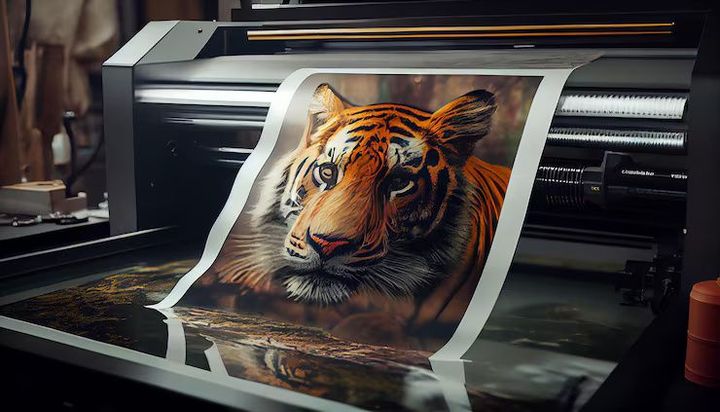
| Wide-Format Printer | Handles larger media widths | Signage, posters, displays, graphics |
Main Components
Digital printing machines generally include:
- Printheads or imaging units
- Ink or toner delivery system
- Media feeding mechanism
- Media transport system
- Control panel
- Digital front-end software
- RIP or image-processing software
- Colour-management system
- Drying or curing unit
- Sensors
- Waste or ink-management components
- Output collection system
The interaction between hardware and software is important because the final output depends not only on the mechanical printing process but also on image processing, colour profiles, substrate characteristics, and ink or toner behaviour.
Importance
Digital printing has changed how many printed materials are prepared and produced. Its ability to work directly from digital files makes it suitable for applications where design flexibility and variable content are important.
Flexible Printing Processes
Digital systems can switch between different files without physically changing printing plates or screens. This makes the technology suitable for multiple designs, personalized graphics, prototypes, and short production runs.
For example, a packaging workflow can use the same machine to produce several artwork versions, while a textile workflow can process different patterns without preparing a separate screen for every design.
Variable Data Printing
One important capability is variable data printing. Text, numbers, barcodes, QR codes, images, and other elements can be changed from one printed item to another.
This is useful for:
- Product identification
- Sequential numbering
- Personalized documents
- Barcodes
- QR codes
- Event materials
- Variable packaging graphics
- Promotional communication
Reduced Prepress Complexity
Because artwork can be transferred digitally to the machine, some traditional prepress stages can be simplified. A digital workflow can connect design software, colour management, file processing, and the printer through an integrated workflow.
This does not eliminate the need for preparation. File checking, colour calibration, substrate selection, resolution, and print testing remain important.
Applications Across Industries
Digital printing machines are used in many sectors.
Textiles: Fabric, garments, home décor, fashion patterns, and sampling.
Packaging: Labels, cartons, flexible materials, prototypes, and variable graphics.
Commercial printing: Brochures, books, photographs, manuals, and marketing materials.
Signage: Posters, banners, display graphics, boards, and indoor or outdoor visual materials.
Industrial printing: Graphics and identification marks on selected industrial substrates.
Recent Updates
Digital printing technology continues to develop through improvements in print speed, printhead technology, automation, colour management, substrate compatibility, and digital workflow integration.
Development of Digital Printing Machinery Standards
BIS identifies digital printing machinery as an area within its printing machinery standardization work. Its standardization planning also lists work related to commissioning, operation, and testing of colour printing machines.
For digital commercial printing, India has adopted IS/ISO/TS 15311-2:2018, covering print-quality requirements for commercial applications using digital printing technologies. The corresponding international specification provides guidance on print-quality metrics, measurement methods, and reporting.
Growth of Digital Textile Printing
Digital textile printing is an important area of development. Recent industry research identifies direct-to-fabric and direct-to-garment processes as significant segments, with increasing interest in shorter runs, customization, automation, and different ink technologies.
Recent textile-industry discussions also highlight pigment, reactive, and disperse ink systems, together with improvements in high-speed digital textile equipment.
High-Speed and Automated Systems
Newer textile printing systems are increasingly integrating fabric feeding, printing, drying, and collection into more automated workflows. In 2025, a hybrid single-pass digital textile printer introduced in India demonstrated this direction by combining printing and downstream handling within one production flow.
Automation can help monitor media movement, ink delivery, printhead operation, temperature, and other process parameters.
Improved Colour Management
Colour consistency remains an important technical area. Modern digital workflows increasingly use calibration, colour profiles, spectrophotometers, and software-based colour management.
The purpose is to maintain closer agreement between the digital artwork, proof, and final printed output. ISO/TS 15311-2 provides a framework for evaluating printed output using defined quality metrics and measurement approaches.
Digital Printing and Packaging
Digital printing is also relevant to packaging because packaging artwork may require different versions, variable information, or shorter production cycles. When printing is intended for food packaging, however, additional regulatory considerations apply to the packaging material and printing inks.
FSSAI's Packaging Regulations include requirements concerning printing inks used on food packages.
Laws or Policies
Digital printing machines are influenced by machinery safety, printing quality, environmental requirements, and application-specific regulations in India.
BIS Standards
BIS provides standards covering printing and graphic technology. Its current standards database includes IS/ISO 12643 (Part 4):2023, which addresses safety requirements for graphic-technology equipment and systems in the converting area.
The applicability of a particular standard depends on the machine design and application. Users should identify the relevant Indian Standard rather than assuming that one standard covers every digital printer.
BIS's Know Your Standard portal allows standards to be searched by IS number or product keyword and provides related information such as amendments, testing arrangements, laboratories, and committee details.
Machinery Safety
Digital printing machines can contain moving rollers, belts, printhead assemblies, electrical equipment, heating systems, UV curing units, and automated material-handling components.
Guarding, emergency controls, electrical protection, access arrangements, interlocking, ventilation, and safe operating procedures should therefore be considered during installation and operation.
The Ministry of Heavy Industries was also examining sector-specific questions around digital printing machines in relation to India's machinery and electrical equipment safety framework during 2025.
Food Packaging Applications
When digital printing is used for food packaging, the printing process cannot be considered separately from food-contact packaging requirements. FSSAI maintains a dedicated Packaging Regulation framework, and its current regulations page includes the Food Safety and Standards (Packaging) Regulations, 2018 and subsequent amendments.
Therefore, packaging manufacturers should verify the applicable requirements for the substrate, ink, migration characteristics, and intended food-contact application.
Tools and Resources
Several tools support digital printing preparation, operation, and quality evaluation.
RIP Software
Raster Image Processor software converts digital artwork into instructions that a printing machine can use. It can manage image placement, colour conversion, screening, nesting, and other workflow functions.
Colour Management Tools
Colour-management systems help maintain consistency between design files, monitors, proofing systems, and printed output. Spectrophotometers and colour-calibration equipment can be used for measurement and profiling.
Printhead Monitoring
Printhead inspection and nozzle checks can identify blocked or misfiring nozzles. Regular monitoring is important for maintaining consistent image quality.
Substrate Testing
Different substrates absorb, reflect, stretch, or react to ink differently. Testing the selected paper, film, fabric, board, or other material helps determine appropriate print settings.
Digital File Preparation
Common preparation activities include:
- Checking image resolution
- Confirming document dimensions
- Verifying colour profiles
- Checking fonts and transparency
- Inspecting bleed and trim areas
- Reviewing variable-data fields
- Creating print-ready files
BIS Resources
BIS provides online access to Indian Standards and related technical information. Its Know Your Standard platform can be used to locate standards by keyword or IS number.
FSSAI Resources
For food-packaging applications, FSSAI's regulations and notifications provide current information on packaging requirements and amendments. Its regulations portal states that the current compendium incorporates amendments for reference, while original notifications remain authoritative where differences arise.
FAQs
What are digital printing machines?
Digital printing machines are computer-controlled printers that transfer digital artwork directly onto a selected substrate using inkjet, toner-based, or other digital imaging technologies.
How does a digital printing machine work?
A digital file is processed through printing software, converted into image instructions, and transferred to the printing system. Ink or toner is then applied to the substrate, followed by drying, curing, or fixing when required.
What are the main types of digital printing machines?
Common types include inkjet printers, laser printers, UV printers, digital textile printers, direct-to-garment printers, dye-sublimation printers, label printers, and wide-format printers.
What is digital textile printing?
Digital textile printing uses computer-controlled printing technology to place designs directly onto fabric. Different ink systems are selected according to the textile material and required finishing process.
What standards are relevant to digital printing machines in India?
Relevant standards depend on the machine and application. Indian and international graphic-technology standards cover areas such as digital print quality and machinery safety, while BIS continues to develop and maintain standards for printing machinery.
Conclusion
Digital printing machines provide a flexible connection between digital artwork and physical printed output. Inkjet, toner, UV, textile, label, and wide-format technologies allow the same broad concept to be applied across many industries and substrates. Current developments are moving toward faster printing, improved colour control, automation, digital textile workflows, and more integrated production systems. Indian standardization activity and application-specific regulations also remain important considerations when evaluating digital printing processes.