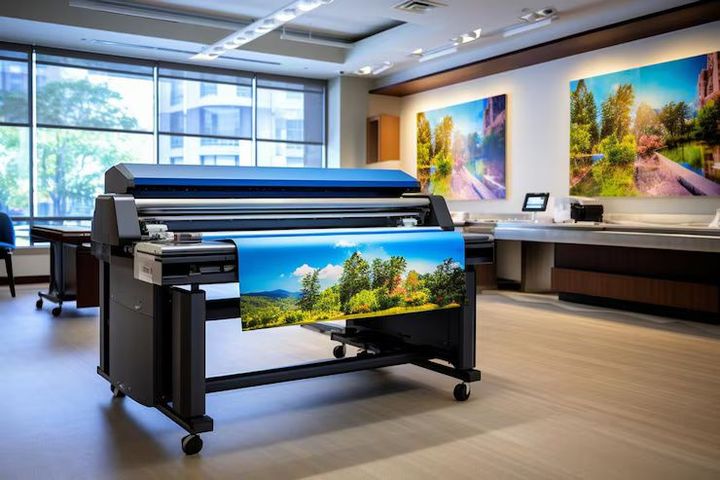
UV Printing Machines: Insights Into Modern UV Technology
UV printing machines are digital printing systems that use ultraviolet light to cure specially formulated inks immediately after they are deposited onto a printing surface. Unlike conventional printing processes that may require extended drying, UV printing uses controlled UV energy to rapidly harden the printed ink layer.
The technology can be applied to materials such as paper, boards, plastics, films, glass, metal, wood, acrylic, and selected textiles. The exact material compatibility depends on the ink system, printhead configuration, surface properties, and machine design.
A typical UV printer combines digital artwork processing, printheads, ink delivery, substrate handling, UV curing units, sensors, and software controls. Some machines are designed for flat materials, while others are configured for rolls, cylindrical objects, or larger-format applications.
How UV Printing Machines Work
The basic UV printing process involves several stages:
- Artwork preparation – Digital artwork is prepared using suitable design software.
- File processing – RIP or digital front-end software converts the artwork into printing instructions.
- Substrate positioning – The selected material is placed on the printing bed or feeding system.
- Ink deposition – Printheads deposit controlled quantities of UV-curable ink onto the surface.
- UV curing – UV lamps or LED curing units expose the freshly deposited ink to ultraviolet energy.
- Layer formation – The ink rapidly cures and forms the printed image.
- Inspection – The output can be checked for colour, registration, surface appearance, and other quality characteristics.
The curing process may occur almost immediately after ink deposition, allowing printed material to move through subsequent handling or finishing stages.
Main Types of UV Printing Machines
| Machine Type | Basic Configuration | Common Applications |
|---|---|---|
| UV Flatbed Printer | Rigid material is placed on a flat bed | Boards, acrylic, glass, wood, plastics |
| UV Roll-to-Roll Printer | Flexible material moves continuously from a roll | Films, banners, flexible media |
| UV Hybrid Printer | Supports both rigid and flexible substrates | Mixed-format printing |
| UV LED Printer | Uses LED-based UV curing | Graphics and industrial printing |
| UV DTF Printer | Produces UV-printed transfer films | Decorative applications and selected objects |
| UV Cylindrical Printer | Designed for curved or cylindrical surfaces | Bottles, tubes, containers |
| UV Wide-Format Printer | Handles large-format media | Signage and display graphics |
Main Components
A UV printing machine generally contains:
- Printheads
- UV-curable ink reservoirs
- Ink circulation or delivery system
- UV LED or lamp curing unit
- Printing bed or media transport mechanism
- Vacuum table on suitable flatbed systems
- Sensors
- Control panel
- RIP or workflow software
- Colour-management system
- Waste-ink management components
- Ventilation or extraction arrangements where applicable
The interaction between these components affects print consistency, curing performance, substrate handling, and overall process control.
Importance
UV printing technology is important because it combines digital image processing with rapid ink curing. This allows printed graphics to be produced on a broad range of materials that may be difficult to handle with conventional aqueous or solvent-based processes.
Printing on Different Substrates
One of the notable characteristics of UV printing is its ability to print on many rigid and flexible materials.
Potential substrates include:
- Acrylic
- PVC and selected plastics
- Glass
- Aluminium and other metals
- Wood
- Ceramic surfaces
- Paper and board
- Films
- Selected textile materials
- Composite panels
However, not every UV ink is suitable for every substrate. Surface energy, cleanliness, flexibility, adhesion, curing conditions, and intended use must be considered.
Rapid Ink Curing
UV curing changes liquid ink into a solid printed layer through exposure to ultraviolet radiation. Because curing occurs rapidly, printed material can often be handled soon after the image is produced.
This characteristic is useful in workflows where printed material moves directly into cutting, assembly, coating, packaging, or other finishing operations.
High-Detail Digital Graphics
UV printing machines can produce detailed graphics using digitally controlled ink placement. Depending on the printer configuration, different ink channels may be used to create colour combinations and special effects.
White ink is particularly useful when printing on transparent or dark substrates because it can create a light base layer beneath colour graphics.
Decorative and Industrial Applications
UV printing extends beyond conventional paper graphics.
Applications can include:
- Signage
- Display panels
- Interior graphics
- Product decoration
- Packaging prototypes
- Labels
- Promotional graphics
- Architectural samples
- Industrial identification
- Decorative panels
- Customized objects
For industrial applications, the required durability, adhesion, chemical resistance, abrasion resistance, and environmental exposure should be evaluated for the particular substrate and ink combination.
Recent Updates
Recent UV printing developments have focused on LED curing, automation, printhead control, colour management, substrate flexibility, and integrated digital workflows.
UV LED Curing
UV LED systems have become an important technology within modern UV printing. Compared with traditional UV lamp arrangements, LED-based systems can provide electronically controlled curing with different thermal characteristics.
The curing wavelength, irradiance, exposure time, and ink formulation must be matched correctly. These parameters influence whether the ink achieves the intended curing condition.
Automation and Digital Controls
Modern printing equipment increasingly incorporates automated functions for:
- Printhead alignment
- Media detection
- Ink monitoring
- Height adjustment
- UV intensity control
- Nozzle checking
- Colour calibration
- Job management
- Data logging
Automation can reduce the amount of manual adjustment required between print jobs while providing greater visibility into operating conditions.
Expanded Substrate Handling
UV printing continues to develop around rigid and irregular substrates. Flatbed and hybrid systems can accommodate boards and other rigid materials, while cylindrical systems can be designed around curved objects.
Some workflows also use robotic or automated positioning systems for repeatable object placement.
Improved Colour Management
Colour management is becoming increasingly important as UV printing is applied to different substrates. A colour that appears consistent on paper may behave differently on glass, plastic, metal, or wood.
Modern workflows therefore use colour profiles, calibration tools, spectrophotometers, test charts, and software-based colour management to improve repeatability.
Safety Standard Development
BIS continues to maintain and develop graphic-technology machinery safety standards. IS/ISO 12643 (Part 4):2023 covers safety requirements for graphic-technology converting equipment and systems, while BIS's printing machinery committee has also worked on revisions to the ISO 12643 safety series.
The wider graphic-technology safety framework is relevant when considering guards, interlocks, access points, controls, and other machine-safety features.
Digital Printing Workflow Integration
UV printers are increasingly connected with digital prepress systems, RIP software, colour-management tools, workflow servers, inspection systems, and automated finishing equipment.
This creates a more connected production workflow:
Artwork → RIP → Colour Management → Printing → UV Curing → Inspection → Finishing
Such integration allows print jobs and process information to move between different stages with fewer manual file-handling steps.
Laws or Policies
UV printing machines are influenced by machinery safety requirements, printing standards, workplace practices, environmental considerations, and application-specific regulations.
BIS Printing Machinery Standards
BIS's printing machinery work covers graphic-technology equipment and related safety requirements. The IS/ISO 12643 series provides an important reference for machinery safety in the graphic-technology sector.
The exact standard applicable to a particular UV printer depends on its design and intended application. Users should verify the current standard through the BIS standards system rather than assuming that one document applies to every printer.
BIS's Know Your Standard portal allows searches by Indian Standard number or keyword and provides access to information such as amendments, testing arrangements, laboratories, and committee details.
Machinery Safety
UV printing machines can contain moving carriages, rollers, vacuum systems, electrical equipment, high-intensity UV sources, heating components, and automated material-handling systems.
Safety considerations may therefore include:
- Machine guarding
- Interlocking systems
- Emergency controls
- Electrical protection
- Safe access arrangements
- UV radiation shielding
- Ventilation
- Ink handling procedures
- Maintenance isolation procedures
BIS's current machinery-safety framework also references standards addressing risk assessment, guarding, and interlocking devices.
Printing Inks for Food Packaging
Special attention is required when UV printing is used in food-packaging applications. FSSAI's Packaging Regulations state that printing inks used on food packages must conform to IS 15495, and the printed surface must not come into direct contact with food.
Therefore, a UV ink should not be considered suitable for food-packaging use merely because it cures under UV light. The ink, substrate, migration characteristics, printing arrangement, and intended application all need to meet the applicable requirements.
FSSAI maintains the current Food Safety and Standards regulations and notes that original notifications and amendments prevail where there is any difference from a consolidated reference document.
Tools and Resources
Several tools support UV printing preparation, operation, inspection, and maintenance.
RIP Software
RIP software converts digital artwork into printer instructions. It can control image placement, colour conversion, screening, nesting, white-ink layers, and other workflow parameters.
Colour Measurement Equipment
Spectrophotometers and colour-measurement instruments can compare printed output against defined colour targets. They are useful when consistency across different substrates or print batches is important.
UV Radiometer
A UV radiometer can be used to evaluate UV exposure characteristics in suitable testing and maintenance situations. Monitoring helps identify changes in curing-system performance.
Printhead Inspection Tools
Nozzle-check patterns and printhead inspection systems help identify missing or irregular ink channels. Regular inspection can help detect printing problems before they become more extensive.
Substrate Testing
A substrate test should consider:
- Ink adhesion
- Surface cleanliness
- Colour appearance
- Scratch resistance
- Flexibility
- Curing condition
- Chemical resistance where relevant
Testing is particularly important when printing on unfamiliar materials.
Maintenance Tools
Routine maintenance may involve:
- Printhead cleaning systems
- Wiper inspection
- Ink-line inspection
- Filter replacement
- UV curing-system checks
- Vacuum-system inspection
- Media-path cleaning
The exact maintenance procedure should follow the machine's technical documentation.
BIS Resources
BIS's Know Your Standard platform provides a searchable route to Indian Standards and related information. Users can search by product keyword or IS number and review available documents and technical details.
FSSAI Resources
For food-packaging applications, FSSAI's regulations portal provides current packaging requirements and amendments. The portal currently lists the Food Safety and Standards (Packaging) Regulations, 2018 along with subsequent amendments and related documents.
FAQs
What are UV printing machines?
UV printing machines are digital printers that use UV-curable inks and ultraviolet energy to produce and rapidly cure printed images on suitable substrates.
How does a UV printing machine work?
The printer deposits UV-curable ink onto a substrate, after which a UV lamp or LED curing system exposes the ink to ultraviolet energy. The ink cures and forms the printed layer.
What materials can UV printers print on?
Depending on the machine and ink system, UV printers can work with materials such as acrylic, plastics, glass, metal, wood, paper, board, films, and selected textiles.
What is UV LED printing?
UV LED printing uses light-emitting diodes as the ultraviolet curing source. The system coordinates ink deposition with controlled UV exposure to cure the printed image.
Are UV printing machines suitable for food packaging?
UV printing for food packaging requires careful evaluation of the ink, substrate, printing arrangement, and applicable food-safety requirements. FSSAI's Packaging Regulations require printing inks used on food packages to conform to IS 15495 and state that the printed surface must not directly contact food.
Conclusion
UV printing machines combine digital image processing with rapid ultraviolet curing to print graphics on a wide range of suitable substrates. Modern systems are developing through UV LED curing, automated controls, improved colour management, substrate handling, and integrated digital workflows. Safety standards for graphic-technology equipment and food-packaging requirements are important considerations for specific applications. As UV printing technology continues to develop, its role is expanding across signage, decoration, packaging, textiles, and selected industrial printing processes.