Rock Drills for Mining Operations: Discover Drilling Methods and Important Facts
Rock Drills for Mining Operations are machines or powered drilling tools used to create holes in rock during exploration, excavation, mine development, and production activities. Depending on the application, a drill may create holes for geological sampling, rock fragmentation, ground support, drainage, or other mining processes.
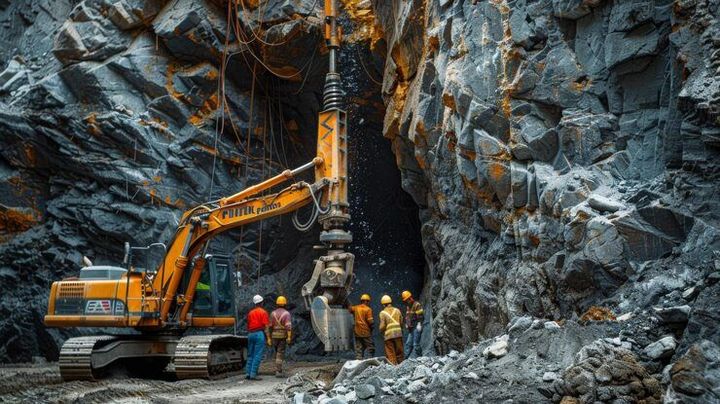
Rock drilling involves applying mechanical energy to a drill bit so that it penetrates hard geological material. The energy can be delivered through percussion, rotation, or a combination of both. The choice depends on rock hardness, hole diameter, required depth, drilling direction, and the type of mining activity.
A rock-drilling system normally includes a drill machine, drill rods or tubes, a bit, an energy source, controls, and a method for removing rock cuttings from the hole.
How Rock Drilling Works
A simplified drilling sequence involves several stages.
Positioning: The drilling machine is placed and aligned at the required location.
Bit contact: The drill bit is pressed against the rock surface.
Rock penetration: Percussive impacts, rotation, or combined forces break and penetrate the rock.
Cutting removal: Air, water, drilling fluid, or mechanical arrangements can help remove broken material from the hole.
Rod extension: Additional drill rods can be connected when deeper holes are required.
Hole completion: The hole is inspected, cleaned, sampled, used for fragmentation, or prepared for another mining activity.
The drilling method has a major influence on penetration behavior, hole accuracy, energy consumption, equipment selection, and the quality of recovered geological information.
Main Components
A typical rock drill may contain several important components.
Drill head: Produces the mechanical action required for drilling.
Drill rods: Transfer force and rotation between the machine and the drill bit.
Drill bit: Directly contacts the rock and performs the cutting or breaking action.
Feed mechanism: Moves the drill assembly toward the rock at a controlled rate.
Compressor or hydraulic system: Provides the energy needed by pneumatic or hydraulic equipment.
Flushing system: Removes cuttings from the borehole and can help control heat and dust.
Control system: Allows the operator or automated system to manage drilling parameters.
Importance
Supporting Mine Development
Rock drilling is fundamental to many mining activities. Underground development headings, tunnels, raises, production areas, and surface excavation zones may require drilling before subsequent operations can take place.
In some applications, drilling creates a pattern of holes that is later used for controlled rock fragmentation. The hole diameter, depth, spacing, and orientation depend on the geological and operational requirements.
Exploration and Geological Investigation
Drilling can also provide information about what exists below the surface. Exploration drilling may recover rock samples or generate measurements that help geologists understand geological formations.
ISO 22475-1:2021 provides technical principles for sampling soil, rock, and groundwater as part of geotechnical investigation and testing programs.
Ground Support and Infrastructure
Drilled holes can have purposes beyond fragmentation. In underground mining, drilling may support the installation of rock bolts and other ground-support systems.
Drilling can also be used for drainage, ventilation-related applications, monitoring, and selected geological investigations.
Matching the Drill to the Rock
Rock properties vary substantially. Hard crystalline rock, fractured formations, softer sedimentary material, and highly variable geological zones can behave differently during drilling.
Important selection factors include:
Rock hardness and abrasiveness
Required hole diameter
Drilling depth
Hole direction
Required penetration rate
Ground conditions
Available power source
Water or air availability
Mobility requirements
Dust and noise controls
Common Rock-Drilling Methods
| Drilling Method | Main Action | Typical Application |
|---|---|---|
| Percussion | Repeated impact | Hard-rock drilling |
| Rotary | Continuous rotation | Selected rock formations |
| Rotary-percussive | Rotation plus impact | Hard and mixed formations |
| Down-the-hole | Impact mechanism near bit | Deep production holes |
| Top-hammer | Impact delivered through drill string | Development and surface drilling |
| Core drilling | Cuts cylindrical rock sample | Exploration and investigation |
Recent Updates
Automation and Remote Drilling
Mining operations are increasingly incorporating automated drilling systems. Sensors, positioning technologies, machine controls, and digital communications can allow drilling equipment to follow predefined patterns with reduced manual intervention.
Automated drilling can monitor parameters such as hole position, drilling depth, feed pressure, rotation, and penetration behavior. Remote operation can also allow personnel to supervise equipment from a location separated from certain operating hazards.
The level of automation varies considerably between mining environments and equipment types.
Digital Drill Monitoring
Modern drilling systems can collect information while a hole is being drilled. Measurements can include penetration rate, pressure, rotation, energy use, vibration, and other machine parameters.
This information can help operators and engineers understand changes in geological conditions. Abnormal drilling behavior may also indicate changes in rock characteristics or equipment condition.
Machine Guidance and Positioning
Accurate positioning is increasingly important when drilling patterns need to follow planned locations and angles.
Satellite positioning, onboard sensors, digital mine plans, laser-based measurement, and machine-guidance systems can help position drilling equipment. Underground environments may require different positioning technologies because satellite signals may not be available.
Dust-Control Technology
Rock drilling can generate airborne dust, particularly when drilling dry material. Modern drilling systems can incorporate water injection, wet drilling, enclosed cabins, dust collectors, local extraction, or combinations of these approaches.
For example, U.S. OSHA rules for underground construction require appropriate dust-control measures when drilling rock or concrete, including wet drilling and vacuum collection approaches.
Electrification and Alternative Power Systems
Mining equipment is also experiencing increased interest in electric and battery-based systems. For drilling equipment, electrification can involve changes to power distribution, energy storage, motors, controls, and charging infrastructure.
The appropriate power arrangement depends on the mining environment. Underground operations may have additional requirements concerning ventilation, electrical protection, heat, and equipment configuration.
Data-Driven Drilling
Drilling data can increasingly be combined with geological models and mine-planning systems. This can create a more detailed relationship between machine behavior and geological conditions.
Machine learning may be used in selected applications to identify patterns in drilling data, classify geological characteristics, or monitor equipment behavior. Such systems require suitable data and validation before their outputs are used in operational decisions.
Laws or Policies
International Safety Frameworks
Rock drilling is subject to different safety requirements depending on the country, mine type, equipment configuration, and workplace environment. International standards can provide technical references, while national laws and regulators establish enforceable requirements.
ISO 11148-5:2011 covers safety requirements for rotary percussive drills, including rock drills and rotary hammers used for making holes in hard materials such as rock and concrete. The standard addresses hazards associated with these hand-held non-electric power tools.
United States Requirements
In the United States, mining operations can fall under requirements administered by the Mine Safety and Health Administration. Dust generated during rock drilling is specifically addressed in federal mining legislation, which requires appropriate methods for controlling drilling dust.
OSHA also has requirements concerning underground construction. Its regulations address ventilation, air contaminants, and dust controls during rock or concrete drilling.
European Union Machinery Framework
The European Union's Machinery Regulation 2023/1230 establishes a framework for machinery safety and will generally apply from 20 January 2027. Some provisions have earlier application dates.
Mining equipment placed on the European market may therefore need to be assessed against the applicable machinery framework and other relevant requirements.
Indian Mining Framework
India has a dedicated mining-safety framework administered by the Directorate General of Mines Safety. DGMS currently publishes mining legislation and regulations covering coal, metalliferous, and oil mines, together with related electricity and explosives requirements.
DGMS also maintains technical circulars addressing drilling and boring equipment. Its published material includes requirements and guidance concerning dust-control or dust-prevention equipment fitted to drilling equipment used in coal mines.
Because mining regulations differ by jurisdiction, operators need to consult the rules applicable to their particular mine and equipment.
Tools and Resources
Drill Monitoring Systems
Digital monitoring systems can record drilling parameters such as penetration rate, feed pressure, rotation, depth, and equipment status. The information can help engineers examine drilling performance and geological changes.
Geological Logging Tools
Geological logging systems allow drilling information and recovered samples to be documented. Digital records can connect sample information with depth, location, geological characteristics, and exploration models.
Drill-Planning Software
Mine-planning software can define hole locations, depths, angles, drilling patterns, and other parameters. Digital plans can then be transferred to compatible machine-guidance systems.
Dust Monitoring Equipment
Air-quality monitors can measure selected airborne particles and environmental conditions around drilling activities. Dust-control arrangements may include water systems, extraction equipment, filtration, and enclosed operator cabins.
Rock-Drill Accessories
Common drilling components include:
Drill bits: Contact and break the rock.
Drill rods: Transfer drilling forces to the bit.
Couplings: Connect sections of drill rods.
Shanks: Transfer energy between the drill mechanism and drilling assembly.
Flushing equipment: Helps remove cuttings.
Feed systems: Move the drilling assembly along the required path.
Water systems: Can assist with cooling and dust suppression.
International Standards and Regulatory Resources
ISO publications can provide technical references for drilling equipment and sampling methods. National mining regulators provide legally applicable requirements, safety notices, technical guidance, and inspection information.
For global operations, teams commonly need to consider the requirements of the country where the equipment is manufactured, supplied, installed, and operated.
FAQs
What are Rock Drills for Mining Operations?
Rock Drills for Mining Operations are powered drilling machines or tools used to create holes in rock for exploration, mine development, production, ground support, drainage, and other mining activities.
What are the main rock drilling methods?
The main methods include percussion, rotary, rotary-percussive, top-hammer, down-the-hole, and core drilling. The appropriate method depends on rock conditions, hole requirements, drilling depth, and the intended application.
What is a rotary-percussive rock drill?
A rotary-percussive rock drill combines rotation with repeated impact. The rotation helps position the bit and advance the hole, while impact energy breaks hard rock.
Why is dust control important during rock drilling?
Rock drilling can generate airborne dust, including respirable particles in certain geological materials. Water suppression, dust collection, ventilation, and appropriate protective measures can help control exposure.
Are Rock Drills for Mining Operations automated?
Some modern Rock Drills for Mining Operations incorporate automated positioning, machine guidance, sensors, digital monitoring, and remote-control functions. The degree of automation depends on the equipment and mining environment.
Conclusion
Rock Drills for Mining Operations are important tools for exploration, mine development, production drilling, ground support, and geological investigation. Percussion, rotary, rotary-percussive, top-hammer, down-the-hole, and core-drilling methods address different rock and drilling requirements. Modern systems increasingly combine sensors, digital positioning, automation, dust-control technology, and data analysis. International standards and national mining regulations also play an important role in equipment design, workplace protection, and responsible drilling practices.