Quantum Cryptography Hardware: Guide to Components and Practical Insights
Quantum cryptography hardware refers to the physical equipment used to create, transmit, detect, and process quantum information for secure communication. Unlike conventional cryptographic systems that mainly rely on mathematical algorithms, quantum cryptography uses properties of quantum physics to support secure key exchange.
A major application is Quantum Key Distribution (QKD). QKD allows two communicating parties to establish a shared secret key while providing mechanisms for detecting certain types of interception or measurement.
Quantum cryptography hardware can include single-photon sources, photon detectors, optical components, lasers, modulators, timing electronics, control systems, and specialized processors.
How Quantum Cryptography Hardware Works
A typical QKD setup has three major stages:
Quantum signal generation: A transmitter prepares quantum states using photons.
Quantum transmission: Optical fiber or free-space links carry the quantum signals.
Quantum detection: A receiver measures incoming photons and converts the measurements into electronic data.
After the quantum transmission stage, conventional communication channels are generally used for authentication, error processing, and key reconciliation.
The hardware therefore combines quantum optical components with conventional electronics and networking equipment.
Importance
Secure Key Distribution
The primary purpose of quantum cryptography hardware is to support secure distribution of cryptographic keys. In QKD systems, the quantum properties of transmitted signals can reveal certain forms of interference or measurement.
The resulting key can then be used with conventional encryption systems to protect data.
Photon Detection
Photon detection is one of the most important hardware functions. Many quantum communication systems operate with extremely weak optical signals, sometimes approaching the single-photon level.
Common detector technologies include:
Single-photon avalanche diodes (SPADs)
Superconducting nanowire single-photon detectors (SNSPDs)
Transition-edge sensors (TES)
Other specialized semiconductor and superconducting detectors
Each technology has different characteristics involving detection efficiency, timing precision, operating temperature, wavelength, and system complexity.
Optical Signal Control
Quantum communication requires precise control of optical signals. Components such as lasers, phase modulators, polarization controllers, beam splitters, optical filters, and attenuators help prepare and manage quantum states.
For example, a QKD transmitter may use a laser source followed by modulation and attenuation stages before sending photons into an optical fiber.
Timing and Synchronization
Quantum communication systems require accurate timing because transmitters and detectors must coordinate measurements.
High-speed electronics, clock sources, time-to-digital converters, synchronization circuits, and timing controllers can therefore form an important part of the hardware architecture.
Key Components
Single-Photon Sources
A quantum communication transmitter needs a controlled source of optical signals. Some systems use heavily attenuated laser pulses, while research platforms may use more specialized single-photon or quantum-light sources.
The source must provide stable and predictable optical characteristics.
Single-Photon Detectors
Detectors convert very weak optical signals into measurable electrical events.
| Detector Type | Typical Characteristics | Common Considerations |
|---|---|---|
| SPAD | Compact semiconductor detector | Efficiency, noise, timing |
| SNSPD | Very high timing performance | Cryogenic operation |
| TES | Precise photon measurement | Complex cooling requirements |
| InGaAs detector | Often used around telecom wavelengths | Noise and afterpulsing |
The appropriate detector depends on wavelength, transmission distance, required timing accuracy, environmental conditions, and system architecture.
Lasers and Optical Sources
Lasers can provide the optical pulses used in several QKD implementations. Their wavelength, pulse width, stability, and modulation characteristics affect system performance.
Telecommunications-oriented systems frequently use wavelengths compatible with optical-fiber infrastructure.
Optical Modulators
Modulators change characteristics of optical signals, such as phase, intensity, or polarization.
Common technologies include electro-optic modulators and integrated photonic modulators. Their function is to prepare different quantum states according to the selected QKD protocol.
Beam Splitters and Optical Filters
Beam splitters divide or combine optical paths, while filters can reduce unwanted wavelengths and background light.
These components help control the optical environment surrounding the quantum signal.
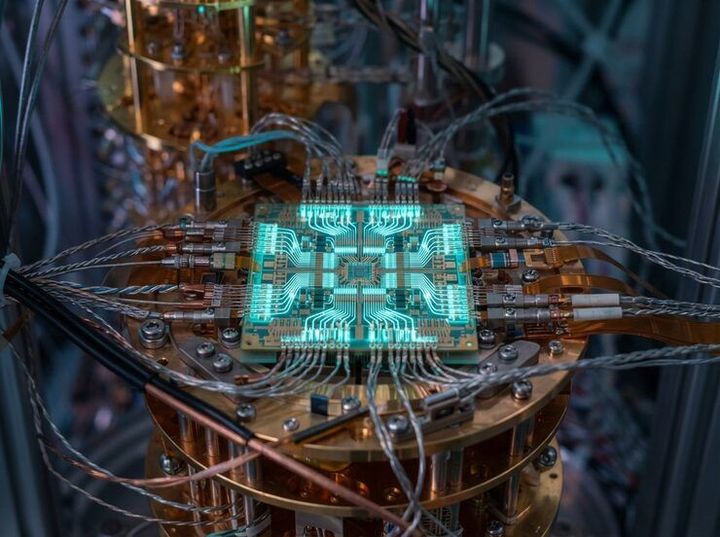
Cryogenic Systems
Some high-performance photon detectors, particularly superconducting detectors, require extremely low operating temperatures.
Cryogenic hardware may include:
Cryocoolers
Vacuum chambers
Thermal stages
Temperature sensors
Control electronics
Low-temperature cabling
This makes detector packaging and thermal management important parts of a complete quantum communication platform.
Control Electronics
Quantum cryptography hardware requires conventional electronics to operate lasers, modulators, detectors, clocks, and communication interfaces.
Field-programmable gate arrays (FPGAs), digital signal processors, microcontrollers, and specialized timing electronics can perform real-time control and data processing.
Recent Updates
Integrated Photonics
Quantum communication hardware is increasingly moving toward photonic integration. Instead of connecting many separate optical components, multiple functions can potentially be combined onto photonic integrated circuits.
This approach can reduce physical size and simplify optical alignment.
Improved Photon Detectors
Research and development continues to improve detector efficiency, timing precision, noise performance, and operating practicality.
SNSPD technology remains an important area for long-distance and high-performance quantum communication because of its strong detection characteristics, although its cryogenic requirements add hardware complexity.
Chip-Scale Quantum Communication
Researchers are developing smaller quantum photonic components that can integrate sources, modulators, interferometers, and detectors into more compact platforms.
Miniaturization is important for applications that require deployment outside laboratory environments.
Satellite and Free-Space QKD
Quantum communication research has expanded beyond terrestrial fiber networks. Free-space and satellite-based systems can potentially support quantum links over distances where conventional optical fiber becomes challenging.
Such systems require specialized optical tracking, pointing, stabilization, atmospheric monitoring, and photon-detection equipment.
Post-Quantum Security Integration
Quantum cryptography hardware is also being considered alongside post-quantum cryptography (PQC).
PQC uses classical algorithms designed to resist attacks from future quantum computers, while QKD uses quantum communication principles for key distribution. These approaches can potentially be deployed together as part of layered security architectures.
Laws or Policies
International Standards
Quantum cryptography hardware is developing within a broader cybersecurity and telecommunications standards environment.
Organizations such as the International Organization for Standardization (ISO), International Electrotechnical Commission (IEC), International Telecommunication Union (ITU), and European Telecommunications Standards Institute (ETSI) have published or developed work relevant to quantum technologies, cybersecurity, optical communication, and QKD.
Organizations and system developers should check the latest applicable standards because specifications continue to evolve.
Quantum Key Distribution Standards
QKD systems require consideration of both quantum-layer performance and conventional cybersecurity functions.
Important areas include:
Key management
Authentication
Random-number generation
Optical safety
Network interoperability
Device testing
Security evaluation
Physical protection
QKD does not automatically secure an entire network. Authentication and conventional cryptographic controls remain important parts of a complete architecture.
Regional Requirements
Rules can differ between countries and sectors, particularly for telecommunications equipment, encryption technology, critical infrastructure, and government networks.
Organizations deploying quantum communication equipment should therefore review national telecommunications, cybersecurity, export-control, data-protection, and infrastructure requirements relevant to their deployment.
Tools and Resources
Optical Testing Equipment
Laboratories working with quantum cryptography hardware may use:
Optical power meters
Optical spectrum analyzers
Oscilloscopes
Laser measurement equipment
Photon-counting modules
Optical time-domain measurement equipment
These instruments help engineers characterize optical signals and troubleshoot system performance.
Photon Detection Equipment
Dedicated photon-counting equipment is used to evaluate detector characteristics such as timing jitter, dark counts, detection efficiency, and response stability.
Cryogenic Measurement Systems
When superconducting detectors are used, cryogenic measurement equipment helps maintain and monitor the required low-temperature environment.
Control and Development Platforms
FPGAs and embedded computing platforms can be used to implement timing control, detector readout, protocol logic, and communication interfaces.
Simulation and Research Software
Quantum optics and photonics researchers can use simulation tools to model optical systems, quantum states, detector behavior, communication channels, and protocol performance.
When evaluating software or hardware platforms, researchers should consider compatibility with the intended QKD protocol, optical wavelength, detector technology, communication interface, and testing environment.
FAQs
What is quantum cryptography hardware?
Quantum cryptography hardware consists of physical components used to generate, manipulate, transmit, detect, and process quantum signals for secure communication. QKD is one of its major applications.
What components are used in quantum cryptography hardware?
Typical components include lasers, single-photon sources, photon detectors, optical modulators, beam splitters, filters, timing electronics, control processors, optical fibers, and network interfaces.
Why are single-photon detectors important?
Quantum communication can involve extremely weak optical signals. Single-photon detectors allow systems to identify individual or very small numbers of photons and convert those events into electronic information.
Does quantum cryptography require special cooling?
Not every quantum cryptography system requires cryogenic cooling. However, some superconducting photon detectors, such as SNSPDs, require very low temperatures and therefore need specialized cryogenic equipment.
Can quantum cryptography hardware work with existing networks?
Some QKD technologies are designed to operate over optical-fiber infrastructure, but deployment may require specialized optical components, dedicated channels, synchronization equipment, and network integration. Compatibility depends on the selected architecture.
Conclusion
Quantum cryptography hardware combines quantum optical components with conventional electronics, computing, and communication infrastructure. Photon sources, detectors, modulators, optical components, timing systems, and control electronics each contribute to the operation of a quantum communication platform.
Recent developments are focusing on integrated photonics, improved photon detectors, compact hardware, satellite communication, and stronger integration with conventional cybersecurity technologies.
As quantum communication develops, hardware design will continue to focus on reliability, synchronization, optical stability, detector performance, interoperability, and practical deployment requirements.