Food Delivery Robots: Discover How Autonomous Delivery Systems Work
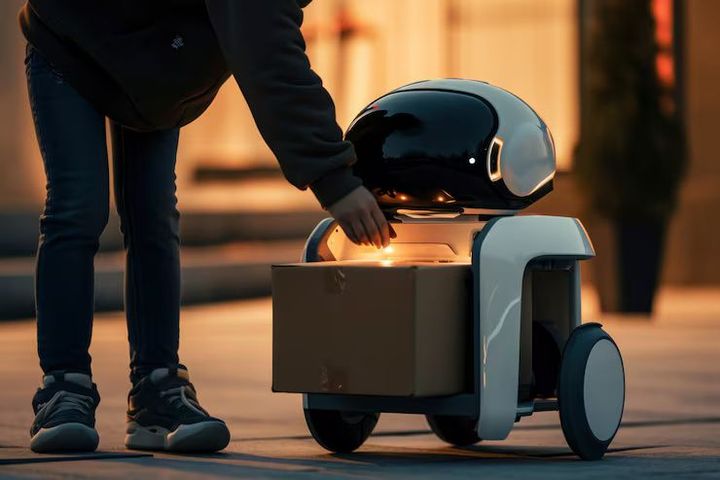
Food Delivery Robots are small autonomous machines designed to transport meals or other lightweight items from a restaurant, kitchen, store, or collection point to a designated destination. Most ground-based models operate on sidewalks, pedestrian paths, private campuses, residential areas, or controlled environments.
These robots combine wheels, batteries, cameras, sensors, computers, navigation software, communication systems, and a secure storage compartment. The system receives a delivery destination, plans a route, moves through its permitted operating area, detects obstacles, and reaches the destination.
Unlike a conventional delivery vehicle, a sidewalk robot is generally designed for short-distance movement at relatively low speeds. Its compact size allows it to navigate environments where a larger vehicle may not be practical.
How Food Delivery Robots Work
A typical autonomous delivery process involves several stages:
Order preparation: A restaurant prepares the food and places it inside the robot's compartment.
Assignment: The delivery platform sends the destination and other relevant information to the robot.
Route planning: Navigation software determines a suitable path.
Environment sensing: Cameras, radar, ultrasonic sensors, GPS, and other technologies help the robot understand its surroundings.
Autonomous movement: Motors and wheels move the robot along the selected route.
Obstacle handling: The robot slows down, stops, or changes direction when it detects people, objects, or other obstacles.
Arrival: The recipient receives an alert when the robot reaches the designated location.
Compartment access: A digital code, application, or other authentication method can unlock the compartment.
Return: After delivery, the robot may return to a restaurant, charging point, or local operating station.
The exact process varies according to the robot design and the environment in which it operates.
Main Types of Delivery Robots
Sidewalk delivery robots are compact wheeled machines designed for pedestrian environments. They generally carry small food orders and travel at walking or near-walking speeds.
Campus delivery robots operate within universities, technology parks, hospitals, residential developments, or other defined areas.
Indoor delivery robots move through buildings such as hotels, hospitals, restaurants, and large facilities. They may use elevators or designated routes where the building has been configured for robotic movement.
Autonomous ground vehicles are larger than typical sidewalk robots and can operate in selected road or private-site environments depending on local regulations and vehicle requirements.
Semi-autonomous robots can navigate independently but may have remote operators available to assist when unusual situations occur.
Importance
Supporting Short-Distance Delivery
Food Delivery Robots are particularly suited to short journeys within defined geographic areas. A restaurant located near an apartment complex, university campus, or office area could use a robot to move small orders without requiring a conventional delivery vehicle for every trip.
The practical usefulness depends on distance, terrain, pedestrian density, weather, local rules, and the availability of suitable operating routes.
Autonomous Navigation
One of the main technological features is autonomous navigation. The robot must determine where it is, identify obstacles, understand its permitted path, and continuously adjust its movement.
A robot may use several technologies together rather than relying on a single sensor.
Contactless Collection
A secured compartment separates the food from the outside environment during transportation. At the destination, the recipient can authenticate the order and access the compartment.
This approach can reduce direct handling during the final part of the delivery process.
Fleet Management
Multiple robots can be monitored through a central software platform. Operators can track locations, battery levels, delivery status, alerts, and operational conditions.
A fleet-management system can also help coordinate charging, dispatching, maintenance, and route assignments.
Important Components
| Component | Main Function | Example |
|---|---|---|
| Electric motor | Moves the robot | Wheel propulsion |
| Battery | Supplies electrical power | Lithium-ion battery |
| Camera | Captures visual information | Object detection |
| Ultrasonic sensor | Detects nearby objects | Obstacle detection |
| GPS/GNSS | Provides location information | Position tracking |
| Computer | Processes sensor information | Navigation decisions |
| Communication unit | Connects with remote systems | Cellular connection |
| Storage compartment | Holds the order | Insulated food box |
| Locking system | Controls access | Digital unlocking |
| Charging system | Replenishes battery | Charging station |
Recent Updates
Expansion of Robot Food Delivery
Autonomous food delivery continues to move from small demonstrations toward larger commercial pilots in selected cities and campuses.
In 2025, Uber announced a partnership with Starship Technologies to introduce autonomous robot deliveries in the United Kingdom, beginning in Leeds and Sheffield and with plans for expansion to additional markets.
In the United States, Grubhub and Avride began a robot-delivery pilot in Jersey City in 2025, following earlier deployments at university campuses. The pilot was designed to test autonomous robots in an urban environment and different operating conditions.
Growing Multi-Platform Integration
Robot manufacturers are increasingly connecting their systems with established food-ordering platforms rather than requiring customers to use an entirely separate ordering system.
In 2026, Serve Robotics announced an expanded partnership with Grubhub covering selected U.S. cities. The company also continued expanding its relationship with DoorDash into additional markets.
This type of integration allows the robot to become part of an existing digital ordering process.
Artificial Intelligence and Computer Vision
AI and computer vision are important parts of autonomous navigation. Cameras and other sensors generate information about pedestrians, vehicles, curbs, crossings, objects, and the surrounding environment.
The robot's onboard computer processes this information and determines an appropriate movement response. India's draft National Strategy on Robotics describes robots as systems that sense their environment, process information, and use control signals to operate motors and actuators.
Remote Assistance
Autonomous operation does not necessarily mean that humans are completely removed from the system. A remote operator may be available to assist when a robot encounters an unusual obstacle, unclear path, technical problem, or situation outside its normal operating conditions.
This creates a combination of autonomous navigation and human supervision.
Better Battery and Fleet Systems
Battery technology, charging management, and fleet software are important areas of continuing development. A delivery fleet needs sufficient battery capacity for its operating routes while also maintaining predictable charging cycles.
Fleet platforms can combine location, battery status, delivery assignments, and technical alerts into a centralized monitoring environment.
Laws or Policies
Robotics Policy in India
India does not currently have one nationwide law specifically dedicated to sidewalk food-delivery robots. Instead, different legal and technical areas can become relevant depending on where the robot operates and what capabilities it has.
MeitY's draft National Strategy on Robotics identifies robotics as an emerging technology area and discusses applications involving transportation, food handling, logistics, AI, sensors, and autonomous systems. The document is a strategy proposal rather than a standalone law.
Motor Vehicle Framework
If an autonomous delivery machine is classified or operated as a motor vehicle on public roads, applicable provisions of India's motor-vehicle framework may become relevant.
The Ministry of Road Transport and Highways maintains India's motor-vehicle legislation and related notifications. Its annual report has also discussed the need for regulatory frameworks that can allow new technologies, including driverless vehicles, to be tested in controlled environments.
The exact legal treatment of a small sidewalk robot can depend on its physical design, operating area, classification, and local requirements.
Local Permissions
Robots operating on sidewalks, public spaces, private campuses, or commercial premises may encounter different requirements. Municipal authorities, property owners, traffic authorities, and other relevant bodies may have jurisdiction depending on the deployment location.
Operators therefore need to examine the rules applicable to the specific operating area rather than assuming that one national rule covers every deployment.
Data Protection
Autonomous robots may use cameras and other sensors that capture information about their surroundings. If personal data is collected or processed, India's digital data-protection framework can become relevant.
MeitY lists the Digital Personal Data Protection Rules, 2025 and related implementation material within its current policy resources.
Organizations deploying camera-equipped robots need to consider how collected information is handled, stored, accessed, and protected.
Technical Standards
The Bureau of Indian Standards provides a searchable platform for Indian Standards and related documents. Users can search by standard number or keyword and access information concerning standards, amendments, testing laboratories, and related material.
For a particular robotic system, applicable standards depend on its design, operating environment, electrical systems, communication technology, and intended use.
Tools and Resources
Navigation Software
Navigation software combines information from sensors, maps, positioning systems, and programmed operating boundaries. It helps a robot determine where it is and select a suitable route.
Computer Vision
Computer-vision systems analyze camera images to identify objects and environmental features. They can help distinguish pedestrians, vehicles, curbs, signs, and other obstacles.
Mapping Systems
Digital maps define roads, sidewalks, crossings, buildings, restricted areas, and delivery zones. Some robots can also build or update environmental maps using sensor data.
Fleet Management Platforms
Fleet-management software allows operators to monitor multiple robots from a central interface. Typical information includes:
Current robot location
Battery condition
Delivery status
Communication status
Technical alerts
Assigned route
Charging activity
Remote Monitoring
Remote-monitoring systems allow human operators to observe robot activity and intervene when an unusual situation occurs.
This can be particularly important when robots operate in busy public environments where unexpected situations are difficult to model completely.
Charging Infrastructure
Robots require appropriate charging arrangements based on battery type, operating range, fleet size, and daily delivery volume.
Charging stations can be located near restaurants, distribution points, campuses, or dedicated robot depots.
Safety Testing
Testing can examine braking, obstacle detection, pedestrian interaction, navigation accuracy, communication failure, battery behavior, compartment security, and emergency stopping.
Testing should reflect the actual environment in which the robot will operate, including slopes, uneven surfaces, crossings, weather conditions, and pedestrian activity.
FAQs
What are Food Delivery Robots?
Food Delivery Robots are autonomous or semi-autonomous machines designed to transport prepared meals over short distances. They commonly use wheels, sensors, cameras, computers, navigation software, and secured compartments.
How do Food Delivery Robots work?
Food Delivery Robots receive delivery information, plan a route, use sensors to understand their surroundings, travel toward the destination, and stop or change direction when obstacles are detected. The recipient can then access the secured compartment.
Are Food Delivery Robots fully autonomous?
Some are designed for high levels of autonomous operation, while others use remote human assistance when unusual situations occur. The degree of autonomy varies by technology and operating environment.
Where are Food Delivery Robots used?
They can be used on selected sidewalks, university campuses, residential developments, business parks, private properties, restaurants, hotels, hospitals, and other controlled environments.
What technology do Food Delivery Robots use?
Common technologies include cameras, ultrasonic sensors, GPS or GNSS, computer vision, artificial intelligence, electric motors, batteries, wireless communication, digital maps, and fleet-management software.
Conclusion
Food Delivery Robots combine autonomous navigation, sensors, artificial intelligence, electric propulsion, communication systems, and secure storage compartments to transport meals over relatively short distances. Their development is progressing through pilots and deployments in selected cities, campuses, and controlled environments. Safety, navigation reliability, battery management, data handling, and local regulatory requirements remain important parts of deployment planning. In India, robotics policy, motor-vehicle rules where applicable, data-protection requirements, local permissions, and relevant technical standards can all influence how autonomous delivery systems are developed and operated.