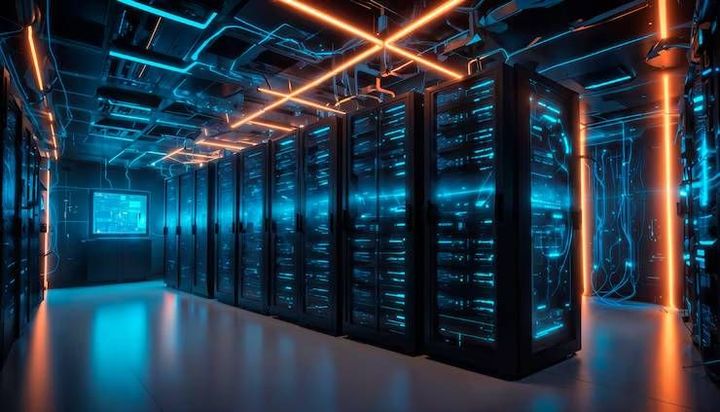
Data Center Virtualization: Explore Virtual Machines, Storage, Networks, and Management
Data center virtualization is a technology approach that allows physical computing resources such as servers, storage, and networking equipment to be represented as virtual resources.
Instead of dedicating one physical server to one application, virtualization can allow several virtual machines (VMs) to operate on a single physical host.
A software layer called a hypervisor manages the physical hardware and distributes computing resources among virtual machines. Each VM can have its own operating system, applications, storage allocation, and network configuration. NIST describes virtualization as an abstraction of computing hardware that enables multiple operating systems to run on a single physical computer.
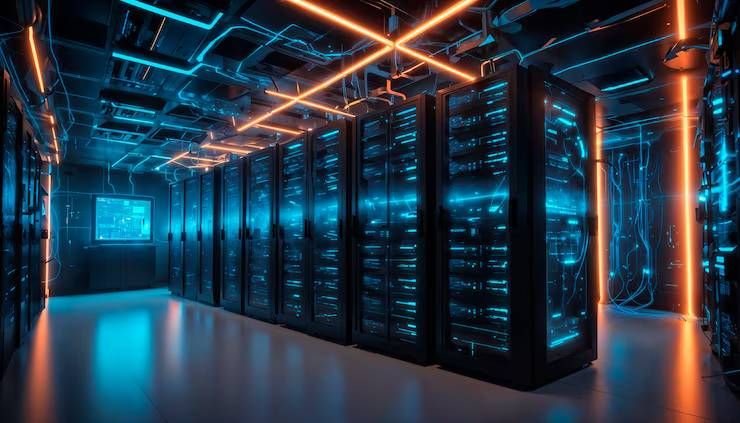
A traditional data center may have many physical servers running below their maximum capacity. Virtualization creates a logical layer between applications and physical hardware, allowing computing resources to be allocated more dynamically.
Common forms include:
- Server virtualization: Divides one physical server into multiple virtual servers.
- Storage virtualization: Combines storage resources into logical pools.
- Network virtualization: Creates logical networks independent of individual physical connections.
- Desktop virtualization: Delivers virtual desktop environments from centralized infrastructure.
- Application virtualization: Separates applications from the underlying operating system.
- Hardware-assisted virtualization: Uses processor and hardware capabilities to improve VM performance and isolation.
The basic structure can be viewed as:
| Layer | Main Function |
|---|---|
| Applications | Runs business and technical workloads |
| Guest operating systems | Provides the operating environment for each VM |
| Virtual machines | Isolated computing environments |
| Hypervisor | Allocates CPU, memory, storage and networking |
| Physical infrastructure | Servers, storage, networking and power systems |
This architecture has become closely associated with cloud computing because cloud platforms rely heavily on pooled and abstracted computing resources.
Why Data Center Virtualization Matters
Data center virtualization matters because modern organizations need computing infrastructure that can adapt to changing workloads. Applications may experience different levels of demand throughout the day, month, or year.
Virtualization makes it possible to adjust virtual resources without treating every workload as a separate physical installation.
One important advantage is resource utilization. A physical server running only one lightly used application may leave significant processing capacity unused. Several compatible workloads can instead share the same host through virtualization.
Virtualization can also support:
- Better allocation of CPU and memory resources
- Faster deployment of computing environments
- Isolation between workloads
- Centralized virtual machine management
- Easier testing and development
- Workload migration between physical hosts
- Disaster recovery planning
- Hybrid cloud architectures
- More consistent infrastructure configurations
The technology affects data center administrators, software teams, cloud architects, cybersecurity professionals, researchers, and organizations operating large computing environments.
However, virtualization does not automatically make an infrastructure more secure or efficient. Poor VM configuration, excessive resource allocation, outdated hypervisors, weak access controls, or insufficient monitoring can create operational and cybersecurity risks.
Virtualization and Modern Data Center Infrastructure
Virtualization is increasingly being used alongside containers, Kubernetes, cloud computing, automation, and artificial intelligence infrastructure.
Containers and virtual machines are not identical. A VM generally includes a complete guest operating system, while containers typically share the host operating system kernel. Both approaches can coexist in the same environment.
Modern platforms are therefore moving toward infrastructure that can manage traditional VMs and cloud-native workloads together.
This is particularly relevant as organizations modernize older applications. Instead of immediately rewriting every application as a cloud-native application, existing VM workloads can continue operating while newer applications use containers and other technologies.
Recent Developments in Data Center Virtualization
Virtualization has undergone several important changes during 2025 and 2026.
In January 2025, Red Hat introduced OpenShift Virtualization Engine, a virtualization-focused edition designed specifically around deploying, managing, and scaling virtual machines.
Red Hat subsequently released OpenShift Virtualization 4.18 in February 2025, adding improvements related to VM management, networking, storage migration, and hybrid cloud infrastructure.
In June 2025, OpenShift Virtualization 4.19 introduced additional capabilities including networking improvements, live storage migration, and broader hybrid-cloud functionality.
Another notable development has been the closer integration of virtualization with AI infrastructure. OpenShift 4.20, released in November 2025, emphasized environments where virtual machines, containers, and AI workloads can operate within the same broader platform.
Microsoft also continued developing Azure Local. A March 2026 update introduced improvements for cloud-based deployment and updates, monitoring, virtual machine management, and security in hyperconverged infrastructure.
India's data center expansion is another important trend. Government information published in March 2026 stated that India's data center capacity had increased from approximately 375 MW in 2020 to more than 1,500 MW by 2025.
The growth of AI computing is contributing to this infrastructure demand. Under the IndiaAI Mission, more than 38,000 GPUs had been onboarded for common compute capacity by early 2026, while additional computing capacity was announced during the India AI Impact Summit in February 2026.
These developments indicate that data center virtualization is increasingly being considered as part of a broader infrastructure strategy rather than as an isolated server technology.
Laws, Regulations and Policies in India
Data center virtualization in India is affected by several cybersecurity, data protection, and digital infrastructure requirements. The rules generally apply to the organization and its information systems rather than to virtualization technology alone.
The Digital Personal Data Protection Act, 2023 is particularly relevant when virtualized infrastructure processes digital personal data. The Digital Personal Data Protection Rules, 2025 were notified in November 2025, establishing additional requirements for organizations handling personal data. The rules use a phased commencement structure, so organizations need to consider the applicable implementation dates rather than assuming that every provision applies immediately.
Cybersecurity requirements are also important. CERT-In's 2022 directions specifically cover data centers and require covered entities to report specified cybersecurity incidents within six hours of noticing them. They also require ICT logs to be securely maintained for a rolling period of 180 days within Indian jurisdiction.
The directions also address information maintained by data centers, VPS providers, cloud service providers, and VPN providers, including specified subscriber and customer information.
India's broader infrastructure policy is also encouraging data center and AI infrastructure development. In May 2025, NITI Aayog held a workshop focused on accelerating AI-ready data center development across Indian states.
The IndiaAI Mission, approved with an outlay of about ₹10,372 crore over five years, includes compute capacity, datasets, future skills, application development, and safe and trusted AI as major components.
Organizations operating virtualized infrastructure should therefore consider privacy, cybersecurity, incident response, logging, access control, data governance, and applicable sector-specific requirements together.
Tools and Resources for Data Center Virtualization
Several tools and technical resources can help readers understand, plan, monitor, and secure virtualized environments.
- VMware vSphere: A widely known platform for managing virtualized server infrastructure.
- Microsoft Azure Local: Supports hyperconverged infrastructure and virtual machine workloads across distributed environments.
- Red Hat OpenShift Virtualization: Provides VM management alongside containerized workloads.
- KVM: An open-source virtualization technology integrated into the Linux kernel.
- Proxmox Virtual Environment: An open-source platform for managing virtual machines and containers.
- NIST virtualization guidance: Provides technical security recommendations for hypervisors and virtualized infrastructure.
- CERT-In resources: Useful for understanding cybersecurity incident reporting and security requirements applicable in India.
- MeitY policy resources: Useful for monitoring India's digital infrastructure, data protection, and technology policies.
A simple planning checklist can include:
| Area | Key Consideration |
|---|---|
| Compute | CPU and memory allocation |
| Storage | Capacity, performance and backup |
| Networking | Segmentation and virtual networks |
| Security | Access control, patching and monitoring |
| Availability | Redundancy and workload migration |
| Recovery | Backup and disaster recovery procedures |
| Compliance | Data protection and cybersecurity requirements |
| Monitoring | VM, host and infrastructure performance |
Frequently Asked Questions
What is data center virtualization?
Data center virtualization is the use of software to represent physical computing resources as virtual resources. It allows multiple virtual machines or logical environments to share physical infrastructure.
What is a hypervisor?
A hypervisor is software that manages virtual machines and controls their access to physical resources such as processors, memory, storage, and networking. It helps separate multiple virtual environments running on the same physical host.
Is virtualization the same as cloud computing?
No. Virtualization and cloud computing are related but different. Virtualization creates abstracted computing resources, while cloud computing is a broader model for delivering computing resources through defined provisioning, management, and access mechanisms.
Does virtualization improve data center security?
Virtualization can provide workload isolation and support centralized security controls, but it does not guarantee security. Hypervisors, virtual machines, management interfaces, networks, and applications all require appropriate security controls.
Why is virtualization important for AI infrastructure?
AI environments require substantial computing, storage, and networking resources. Virtualization can help organizations allocate infrastructure dynamically and operate different workloads on shared environments, although specialized AI hardware may require additional configuration and optimization.
Conclusion
Data center virtualization provides an abstraction layer that allows organizations to use physical computing infrastructure more flexibly. By supporting multiple virtual machines on physical hosts, it can simplify resource allocation, workload management, testing, recovery, and infrastructure administration.
The technology is also evolving. Recent developments show increasing integration between virtual machines, containers, hybrid cloud platforms, and AI infrastructure. At the same time, India's expanding data center and AI computing ecosystem is increasing the importance of scalable and manageable infrastructure.
For organizations operating virtualized environments, technology selection is only one part of the picture. Security controls, monitoring, backup practices, data protection, incident response, and regulatory compliance are equally important. As data centers become more closely connected with cloud and AI systems, virtualization is likely to remain an important component of modern digital infrastructure.